 Sudden Valley Siding
 Building a Deck That Actually Holds Up in South Hill
South Hill sits inside the same weather pattern that shapes the rest of Sudden Valley and the surrounding Whatcom County lake country: long wet winters, a marine air mass that carries salt off the coast on windy days, and a moss season that can stretch from October clear through April. A deck built to a generic national spec — the kind you'd see in a big-box how-to guide — will look fine the first summer and start showing problems by the third winter. Fastener heads bleed rust. The ledger board where the deck meets the house stays damp two days after it stops raining. Moss creeps across the north-facing boards and the whole thing gets slick underfoot.
None of that is inevitable. It's a function of how the deck was framed, flashed, and fastened before the first board ever went down. We build decks in South Hill the way we'd want one built at our own house — with the moisture and moss reality of this region treated as the starting assumption, not an afterthought.
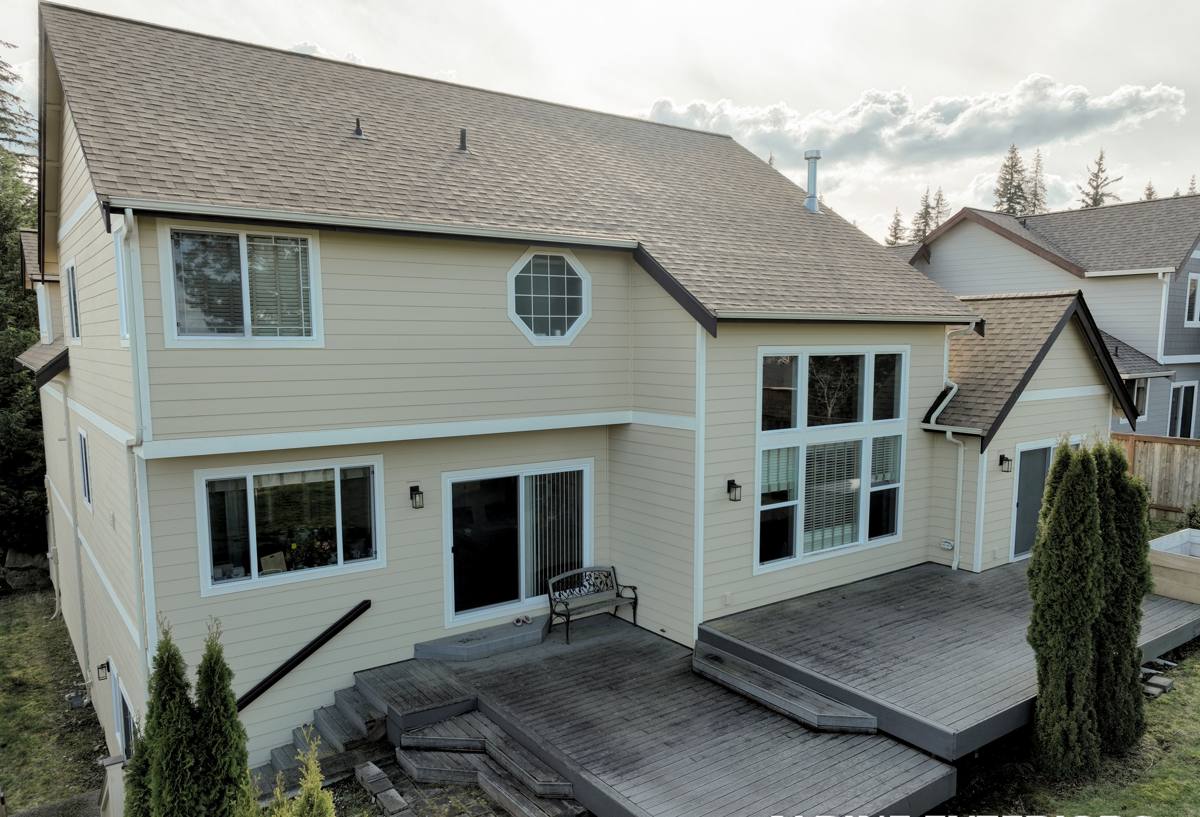
What a Deck in This Climate Actually Needs
A correct deck build here comes down to a handful of details that don't show up in a finished photo but decide whether the structure is still sound in fifteen years.
Ledger Board Flashing Where the Deck Meets Your Home
Most deck failures we get called out to inspect start at the ledger board — the framing member bolted to the house that carries a huge share of the deck's load. If that connection isn't flashed correctly, water tracks behind the siding and into the rim joist and sheathing, and it does it quietly, for years, before anyone sees a sagging deck or a soft spot in the siding above it. Since we work on siding as much as decks, we flash this connection the way we'd want it flashed if it were behind our own cladding: proper step flashing or a deck ledger flashing membrane, correctly lapped so water sheds outward and down, never trapped against the house.
Footings Below the Frost Line, Sized for the Load
Footings need to go below the local frost depth and be sized for the actual post spacing and load — not guessed at. On sloped South Hill lots, that sometimes means deeper or stepped footings to keep the structure level and to keep water from pooling against a shallow post base.
Fasteners and Hardware That Won't Bleed or Fail
Salt-tinged marine air corrodes standard coated screws and joist hangers faster than it would inland. We use stainless steel or heavy hot-dip galvanized fasteners and connectors rated for ground contact and coastal exposure, matched to whatever decking material you choose. Cheaper electro-galvanized hardware is the single most common source of rust streaking and premature hanger failure we see on decks in this area.
Airflow Underneath the Deck
A deck built low to the ground with poor ventilation underneath traps moisture against the framing and never fully dries between rain events — which is exactly what accelerates rot and gives moss and algae a foothold. Proper joist spacing, gapping between boards, and where possible some clearance underneath make a measurable difference in how long the structure lasts.
Decking Material Options for South Hill
There's no single right answer here — it depends on your budget, how much upkeep you want to do, and how much sun versus shade your particular lot gets. Here's how the common options actually compare in this climate, honestly:
| Material | Upfront Cost | Moss/Moisture Behavior | Maintenance | Typical Lifespan |
|---|---|---|---|---|
| Pressure-treated wood | Lowest | Absorbs moisture; needs sealing to resist moss and graying | Annual cleaning, re-sealing every 1-2 years | 10-15 years |
| Cedar | Mid | Naturally rot-resistant but still surface-stains and grows moss if not maintained | Cleaning and oil/stain every 1-2 years | 15-20 years |
| Composite | Higher | Doesn't rot, but textured surfaces can still hold moss/algae film in constant shade | Periodic wash-down, no sealing or staining | 25-30 years |
| PVC/capped polymer | Highest | Fully sealed surface, most moss-resistant, sheds water fastest | Occasional wash-down | 25-30+ years |
For lots on South Hill with a lot of tree cover and shaded, north-facing sections, we generally steer clients toward composite or capped polymer for the parts of the deck that stay damp longest, even if the sunnier sections could get by with wood. Mixing materials by exposure is a reasonable way to control cost without inviting moss into the shadiest boards.
Moss, Algae, and the Long Wet Season
Moss doesn't just make a deck look neglected — it holds moisture against the board surface and, on wood decking, accelerates soft spots and splintering. The long stretch of overcast, wet weather typical of this part of Whatcom County means moss has months of uninterrupted growing conditions rather than the occasional damp week other regions deal with. Board spacing, surface texture, and how much direct sun a section gets all factor into how fast moss establishes. On new builds we talk through orientation and drainage slope with you before framing starts; on existing decks, cleaning and re-sealing on a schedule that matches this climate — not a national-average schedule — is what keeps moss from getting ahead of you.
Our Deck Building Process
- On-site assessment — we look at your lot's slope, sun exposure, existing structure (if replacing a deck), and how the deck will tie into your home's siding and roofline.
- Design and material selection — size, layout, railing style, and decking material chosen against your budget and how much maintenance you actually want to do.
- Permitting — we handle the permit application and inspections required for the jurisdiction your property falls under.
- Footings and framing — footings poured to code depth, ledger properly flashed, framing set level and square with correct fastener and hanger hardware.
- Decking and railing installation — boards and railing installed with proper gapping and fastening for the material chosen.
- Final walkthrough — we go over the finished deck with you, including what maintenance it will need and roughly when.
Permits and Code Considerations
Deck construction in Whatcom County — whether your property falls under county jurisdiction or a local municipal code — generally requires a permit once a deck exceeds a certain size or height off grade, and always requires guardrails and proper stair geometry once the deck is elevated past code thresholds. Skipping the permit step is a common shortcut on smaller "handyman" builds, but it leaves you without an inspection record if you ever sell the house or need to make an insurance claim after storm damage. We pull the permit and schedule the required inspections as a standard part of the job, not an upsell.
What to Watch For on an Existing Deck
If you already have a deck and are trying to decide whether it needs repair, replacement, or just a good cleaning, walk it with this in mind:
- Soft or spongy spots anywhere on the decking surface, especially near the house
- Rust streaking around fastener heads or hardware
- Visible gap or daylight where the ledger board meets the siding
- Moss or dark algae film that comes back within weeks of cleaning
- Railing posts that wiggle when pushed — often a sign the post base or blocking has failed
- Standing water or slow drainage after rain instead of water sheeting off
Any one of these on its own might just need attention; several together usually point to a ledger flashing or framing problem worth having looked at before it's hidden behind a fresh coat of stain.
Why Hire a Crew That Already Works South Hill
Deck problems in this region are rarely just deck problems — they're tied to how the structure interacts with siding, flashing, and drainage around the house, which is exactly the work we do every day as Sudden Valley Siding Contractor. A crew that only builds decks in a dry climate somewhere else, or that treats every job with the same generic spec, is going to miss the details that matter here: the ledger flashing, the hardware grade, the moss-prone shade pockets specific to a sloped lot. Working South Hill and the rest of Sudden Valley regularly means we already know what this climate does to a deck over time, and we build for that reality from the footings up rather than learning it the hard way on your project.
Get a Straightforward Estimate
If you're planning a new deck, replacing a failing one, or just want an honest read on whether yours needs repair, we're happy to come take a look. There's no pressure and no pushy sales pitch — just a clear assessment and a written estimate you can take your time with. Fill out the form below to get started.