 Sudden Valley Siding
 Siding in South Hill: Built for What This Climate Actually Does to a House
South Hill sits within our Sudden Valley service area in Whatcom County, and like the rest of the neighborhood, it takes a steady beating from weather that's easy to underestimate because it's rarely dramatic. There's no hurricane season here. What there is instead is relentless, low-grade exposure: salt-tinged air moving in off the Salish Sea, driving rain that comes in sideways more often than straight down, and a moss season that can stretch from October well into spring. None of that shows up as one big event. It shows up ten years later as siding that's swollen at the bottom edge, paint that's peeling in sheets, or green streaking that won't scrub off anymore.
We work on homes throughout South Hill and the wider Sudden Valley area, and the siding failures we get called out to look nearly identical from house to house. That consistency is useful — it means we're not guessing at what a South Hill home needs from its exterior. We're installing for a known set of conditions, not a generic siding job.
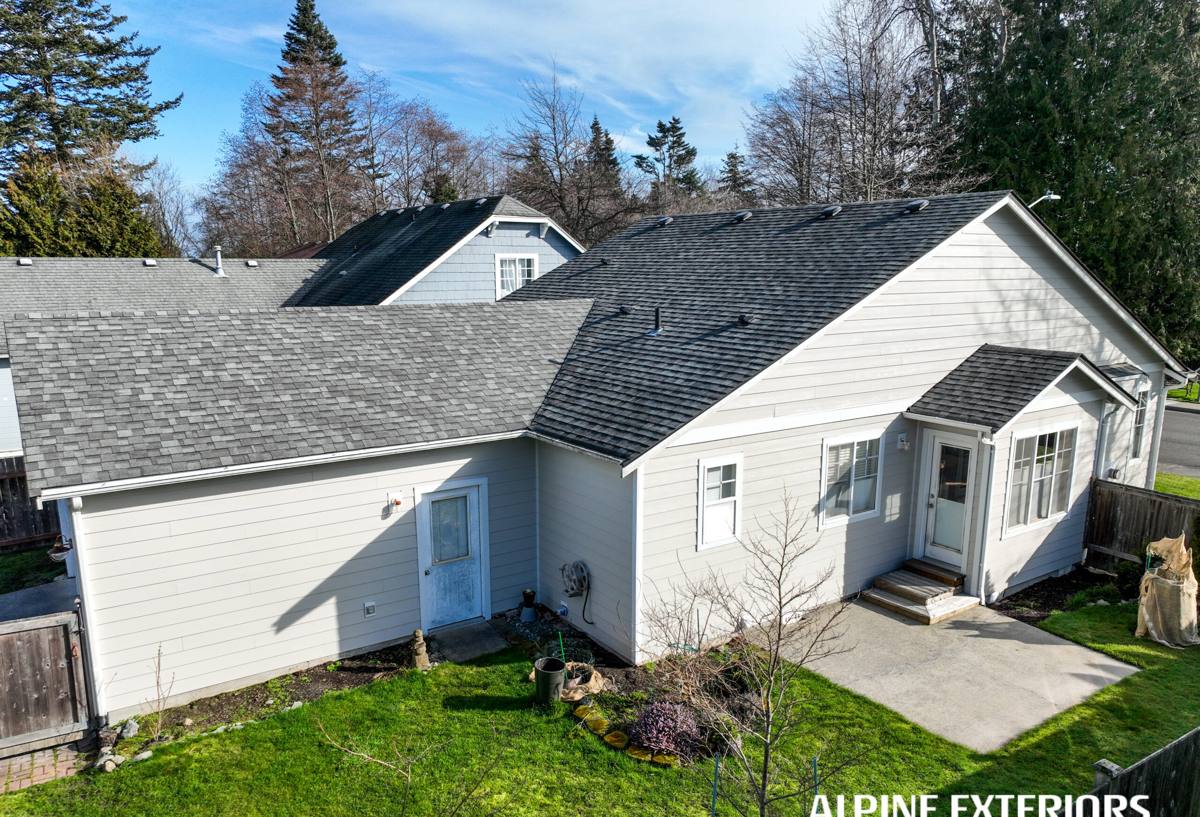
What South Hill's Weather Does to Siding Over Time
Moisture and a Long Moss Season
Whatcom County gets a lot of grey, wet, low-sun weeks in a row, and South Hill's tree cover and hillside terrain hold onto that moisture longer than an open, sunny lot would. Siding that stays damp for extended stretches — especially on north-facing walls and anywhere shaded by mature trees — becomes a growing surface for moss and algae. On wood-based products, that constant moisture cycle also softens fibers and accelerates rot from the inside out, often well before it's visible from the ground.
Salt Air and Wind-Driven Rain
Proximity to the water means airborne salt is a real factor here, not a coastal-postcard exaggeration. Salt-laden moisture accelerates corrosion on fasteners and trim, and it degrades paint and coatings faster than inland exposure would. Combine that with wind-driven rain — which pushes water sideways into laps, seams, and butt joints instead of letting it run straight down and off — and you get moisture intrusion at exactly the joints where siding is most vulnerable if it wasn't installed with the right flashing and gapping details.
Temperature Swings and Sun Exposure
South Hill doesn't get brutal freezes, but it does get repeated cycles of damp cold followed by sun exposure once the clouds break. That expansion-and-contraction cycle stresses caulking, seams, and any siding material that wasn't engineered with dimensional stability in mind. Over years, it's what turns a tight, well-caulked joint into a gap that lets water behind the cladding.
Why We Install Only James Hardie Fiber Cement Siding
We made a deliberate decision as a company to install James Hardie fiber cement exclusively — not vinyl, not LP SmartSide, not Cemplank, not Allura, not primed spruce or cedar. That's not a marketing preference; it's a response to exactly the conditions described above.
Fiber cement is non-combustible, which matters in a region where wildfire smoke and defensible-space concerns have become a bigger part of homeowner insurance conversations. James Hardie's ColorPlus finish is baked on at the factory under controlled conditions, rather than site-applied paint, which gives it far better resistance to fading, chipping, and the kind of coastal-air degradation that eats into standard paint jobs within a few years. Hardie also engineers regional product lines — including versions built specifically for moisture-heavy climates like ours — so the board itself is designed for the weather it's going into, not a generic national spec.
The other piece is the warranty. Hardie backs its products with a strong transferable warranty, which matters both for homeowners planning to stay long-term and for resale value, since it transfers to the next owner rather than resetting or voiding at sale.
How Hardie Compares to Other Siding Materials in This Climate
| Material | Moisture Behavior | Maintenance | Longevity Here |
|---|---|---|---|
| James Hardie fiber cement | Dimensionally stable, resists swelling and rot | Occasional wash; factory finish holds color | Decades, with strong transferable warranty |
| Vinyl siding | Doesn't rot, but can warp, crack, or fade in UV and temperature swings | Low, but damage often means full-panel replacement | Moderate; seams and expansion can loosen over time |
| LP SmartSide (engineered wood) | Wood-based core is sensitive to sustained moisture at cut edges and seams | Requires diligent caulking and paint upkeep | Installation-sensitive; performance depends heavily on detailing |
| Cedar / primed spruce | Natural wood, absorbs and releases moisture, prone to rot and moss in shade | High — regular staining, sealing, and moss treatment | Shorter without consistent upkeep |
None of these are "bad" products in every application — vinyl and engineered wood both have a place. But for the specific combination of salt air, driving rain, and shaded, moisture-holding lots that describes a lot of South Hill, fiber cement's stability and factory-cured finish are the difference between a siding job that looks the same in year fifteen and one that's already showing wear by year seven.
What a South Hill Siding Project Looks Like
Inspection and Assessment
We start by looking at what's actually happening behind the existing siding, not just what's visible on the surface. Soft spots, staining patterns, and where moss is concentrating tell us a lot about where water has been getting in and how the house is shedding rain in practice versus on paper.
Tear-Off and Moisture Barrier
Old siding comes off down to the sheathing, and we check for hidden damage before anything new goes up. A correctly installed weather-resistant barrier underneath the new siding is non-negotiable in this climate — it's the layer that protects the wall assembly even if wind-driven rain does make it past the cladding.
Installation to Manufacturer Spec
James Hardie siding is only as good as its installation. Proper fastening, gapping at butt joints, flashing at windows and penetrations, and correct clearance above grade and roof lines all matter for how the product performs against sustained rain and moisture. We install to Hardie's published specifications, not shortcuts that speed up the job.
Trim and Finish
Corner boards, trim, and caulking get the same attention as the field siding, since these are the joints most exposed to wind-driven rain and the first places a rushed job shows up as a callback.
Siding, Roofing, Windows, and Decks as One System
Siding doesn't work in isolation. We also handle roofing, windows, and decks, and on a lot of South Hill homes those systems are interdependent — a roof that's shedding water incorrectly can compromise siding at the wall-roof intersection, and window flashing that's out of spec is one of the most common sources of the moisture damage we find when we tear off old siding. Having one crew that understands how all four systems interact means fewer gaps between trades and fewer surprises once the old cladding comes off.
Choosing a Contractor for a South Hill Home
A local crew matters here for reasons that go beyond convenience. Contractors who work regularly in Whatcom County understand how this specific stretch of weather behaves on hillside, tree-shaded lots, know which details actually hold up to salt air and driving rain over time, and are around locally if a warranty question or an installation question comes up years down the road.
- Confirm they carry current Washington state contractor licensing and insurance
- Ask specifically whether they're a certified installer for the siding brand they're proposing
- Ask how they handle flashing at windows, doors, and roof intersections — not just the field siding
- Get the warranty terms in writing, including whether it's transferable to a future homeowner
- Ask for a written scope that specifies product line, not just "siding replacement"
What Affects the Cost of a Siding Project
Every South Hill home is a little different, so we don't quote broad numbers without seeing the house, but a few factors consistently move the price:
- How much of the existing siding and sheathing is sound versus needs replacement
- The complexity of the roofline and number of window and door openings to flash
- Access — steep or wooded lots can add setup and staging time
- Product line and profile selected within the James Hardie system
- Whether roofing, window, or trim work is bundled into the same project
If you're weighing a siding project on a South Hill home, we're happy to take a look and walk you through what we're seeing and what it would take to fix it right. There's no pressure and no cost to get a straight answer — just fill out the form below for a free estimate.