 Sudden Valley Siding
 Exterior Work in Sehome: A Climate That Doesn't Let Up
Sehome sits in the same corner of Whatcom County that gives Sudden Valley Siding Contractor its name, and the houses here deal with the same year-round weather pattern: salt-laden air moving in off the water, rain that comes sideways more often than it comes straight down, and a moss season that, on shaded lots, barely takes a break. None of that is dramatic on any given day. It's the accumulation that matters. A house in this part of Whatcom County doesn't usually fail because of one bad storm — it fails because ten years of small, ignored moisture problems finally add up to a soft wall, a leaking roof valley, or a window that's been letting water in behind the trim for longer than anyone realized.
We work on siding, roofing, windows, and decks throughout the Sudden Valley area, including Sehome, and we approach all four as part of one connected exterior system rather than four separate products. Water that gets past a window flashing detail doesn't stay at the window — it travels down into the wall assembly. A roof that isn't ventilating properly doesn't just shorten its own life — it pushes moisture into the attic and eventually into the top of the wall below it. Treating these systems as connected, instead of quoting them in isolation, is a big part of how we keep small problems from becoming expensive ones.
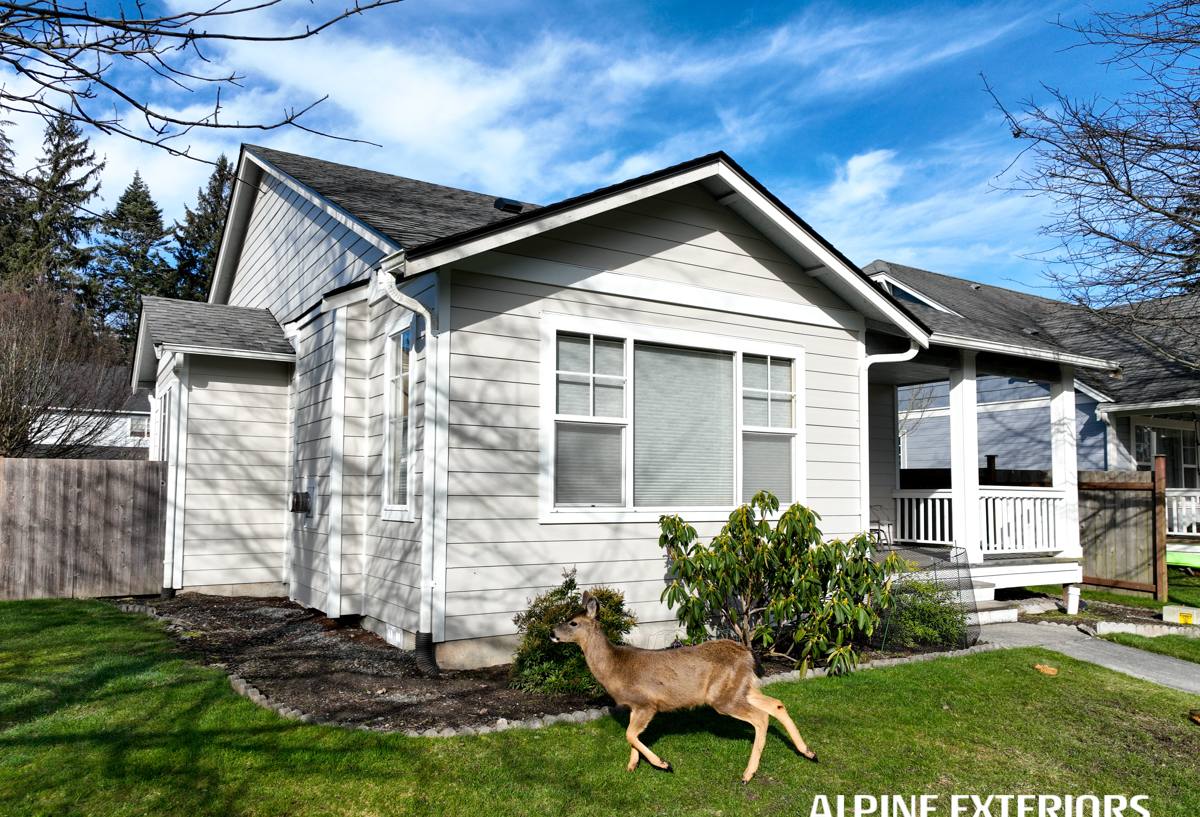
What Salt Air, Rain, and Moss Actually Do to a House
Salt Air and Corrosion
Homes in and around Sehome sit close enough to the water that salt-bearing air is a constant, low-grade presence on exterior surfaces. Salt speeds up corrosion on fasteners, flashing, and any exposed metal trim, and it degrades lower-quality paint and coatings faster than the same products would wear in a drier inland climate. It also has a quieter effect on siding itself: materials and finishes that aren't engineered for this kind of exposure tend to chalk, fade, or lose their protective layer years ahead of schedule. Any material or hardware choice for a Sehome home should account for salt exposure as a baseline condition, not as an occasional stressor.
Driving Rain and Wall Assemblies
Pacific Northwest rain in this region rarely falls straight down. Wind pushes it sideways, into wall assemblies, under window flashing, and into roof-to-wall transitions where two different building systems meet. A siding product or installation detail that would perform fine in a climate with gentle, vertical rainfall can fail here simply because the water is attacking from angles the design never accounted for. This is why lap siding needs correct overlap, why window flashing needs to be integrated with the surrounding wall rather than treated as a standalone gasket, and why roof-to-wall step flashing has to be done right the first time — driving rain finds every shortcut eventually.
A Moss Season That Runs Most of the Year
Mild temperatures, persistent moisture, and tree cover combine to give this part of Whatcom County a moss and algae season that can run nine or ten months out of twelve on shaded, north-facing surfaces. Moss doesn't just look bad — it holds moisture directly against whatever it's growing on, whether that's a roof shingle, a deck board, or a strip of siding. Materials that are even slightly porous, or that have any tendency to absorb and hold water, become long-term growth surfaces. Once moss establishes itself, it's not just a cosmetic problem; it's actively working against the material underneath it every day it's there.
Why We Install Only James Hardie Fiber Cement Siding
We don't install LP SmartSide, vinyl siding, Cemplank, Allura, primed spruce, or cedar. That's a deliberate professional standard, not a default or a lack of options. Every one of those products has legitimate uses and plenty of homeowners who are happy with them in the right setting. But after years of servicing homes in this specific climate — salt air, driving rain, and a long moss season — we standardized on one system we're willing to fully stand behind.
- Non-combustible core: Fiber cement doesn't feed a fire the way wood-based or wood-derived siding products can, which matters for homeowner safety and can matter for insurance considerations as well.
- Factory-applied ColorPlus finish: The finish is baked on in a controlled factory environment rather than brushed on in the field, which gives it better fade and moisture resistance than site-applied paint over the long haul.
- Climate-engineered HZ product lines: Hardie builds region-specific formulations, and the HZ5 line is engineered for areas with heavy moisture exposure and freeze-thaw cycling — a close match for what Whatcom County actually experiences.
- Dimensional stability: Fiber cement doesn't swell, cup, or warp the way engineered wood products can after repeated wet-season exposure, so seams and paint lines stay tighter for longer.
- A strong, transferable warranty: Hardie backs its products with one of the more substantial warranty structures in the siding industry, provided installation follows their specification — which is a requirement we build into every job, not an afterthought.
The honest trade-off is upfront cost: fiber cement generally costs more than vinyl and can cost more than engineered wood siding at time of installation. We think that cost is offset by a longer service life, lower maintenance burden, and fewer surprises once the siding has been through a few full Whatcom County winters — but it's a real trade-off, and we'd rather be straightforward about it than pretend it doesn't exist.
Siding Services for Sehome Homes
Siding work in this neighborhood generally falls into a few categories, and the right approach depends heavily on what's happening behind the existing siding, not just what it looks like from the curb.
Full Replacement
When siding has reached the end of its service life, or when moisture has already gotten behind it, a full tear-off and replacement lets us inspect and repair the wall assembly underneath before anything new goes up. This is the only way to know for certain what condition the sheathing and framing are in, and it's the approach we recommend whenever there's evidence of long-term moisture intrusion.
Repair and Partial Replacement
Not every siding problem requires a full replacement. Localized damage — a section that took impact damage, a run that's been chronically wet because of a nearby downspout or grading issue — can sometimes be addressed with targeted repair, especially on homes where the existing siding is otherwise in reasonable shape. We'll tell you honestly when repair makes sense and when it's just delaying a bigger job.
New Construction and Additions
For new builds and additions in the Sehome and Sudden Valley area, we install Hardie siding to spec from the start, which avoids the remediation work that older homes with different original siding sometimes need down the road.
Roofing, Windows, and Decks: The Rest of the Exterior System
Roofing
Roofs take the most direct hit from this climate — sun, wind-driven rain, and moss all land on the roof plane before they reach anything else. On homes in this area, the most common failure point isn't the field of the roof itself but the flashing at chimneys, dormers, skylights, and roof-to-wall transitions. We treat correct flashing, adequate underlayment, and proper attic and roof-deck ventilation as baseline requirements on every roofing job, because cutting corners in any of those areas tends to show up as a leak within a few wet seasons rather than decades.
Windows
A surprising share of exterior moisture problems actually start at window flashing, even when the visible damage eventually shows up somewhere else on the wall. Wind-driven rain can track down into a wall cavity through a poorly flashed window long before there's any visible staining or soft trim. When we replace windows, or coordinate window work alongside a siding project, we integrate the flashing into the whole wall assembly instead of treating each window as an isolated swap.
Decks
Decks face the same driving rain and moss pressure as the rest of the house, plus the added factor of horizontal surfaces where water and moss can sit longer, especially on shaded lots. Framing choices, corrosion-resistant fasteners, and board spacing all matter more here than they would in a drier climate — a deck built without those considerations in mind tends to develop soft spots, rot, and slippery moss buildup well ahead of schedule.
How a Typical Sehome Project Works
- Walk-through and assessment: We inspect the home in person — siding, roofline, windows, and any deck structures — before quoting anything, since a generic estimate can't account for site-specific conditions like shade, slope, or existing moisture damage.
- Honest scope and estimate: We tell you what we're seeing, what we recommend, and why, including where repair may be a reasonable option instead of full replacement.
- Tear-off and inspection: Once old material comes off, we inspect the sheathing and framing underneath and flag any hidden moisture damage before covering it back up.
- Installation to manufacturer spec: Hardie siding, correct flashing details, and proper ventilation are installed according to manufacturer and code requirements, not shortcuts that only hold up in dry weather.
- Final walk-through: We go over the completed work with you and make sure everything meets both our standard and your expectations before calling the job done.
Comparing Siding Options for This Climate
| Material | Moisture Behavior in This Climate | Maintenance Burden | Where We Land |
|---|---|---|---|
| James Hardie fiber cement | Dimensionally stable, resists moisture-driven warping | Low; factory finish holds up well | What we install |
| Vinyl siding | Doesn't absorb water but can trap moisture behind panels if installed loosely | Low upfront, but can hide problems underneath | Not installed |
| Engineered wood (e.g., LP SmartSide) | Can swell, delaminate, or absorb moisture at cut edges over time | Moderate to high in sustained wet climates | Not installed |
| Cedar | Attractive but naturally porous; performance depends heavily on upkeep | High; needs regular sealing/staining | Not installed |
This isn't a claim that every alternative product fails — plenty perform adequately with diligent maintenance in the right setting. It's a statement of our own standard: given what we've seen on homes in this specific climate, fiber cement is the material we're willing to install and warranty our work behind.
A Homeowner's Maintenance Checklist for This Climate
- Rinse siding and decking surfaces periodically to keep salt residue and organic buildup from settling in
- Check and clear gutters and downspouts before the fall rains start, so water isn't overflowing against siding or foundation lines
- Look at north-facing and shaded wall sections for early moss or algae growth rather than waiting until it's heavy
- Inspect window trim and caulking annually for gaps or cracking that could let wind-driven rain behind the frame
- Walk the deck each spring checking for soft boards, rust staining at fasteners, or standing water that isn't draining
- Have roof flashing at chimneys, dormers, and valleys checked periodically rather than only after a leak appears
Why a Local Crew Matters
A crew that works across the Sudden Valley area day to day — on siding, roofing, windows, and decks alike — sees how salt air, driving rain, and moss actually behave on real houses across a full year, not just how a product performs on a spec sheet. That repeated, local exposure shapes practical decisions on a Sehome job: where extra flashing attention matters most, how shade and slope on a given lot change drainage planning, and which details are worth the extra time on install day so a homeowner isn't dealing with a callback two winters later. A crew that only occasionally works in this specific climate is more likely to apply generic details that don't quite match what this part of Whatcom County actually puts a house through.
If your Sehome home needs new siding, a roof inspection, window replacement, or a deck built to hold up in this climate rather than fight it every season, we're glad to take a look. Reach out using the form below for a free, no-pressure estimate — we'll give you a straightforward assessment, not a sales script.