 Sudden Valley Siding
 Building for Bellingham's Marine Climate
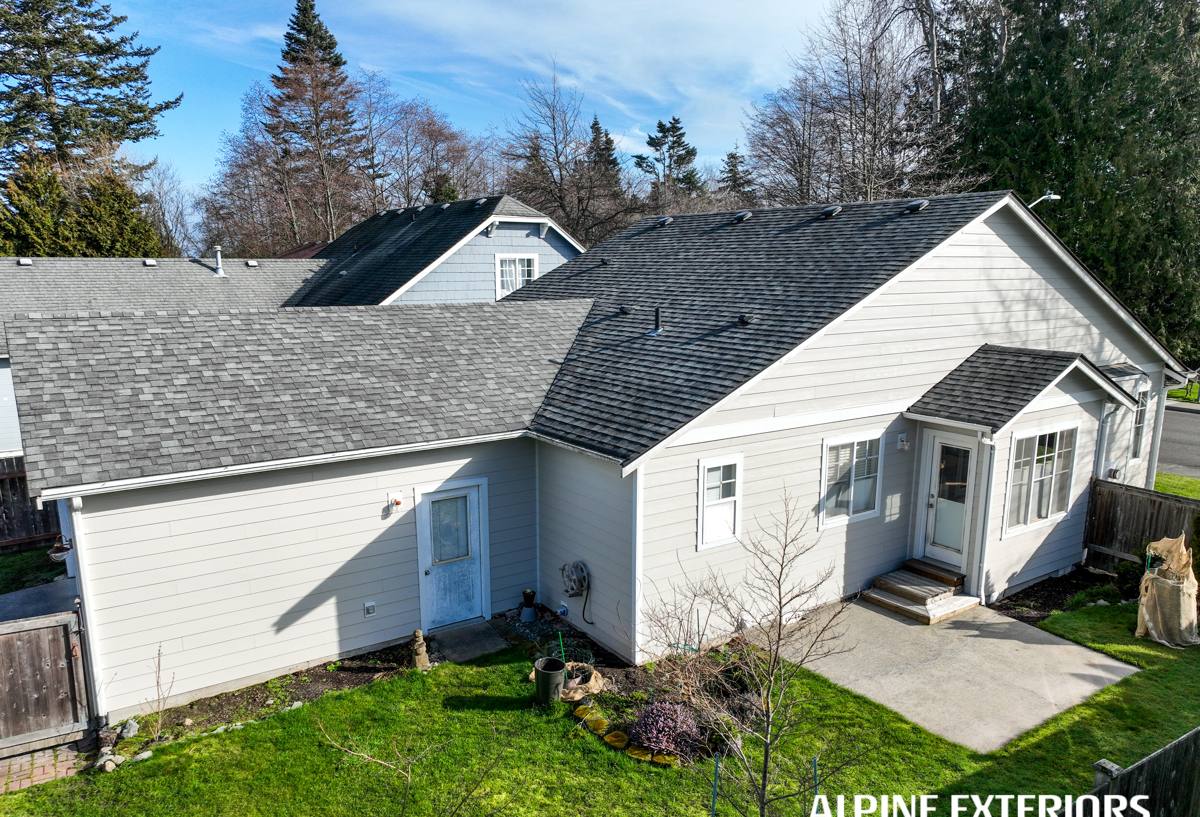
Homes around Bellingham and the Sudden Valley area sit in a climate that's easy to underestimate. It doesn't get brutally cold and it doesn't get brutally hot, so it's tempting to think the exterior of a house here has an easy job. In practice, it's the opposite. Whatcom County trades temperature extremes for something harder on building materials over the long haul: months of low-intensity rain, humid air off the water, heavy tree cover that keeps moisture trapped against walls, and a moss season that can run from fall through spring. None of that shows up as one dramatic event. It shows up as slow, cumulative wear that homeowners often don't notice until paint is peeling, trim is soft, or siding seams are stained green.
We work on homes throughout the Bellingham area, including communities like Sudden Valley near Lake Whatcom, where wooded lots and lakeside humidity add their own wrinkle to the equation. The right exterior materials and the right installation details matter more here than in drier parts of the state, and that's the lens we bring to every siding, roofing, window, and deck project.
What This Climate Actually Does to a House
A Long, Persistent Moss Season
Shade, moisture, and mild temperatures are exactly what moss and algae need to thrive, and much of the Bellingham area offers all three. Wooded and lakeside lots around Sudden Valley are especially prone to it, since tree canopy blocks sun and airflow that would otherwise help siding dry out between rains. North-facing walls and areas tucked under eaves or overhangs tend to stay damp the longest, and that's where you'll typically see the first green or black streaking on siding and trim.
Driving Rain, Not Just Wet Weather
Whatcom County doesn't get the torrential downpours of some regions, but it gets something arguably tougher on a building envelope: sustained, wind-driven rain over many months of the year. That kind of weather pushes water sideways into seams, laps, and fastener points rather than letting it simply run off. Over years, materials that aren't dimensionally stable or that rely on caulking and paint film to stay sealed start to let moisture in at exactly those weak points.
Salt Air Off the Bay
Proximity to Bellingham Bay and the greater Puget Sound means salt-laden air is part of the equation for many homes in the area, even ones set back from the water. Salt air accelerates corrosion of fasteners and metal trim and can be tougher on some paint and coating systems than fresh water alone. It's one more reason we pay attention to what fasteners, flashing, and finishes actually hold up long-term in this specific environment, not just what's rated for "coastal" in general.
Why We Install Only James Hardie Fiber Cement
We made a deliberate decision to install James Hardie fiber cement siding exclusively — not vinyl, not LP SmartSide, not Cemplank, not Allura, not primed spruce or cedar. That's not a marketing position, it's a standard we hold because of what we've seen these products do (and not do) in exactly the kind of climate Whatcom County has.
Vinyl siding is affordable and low-maintenance in the sense that it doesn't need painting, but it's a thin material that expands and contracts with temperature swings, can warp or crack over time, and its seams and butt joints are places where wind-driven rain likes to find a way in. LP SmartSide and other engineered wood products use a wood-strand core, which means their long-term performance depends heavily on paint film and caulking staying intact — a maintenance burden that's harder to keep up with in a climate this wet. Primed spruce and cedar are handsome materials with a long tradition in the Pacific Northwest, but raw or lightly primed wood siding is exactly the kind of surface that moss, algae, and rot organisms exploit fastest, and it asks a lot of the homeowner in terms of ongoing upkeep.
James Hardie fiber cement is cement, sand, and cellulose fiber — it doesn't have the wood content that feeds rot and moss the way traditional wood siding does, and it doesn't rely on staying perfectly sealed the way vinyl and engineered wood do. It's also non-combustible, which matters more each year as wildfire smoke seasons become a summer fixture even on this side of the Cascades. Hardie's ColorPlus factory finish is baked on under controlled conditions rather than field-applied, which gives it more consistent coverage and better resistance to fading and moisture intrusion than a job-site paint job. And Hardie engineers specific product lines, including HZ5 formulations, for climate zones like ours — freeze-thaw cycles, humidity, and moisture exposure are part of the design brief, not an afterthought.
| Factor | Vinyl / Engineered Wood / Raw Wood | James Hardie Fiber Cement |
|---|---|---|
| Moss and algae resistance | Vulnerable, especially wood-based products in shaded areas | Cement-based composition resists organic growth better than wood |
| Finish durability | Relies on field-applied paint or factory coatings of varying quality | Factory-applied ColorPlus finish, engineered for UV and moisture resistance |
| Fire resistance | Vinyl and wood-based products are combustible | Non-combustible cement composition |
| Dimensional stability | Vinyl expands/contracts; wood swells and shrinks with moisture | Stable across temperature and humidity swings |
| Long-term maintenance | Ongoing painting, caulking, and seam inspection | Occasional inspection and repainting on a much longer cycle |
The Full Exterior: Siding, Roofing, Windows, and Decks
Siding doesn't work in isolation. A roof that's shedding water improperly, windows that are leaking at the flashing, or a deck that's trapping moisture against the house wall can all undermine even a well-installed siding job. That's why we handle the full exterior envelope — siding, roofing, windows, and decks — as one connected system rather than treating each as a separate project with separate contractors who may or may not coordinate.
On a home in a moss-prone, high-rainfall area like Sudden Valley, this integrated approach matters in practical ways: roof and gutter work that actually moves water away from siding and foundation walls, window flashing details that tie correctly into the siding's water management plane, and deck ledger connections that don't create a moisture trap against the house. When one crew is responsible for the whole exterior, there's no finger-pointing between trades when something doesn't line up.
What Installation Looks Like for Homes in This Area
Correct installation is what makes any siding material perform the way it's supposed to, and that's especially true for fiber cement in a wet climate. A few details we pay close attention to on Bellingham-area homes:
- Proper rain-screen or drainage plane behind the siding so any moisture that does get past the surface has somewhere to go
- Correct fastener spacing and type, accounting for the corrosion pressure of salt-influenced air near the bay
- Flashing and caulking details at windows, doors, and roof intersections — the places wind-driven rain actually exploits
- Clearance between siding and grade, decks, and roof lines to avoid constant ground or splash moisture contact
- Attention to shaded, north-facing, and tree-covered wall sections where moss and slow-drying conditions are worst
None of these are exotic techniques — they're basic building science. But skipping them is exactly how a good material ends up performing poorly, and it's a common cause of the "why is my siding failing already" calls we get on homes that weren't installed with this climate in mind.
Living with a Wet-Climate Exterior: Realistic Maintenance
Even the best material benefits from basic upkeep, and homeowners in this area should expect a modest, predictable maintenance rhythm rather than a "install it and forget it" experience:
- Periodic gentle rinsing of siding, especially shaded or north-facing walls, to keep moss and algae from establishing
- Keeping gutters clear so roof runoff isn't dumping extra water onto siding and trim
- Trimming back vegetation and tree branches that keep walls in constant shade and reduce airflow
- Visual inspection of caulking and flashing points once a year, particularly after a wet winter
- Prompt attention to any small paint chips or dings before moisture has a chance to work into the material
This is a lighter maintenance load than raw wood or aging vinyl typically demand, but it's not zero, and we'd rather set realistic expectations than oversell "maintenance-free" claims that don't hold up over a Whatcom County winter.
Why a Local Crew Matters Here
A crew that works this specific region regularly knows which wall orientations on a given lot are going to fight moss, which neighborhoods sit close enough to the water for salt air to matter, and which older homes in the area were built with materials and details that don't hold up to today's understanding of the local climate. That knowledge doesn't come from a general contractor's manual — it comes from doing this work, on these kinds of homes, in this weather, repeatedly. It's also what lets us set honest expectations up front instead of promising a maintenance-free exterior that a Whatcom County winter will eventually contradict.
Get a Straightforward Estimate
If you're weighing siding, roofing, window, or deck work on a home in Bellingham, Sudden Valley, or elsewhere in Whatcom County, we're happy to take a look and give you a clear, no-pressure estimate along with an honest read on what your home's specific exposure and layout call for. Use the form below to get started.