 Sudden Valley Siding
 Exterior Work in Geneva, Washington
Geneva sits in the north Whatcom County landscape that surrounds Lake Whatcom and the Sudden Valley area — a mix of wooded lots, lakeside exposure, and the kind of marine-influenced weather that defines this whole corner of the state. Homes here don't fail because Northwest weather is unusually harsh; they fail because a lot of exterior products simply weren't built for a climate that stays damp for eight or nine months out of the year. We work on homes throughout this area, and the patterns repeat from one property to the next: siding that's held moisture too long, trim that's gone soft at the corners, and roofs and decks that took more abuse from moss and standing moisture than from any single storm.
We handle siding, roofing, windows, and decks, and on Geneva homes those four systems tend to fail together rather than separately. A gutter that's overflowing because of moss and needle buildup on the roof will eventually rot the siding beneath it. A deck that's holding water at the ledger board is often doing the same thing to the wall it's attached to. Treating the exterior as one connected system — not four unrelated projects — is the only way repairs actually hold up out here.
What the Local Climate Actually Does to a House
Salt Air and Moisture Load
Properties closer to marine air carry a steady low-grade exposure to salt-laden moisture, which accelerates corrosion on fasteners, flashing, and any metal trim components. It also means exterior surfaces rarely get a long enough dry stretch to fully release the moisture they absorb during the wet months. Materials that swell and contract with moisture — or that rely on a surface coating to keep water out — are working against a losing clock in this environment.
Driving Rain
Wind-driven rain doesn't just fall on a house, it gets pushed sideways into every horizontal joint, seam, and unprotected edge. Lap siding, window trim, and deck ledger connections are the areas that take the brunt of it. Once water gets behind a siding panel or trim board here, the long stretch of overcast, humid weather that follows gives it very little chance to dry out before the next system rolls through.
The Long Moss Season
Whatcom County's moss season isn't a few weeks — it's most of the year on shaded, north-facing, or tree-covered lots, which describes a lot of properties in and around Sudden Valley. Moss on a roof holds moisture against shingles and underlayment far longer than open weather ever would, and moss or algae streaking on siding is a sign that a surface is staying wet longer than it should. On wood-adjacent siding products, that extended dampness is exactly the condition that leads to soft spots, delamination, and paint failure.
Siding: Why We Only Install James Hardie
We install James Hardie fiber cement siding exclusively. We don't install vinyl, LP SmartSide, Cemplank, Allura, primed spruce, or cedar, and that's a deliberate standard, not a lack of options. Each of those alternatives has real strengths — vinyl is inexpensive and low-maintenance in mild climates, engineered wood products install quickly, cedar has a look plenty of homeowners genuinely love. But in a climate that stays wet as long as this one does, the trade-offs on those products show up faster and cost more to fix than most homeowners expect.
Where the Alternatives Struggle Here
- Vinyl siding expands and contracts with temperature swings and can warp or buckle; it also isn't a moisture barrier by itself, so problems behind it can go unnoticed for years.
- LP SmartSide and other engineered wood products use wood strand cores that are vulnerable at cut edges and joints if caulking and paint maintenance lapse — a real risk in a region where exterior maintenance windows are short.
- Cedar siding is a genuinely attractive natural material, but it requires disciplined refinishing on a schedule most homeowners underestimate, and constant dampness accelerates checking, cupping, and rot.
- Primed spruce and lower-grade engineered panels depend heavily on field-applied paint as their primary moisture defense, which is a weak point in a climate that doesn't give paint much time to cure between rain events.
Why James Hardie
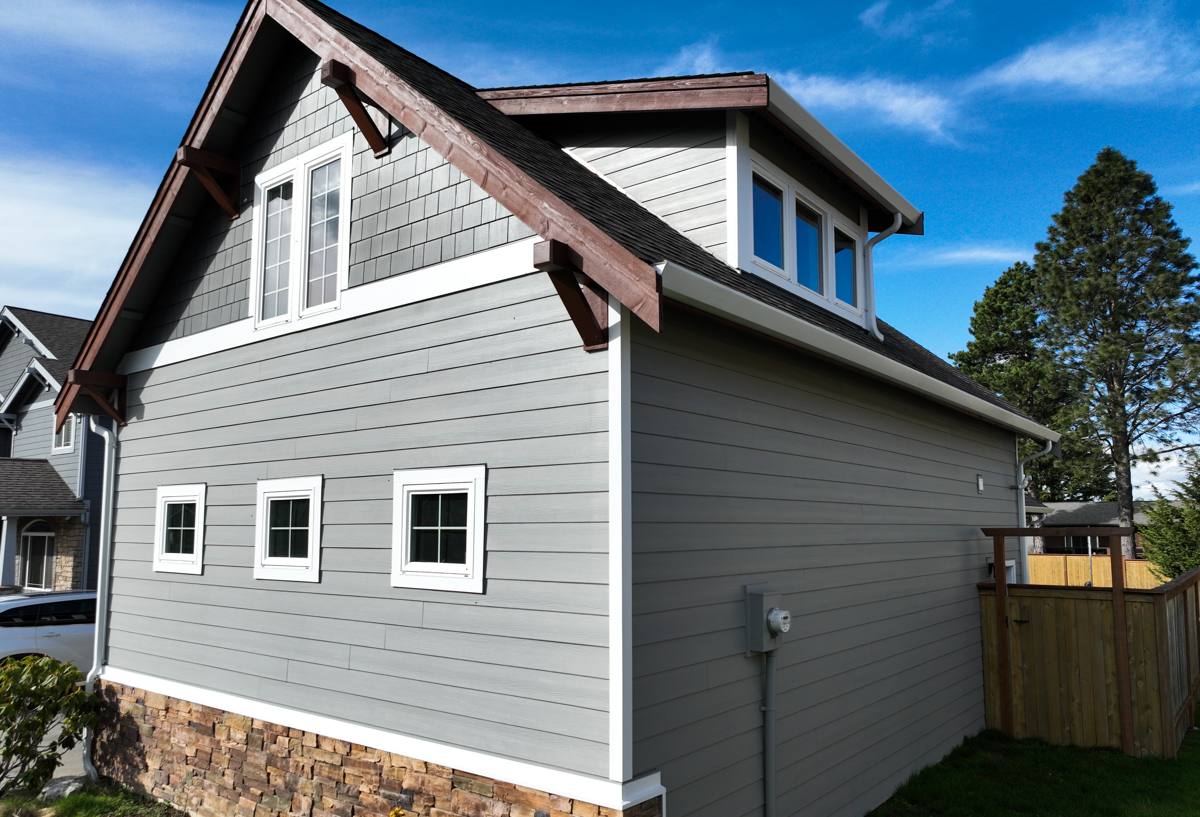
James Hardie fiber cement is non-combustible, dimensionally stable, and doesn't rely on a field-applied coating to keep moisture out — it's engineered from a cement, sand, and cellulose fiber formulation that simply doesn't behave like wood or vinyl in wet conditions. Hardie's ColorPlus factory-applied finish is baked on under controlled conditions rather than brushed on at the jobsite, and it carries its own finish warranty separate from the substrate warranty. Hardie also produces HZ5 product engineered specifically for climates like this one — colder, wetter, and higher-moisture-exposure regions of the country. Installed to manufacturer spec with correct flashing, clearances, and fastening, it's the product we're comfortable standing behind on homes in this area.
Comparing Siding Options for This Climate
| Material | Moisture Behavior | Maintenance | Typical Lifespan Here |
|---|---|---|---|
| James Hardie fiber cement | Stable, factory-sealed finish, non-combustible | Occasional wash, minimal upkeep | 30+ years with proper install |
| Vinyl | Warps/contracts with temperature swings, not a moisture barrier itself | Low, but hides problems behind it | Variable, shorter in high-exposure spots |
| LP SmartSide / engineered wood | Vulnerable at cut edges and joints | Regular caulk/paint inspection required | Depends heavily on maintenance discipline |
| Cedar | Natural material, absorbs and releases moisture | High — refinishing on a set schedule | Shorter without consistent upkeep |
Roofing for Geneva Homes
Roofs here take a different kind of punishment than siding — it's less about driving rain and more about sustained moisture and moss. A roof that isn't cleared of moss and debris regularly holds water against shingles far longer than it should, which shortens the life of the roofing material and increases the odds of a slow leak nobody notices until there's a stain on a ceiling. We look at flashing details, valley condition, and ventilation as closely as the shingles themselves, because a roof that traps heat and moisture in the attic will fail from the inside before the shingles show obvious wear on the outside.
Windows
Window failure around here is almost always a flashing and seal issue before it's a glass issue. Wind-driven rain finds gaps at the head flashing or sill, and once water gets behind a window frame it can travel into the wall assembly and cause damage well beyond the window itself. When we replace windows, we treat the flashing and integration with the surrounding siding as the actual scope of work — the window unit is only part of the job.
Decks
Decks in this climate deal with two problems at once: constant moisture from rain and shade, and the connection point where the deck meets the house. Ledger board attachment is one of the most common failure points we see, because that's where water collects if flashing wasn't done correctly at install. A deck that looks fine on the surface can still be holding moisture against the house framing behind it. We check that connection on every deck project, whether we're building new or repairing an existing structure.
Why a Local Crew Matters
A lot of exterior problems in Whatcom County aren't caused by one bad storm — they're caused by installation details that don't account for how long moisture sits on a surface here compared to drier regions. Flashing laps, fastener spacing, clearance from grade, and ventilation all need to be handled differently in a climate this wet than they would in, say, eastern Washington. A crew that works this area regularly knows which details actually matter for Geneva and Sudden Valley properties specifically — lot shading, proximity to the lake, tree cover — versus generic installation instructions that assume a drier climate.
What to Look for When Hiring for Exterior Work
- Ask specifically what siding product they install and why — a contractor who installs everything usually isn't specializing in the details that make one product perform better in this climate
- Confirm they carry current Washington contractor licensing and liability insurance, and ask to see it
- Ask how they handle flashing at windows, deck ledgers, and roof-to-wall transitions — these are the details that separate a repair that lasts from one that doesn't
- Get a written scope, not just a price, so you know exactly what's included
- Ask how long they've worked in this specific area — familiarity with local conditions is worth more than a generic regional service radius
Getting Started
If you're noticing moss buildup, soft spots in siding or trim, or a deck that feels less solid than it used to, it's worth having someone look at the whole exterior rather than just the symptom you can see. We offer a free, no-pressure estimate for siding, roofing, window, and deck work in Geneva and the surrounding Sudden Valley area — fill out the form below and we'll take a look.