 Sudden Valley Siding
 A Product We're Not Guessing About
Vinyl is the most common siding material in the country, and we get asked about it on nearly every estimate in Sudden Valley. Homeowners want to know why a contractor would turn down the cheapest, lowest-maintenance option on paper in favor of something that costs more upfront. It's a fair question. We're not going to tell you vinyl siding is junk, because it isn't — it's a legitimate, code-compliant product installed on millions of homes across the country, including plenty in drier parts of Washington. What we can tell you is why, after years of working on homes around Lake Whatcom, we stopped offering it as an option here.
That distinction matters. A product can perform reasonably well in a hot, dry climate and still be a poor match for a shaded lakeside lot in Whatcom County that spends half the year wet. This page walks through what vinyl siding actually is, where it tends to struggle in the field, why Sudden Valley's specific climate makes those weak points worse, and why James Hardie fiber cement is the only product we install.
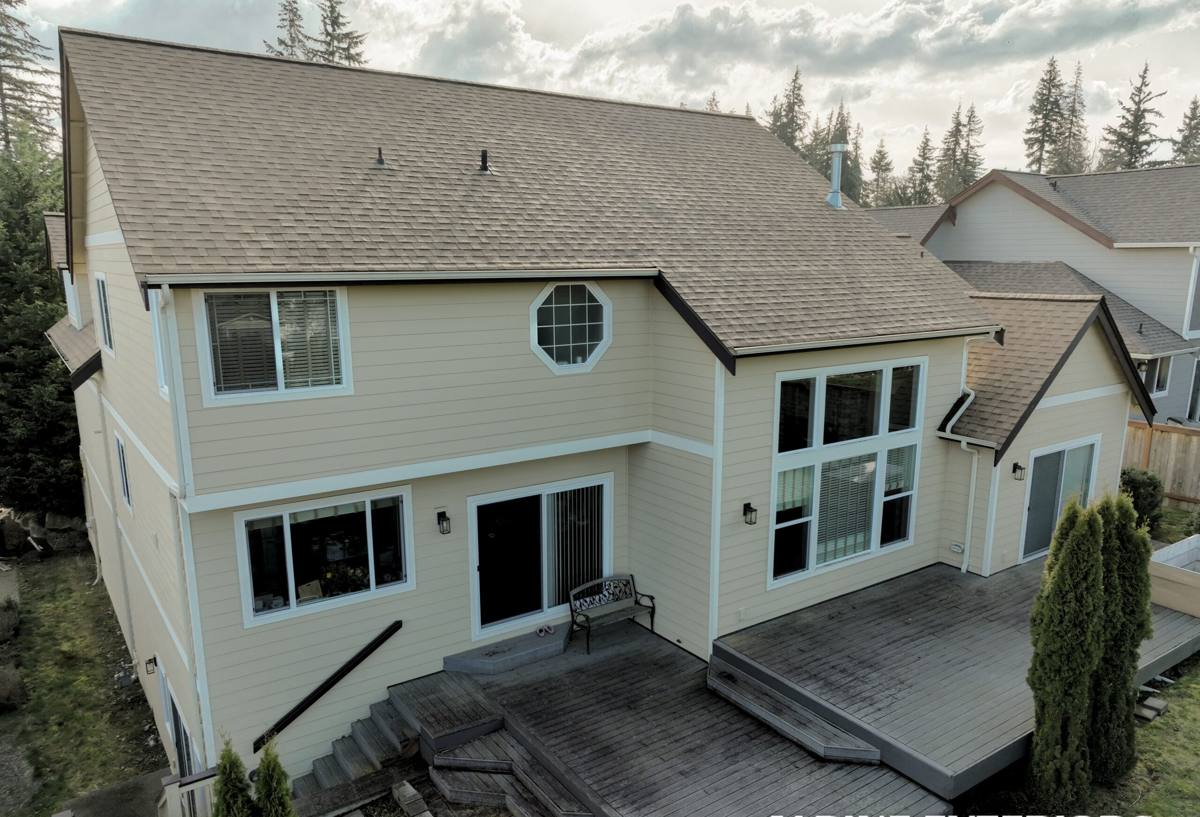
What Vinyl Siding Actually Is
Vinyl siding is extruded PVC — polyvinyl chloride — formed into overlapping panels with a hollow back. The color runs through the material rather than sitting on top as a separate coating, which is a genuine advantage: there's no paint layer to chip or peel. It's light, inexpensive relative to almost every other cladding option, and quick for a crew to install, which is exactly why it dominates the national market. Panels hang on a nailing flange with slotted holes, left slightly loose on purpose so the material can expand and contract with temperature. None of that is a defect. It's how the product is engineered to work.
The part that matters for a wet, wooded climate is what vinyl isn't: it isn't a true water barrier, and it isn't rigid. Every manufacturer's own installation instructions describe vinyl as a rain screen, not a sealed envelope — the housewrap or building paper behind it is what's actually supposed to stop bulk water. Vinyl is designed to shed most of the water and let the rest drain back out through weep points at the bottom of each course. That system works fine when it's installed exactly to spec on a wall that gets a normal amount of sun and wind to dry out between storms. It has a lot less margin when a wall stays damp for weeks at a stretch.
Where the Weak Points Actually Are
- Thin, hollow panels flex and can crack under impact from hail, falling branches, or a stray baseball — a common occurrence on heavily treed lots.
- PVC gets brittle in cold weather, so impact damage is more likely during winter storms than in summer.
- Dark colors absorb heat and can warp or buckle, especially on walls that catch reflected sunlight off windows or a neighboring structure.
- Seams and laps rely on proper overlap and fastening to stay tight; wind-driven rain can find gaps that a rigid product wouldn't have.
What We Actually See on Service Calls
The failures we run into with vinyl aren't usually catastrophic. They're slow, cosmetic, and cumulative: panels that have faded and chalked unevenly on the sun-exposed side of a house while the shaded side still looks close to new, corners that have pulled loose or buckled after a summer heat spell, and, on older installations, water staining on the sheathing behind panels where a weep point got blocked by debris or a lap wasn't overlapped correctly during the original install. We've also pulled off vinyl during re-side jobs and found housewrap that failed years before anyone noticed, because the vinyl itself looked fine from the street the whole time — it was doing its job of hiding what was happening behind it.
That last point is the one that concerns us most as installers. Vinyl's biggest practical risk isn't usually the panel — it's that a failure in the water management system behind it can go undetected for years, because the siding on the surface doesn't show obvious signs of a leak the way a stained or swollen wood-based product would. On a lot that dries out quickly, that's a manageable risk. On a shaded, damp lot where a wall never fully dries between storms, it's a bigger one.
Why Sudden Valley's Climate Is a Harder Test
Salt Air Off the Sound
Whatcom County sits close enough to Puget Sound and Bellingham Bay that salt-laden air reaches inland lots, including many around Lake Whatcom. Salt air accelerates the breakdown of exterior finishes and speeds up corrosion on exposed fasteners and trim. Vinyl's color runs through the material, so it doesn't peel the way a painted surface would, but the surface still chalks and dulls faster under sustained salt exposure than manufacturers' clean-lab testing tends to suggest.
Driving Rain and Lake Wind
Storms coming off Lake Whatcom don't arrive gently. Wind pushes rain sideways into laps, corners, and trim joints, which is a tougher test for an overlap-and-drain system than an annual rainfall total implies. Sustained wind also stresses the loose-fit fastening system vinyl depends on for thermal movement — panels that rattle or work loose over years of wind exposure are a common sight on older installations around the lake.
A Moss Season That Doesn't Really End
Sudden Valley sits under some of the heaviest second-growth tree canopy in the Bellingham area, and many homes here have at least one wall face that gets very little direct sun for most of the year. Shade, humidity, and mild temperatures are the exact recipe for moss and mildew growth, and that recipe stays active here for most of the year, not just a few winter months. Moss and algae can take hold in the horizontal grooves and laps of vinyl siding, especially on north-facing walls, and once established it holds moisture against the surface even longer.
How Vinyl and James Hardie Actually Compare
None of this makes vinyl the wrong choice everywhere. It means the trade-offs land differently depending on climate, sun exposure, and how long you plan to own the home. Here's the honest comparison we walk homeowners through:
| Factor | Vinyl Siding | James Hardie Fiber Cement |
|---|---|---|
| Core material | Extruded PVC, hollow-backed panels | Cement, sand, and cellulose fiber — non-combustible |
| Water management | Rain screen only; relies entirely on housewrap behind it | Rigid panel with engineered water-resistive detailing |
| Impact resistance | Can crack under impact, more brittle in cold weather | Resists impact damage far better across temperature swings |
| Heat and sun exposure | Can warp or buckle, especially in darker colors | Dimensionally stable across normal temperature ranges |
| Fire resistance | Combustible, can melt or ignite under direct heat | Non-combustible, a real factor in Whatcom County's dry-season wildfire risk |
| Color and finish | Color runs through material but fades and chalks over time | ColorPlus baked-on finish, engineered for UV and moisture |
| Upfront material cost | Lowest of common siding options | Higher upfront, offset by lower lifetime replacement cost |
Why We Standardized on James Hardie
James Hardie fiber cement is a rigid, cement-based panel rather than a thin, flexible plastic sheet. It holds its shape across the temperature swings we see between a hot August afternoon and a January cold snap, and it doesn't rely on a loose-fit fastening system to accommodate movement. Hardie also engineers specific product lines for different climate zones, and the HZ5 line is built for regions like ours with sustained wet weather and freeze-thaw cycling — an engineering decision, not a marketing label.
The ColorPlus factory finish is baked on under controlled conditions, which gives it more even, durable coverage than a color that simply runs through an extruded plastic panel, and it carries a longer finish warranty than what we could stand behind on vinyl. Because fiber cement is non-combustible, it also adds real protection during Whatcom County's dry summer stretches, when wildfire smoke and elevated fire risk are a genuine seasonal concern even on the wetter west side of the state — something a PVC-based product simply can't offer.
None of that means Hardie is maintenance-free or foolproof to install. It's a heavier product that has to be cut, gapped, and fastened correctly, and a rushed installation will cause its own problems down the line. That's why installation quality is the other half of this decision — the best material available still has to go on the wall the right way.
What to Ask Any Contractor Bidding Your Siding
Whether you're getting bids from us or anyone else, these questions separate a real answer from a sales pitch:
- What siding products do you actually install, and why did you settle on that list?
- How do you detail the water-resistive barrier behind the siding, regardless of which product goes on top?
- Have you gone back to service jobs you installed five or more years ago, and what did you find?
- What does the manufacturer's warranty actually cover, and does it hold up if the home is resold?
- How does your approach change for a shaded, high-wind, lakeside lot compared to a drier, open site?
If You Already Have Vinyl Siding on Your Home
This isn't a page telling every vinyl homeowner to panic. If it was installed correctly over sound housewrap and the panels are intact, it may still have real service life left. A few things worth checking yourself before calling anyone out:
- Look for panels that have buckled, warped, or pulled away from the wall, especially on sun-exposed sides.
- Check corners and laps for cracks, particularly after a cold snap or a wind storm.
- Look for moss or algae building up in the horizontal grooves on shaded, north-facing walls.
- Press gently on any area near a downspout or roof valley for soft or spongy sheathing underneath, which can signal a water problem behind the panels.
- If you find signs of moisture behind the siding rather than just surface wear, don't wait — hidden water damage tends to get more expensive the longer it sits undetected.
Get a Free, No-Pressure Estimate
Whether you're comparing siding options before a re-side or just want a straight answer about what's on your home now, we're glad to walk the property and tell you exactly what we see. Reach out using the form below to schedule a free estimate — no pressure and no upsell script.