 Sudden Valley Siding
 What Primed Spruce Siding Actually Is
Primed spruce lap siding is a solid-wood product, typically finger-jointed or solid-length boards milled from spruce-pine-fir stock and coated at the factory with a primer coat before it ships. It's been a staple in the Pacific Northwest for decades because the material is familiar, relatively inexpensive per board foot, and easy for crews to cut and nail with standard tools. Homeowners in Whatcom County often ask about it because a neighbor has it, or because a previous owner already installed it and they're comparing repair versus full replacement.
There's nothing dishonest about the product itself. Solid wood siding, installed and maintained correctly, can look good and last a reasonable amount of time. The issue isn't the board — it's what wood does once it's hanging on a wall in a climate like ours, and what that means for the homeowner's time and money over the following 15 to 20 years.
The Sudden Valley Climate Problem
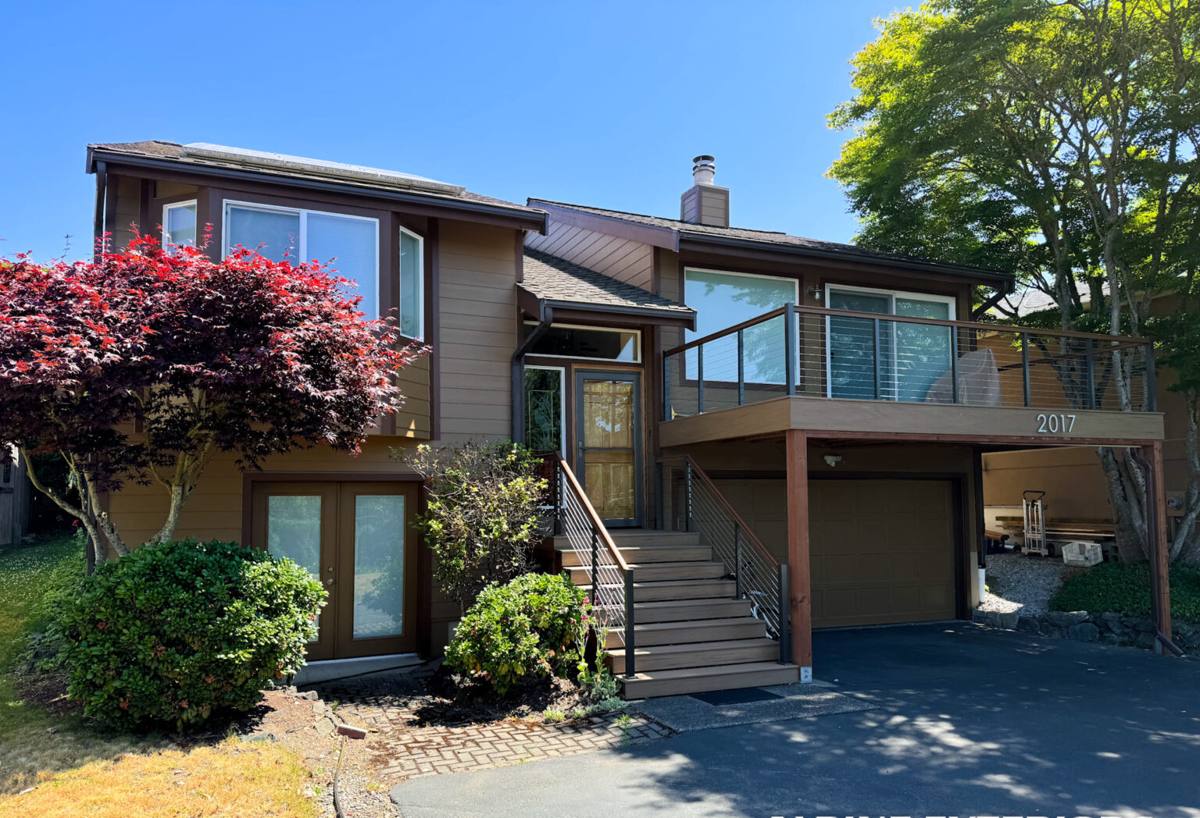
Sudden Valley sits on Lake Whatcom in a part of Whatcom County that gets a long, wet shoulder season — driving rain off the water, heavy morning dew, and shaded, tree-covered lots that stay damp well after a storm has passed. Add in the salt-tinged marine air that reaches inland from Bellingham Bay and the greater Puget Sound corridor, and you get a wall assembly that rarely gets a real chance to dry out between rain events.
Wood siding needs air movement and sunlight to shed moisture. A north-facing wall shaded by cedars, or a section tucked behind landscaping, can stay damp for days. That's exactly the condition under which primed wood starts to fail — not dramatically, but steadily, in ways that show up as maintenance bills long before the siding is "old."
Moss Season Isn't Cosmetic
Our moss season here runs long — often six months or more of the year with enough moisture and shade to support active growth. On fiber cement, moss is mostly a surface nuisance that comes off with a soft wash. On primed wood, moss and algae hold moisture directly against the substrate and against the paint film. Over a few seasons, that constant damp contact is what breaks primer adhesion down and lets water into the wood itself.
Where Primed Spruce Runs Into Trouble
The Primer Is Not the Finish Coat
A factory primer is designed to seal the wood and give a topcoat something to bond to — it is not a standalone weather barrier. Every primed spruce installation depends on the homeowner (or a painter) applying a quality exterior topcoat within a reasonably short window after installation, and then recoating on a schedule going forward. Skip that step, or let it slide by a year or two, and the bare wood underneath starts absorbing moisture at the end grain, at nail heads, and at any hairline crack in the primer film.
End Grain and Butt Joints
Every horizontal butt joint on a lap-sided wall is a piece of end grain exposed to the weather, and end grain soaks up water many times faster than the face of the board. Factory priming rarely fully seals cut ends made on site, which means every joint is a potential entry point unless it's caulked and back-primed correctly at install — a step that's easy to skip and hard to inspect once the wall is closed up.
Dimensional Movement
Wood swells and shrinks with moisture content. In a marine climate with constant wet-dry cycling, that movement is more frequent and more pronounced than in a drier region. Over time it works caulk joints loose, opens hairline gaps at seams, and telegraphs through paint as cracking along the board edges — all of which are maintenance items, not one-time fixes.
Rot Risk at Grade and Behind Trim
Spruce is a softwood with limited natural decay resistance. Where boards meet foundation grade, deck ledgers, or window and door trim — all common failure points on Whatcom County homes — trapped moisture combined with limited air circulation is a known recipe for soft, rotting wood. It's not guaranteed on every home, but it's a predictable risk in this climate, and it's the single most common repair call we hear about on older wood-sided homes in the area.
The Maintenance Math
The real cost of primed spruce siding isn't the install price — it's the recurring cost of keeping it weathertight. Here's how that typically breaks down against a factory-finished fiber cement product over the same period:
| Factor | Primed Spruce Siding | James Hardie Fiber Cement (ColorPlus) |
|---|---|---|
| Initial finish | Site-applied topcoat required after priming | Factory-baked finish, cured before install |
| Repaint cycle | Typically every 5-8 years in this climate | ColorPlus warranty covers finish for 15 years |
| Moisture behavior | Absorbs and swells at cut ends and joints | Non-combustible, engineered to resist moisture-driven damage |
| Moss/algae impact | Traps moisture against substrate | Washes off; does not feed into the board |
| Rot risk at grade/trim | Present, especially in shaded/damp areas | Not a wood-rot product |
| Typical service life here | Highly dependent on maintenance follow-through | Decades, per manufacturer engineering for this climate zone |
None of this means primed spruce is a scam or a bad product in every application. In a drier climate with a disciplined repaint schedule, it can perform fine. Our concern is specific to this region: the combination of driving rain, shaded lake-adjacent lots, salt-tinged air, and a long moss season stacks several risk factors on top of each other, and we've decided we're not willing to install a product whose long-term performance depends so heavily on a homeowner keeping up a maintenance schedule most people don't realize they've signed up for.
Why We Standardized on James Hardie Instead
We install James Hardie fiber cement siding exclusively, and the decision comes down to matching the product to the climate rather than matching the product to the lowest install-day cost. Hardie's HZ5 product line is engineered specifically for climates with high moisture exposure — which describes most of Whatcom County, and Sudden Valley in particular given its lake and marine air exposure.
What That Means in Practice
- Fiber cement doesn't rot, and it isn't a food source for moss or algae the way wood substrate can be
- ColorPlus factory finish is baked on and backed by a separate finish warranty, so you're not relying on a site-applied topcoat holding up under our rain patterns
- It's non-combustible, which matters for insurance consideration in a wildfire-adjacent region
- The product is engineered and warranted for the moisture conditions specific to our climate zone, not a generic all-climate spec
- Correctly installed with proper flashing, clearances, and fastening, it holds paint and caulk lines far longer than site-finished wood
We're not saying this to sell fear about wood siding in general — cedar and spruce have a long history in this region and plenty of homes have carried it well. But when a homeowner asks us to install primed spruce today, knowing what we know about how it performs on lake-adjacent, shaded, moss-prone lots in Whatcom County, we don't think it's an honest recommendation. Hardie is the product we're willing to put our name behind here.
What to Ask Before You Commit to Any Wood Siding Product
- Who is responsible for the topcoat, and within what window after installation?
- What is the manufacturer's actual moisture/warping warranty, and what voids it?
- How are butt joints and end grain treated — caulked, back-primed, both?
- What's the realistic repaint interval for a shaded, lake-adjacent property specifically?
- What does the contractor do differently at grade level and around windows to manage water?
If You Already Have Primed Spruce Siding
We do get calls from homeowners with existing spruce siding who are trying to decide whether to keep maintaining it or replace it. If your siding is still tight, well-caulked, and on a reasonable repaint cycle, there may be a few more years of service life left in it. But if you're seeing soft spots at the bottom courses, paint failure that keeps coming back within a year or two of repainting, or persistent moss buildup that won't stay off, that's usually a sign the substrate underneath is already compromised — and at that point, patch repairs are a delay, not a fix.
If you're weighing a repair against a full re-side, we're happy to take an honest look and tell you which situation you're actually in before you spend money either way.
Get a Straight Answer for Your Home
Every property in Sudden Valley sits a little differently — sun exposure, tree cover, distance from the water, and age of the existing siding all change the picture. If you'd like an honest look at what's on your walls now and what it would take to move to a fiber cement system built for this climate, request a free, no-pressure estimate below and we'll walk the property with you.