 Sudden Valley Siding
 Exterior Work in Sunnyland: What the Climate Actually Does to Your Siding
Sunnyland sits inside the same weather system that shapes exterior work across all of Whatcom County: cool, wet winters, a short dry stretch in summer, and a long shoulder season where the air rarely gets a chance to fully dry out. Homes here don't usually fail because of one dramatic storm. They fail slowly, from months of low-grade moisture exposure that most homeowners never notice until paint starts bubbling or trim starts going soft.
Three things drive most of the siding problems we see in this part of the county: salt-laden air moving inland off Bellingham Bay and the Sound, driving rain that gets pushed sideways by wind instead of falling straight down, and a moss season that can run from fall through spring on shaded or north-facing walls. None of these are exotic problems. They're just persistent, and persistence is what wears out the wrong siding material.
Salt Air and Metal Fasteners
Coastal Whatcom County air carries enough salt to accelerate corrosion on exposed metal — nail heads, flashing, hose bibs, light fixtures. On siding, this shows up as rust streaking through paint, corroded fasteners that back out over time, and faster breakdown of caulk and sealant joints. It's a slow process, but it's constant, and it doesn't take a waterfront lot to matter. Homes several miles inland still see it.
Driving Rain
Straight-down rain is easy for most siding to shed. Wind-driven rain is the harder test, because it gets forced sideways into laps, corner joints, and butt seams instead of running off the face of the wall. Over years, water that repeatedly finds its way behind or into a seam is what causes rot in wood-based products and swelling in anything with a wood-fiber core. The installation detail — how laps are shingled, how joints are flashed, how caulk is used (or isn't) — matters as much as the material itself.
Moss and Prolonged Dampness
Shaded walls, tree cover, and north exposures around Sunnyland stay damp longer than they get to dry. That's the exact condition moss and algae need to take hold. On some siding materials, that surface growth is just cosmetic. On others, sustained moisture contact at the surface is a slow path toward material breakdown underneath the finish.
Why We Install Only James Hardie Fiber Cement
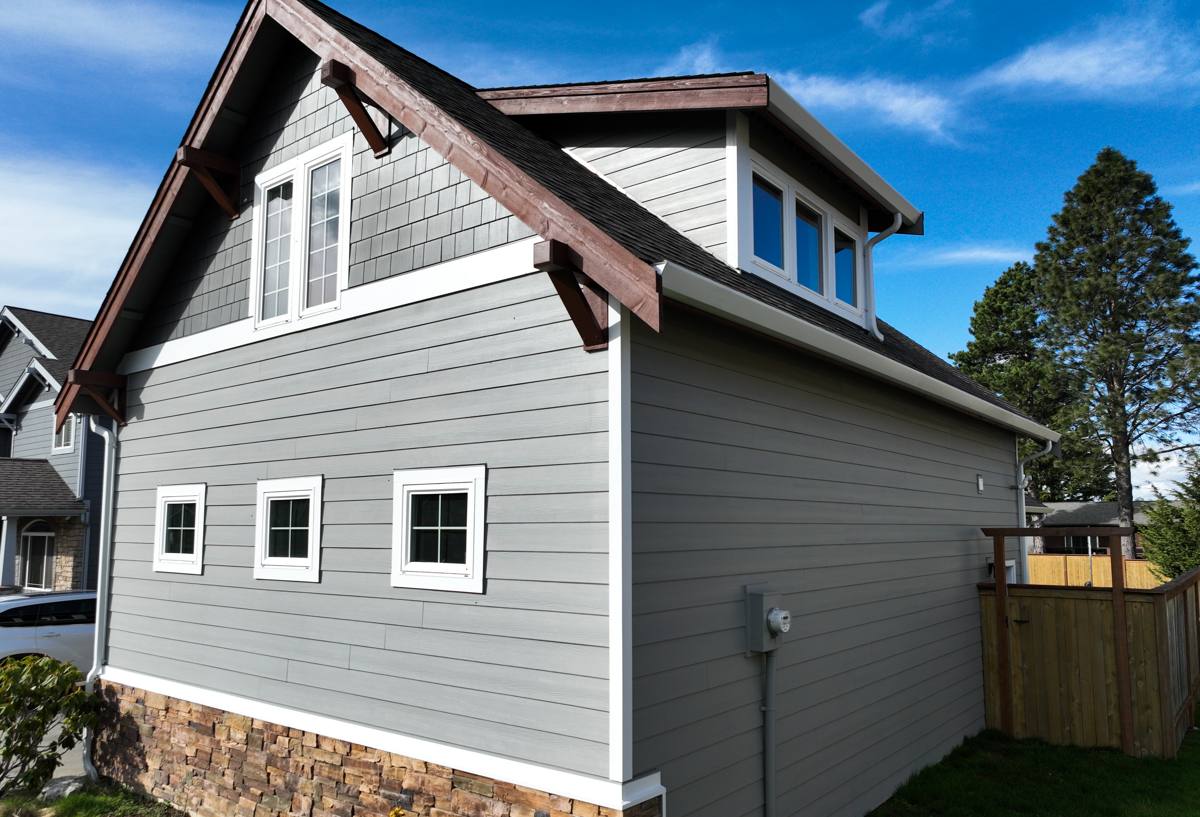
We made a decision a while back to stop installing multiple siding lines and standardize on one product: James Hardie fiber cement. That's not a marketing position — it's a maintenance and durability call based on what actually holds up under years of Pacific Northwest weather.
Fiber cement is made from cement, sand, and cellulose fibers. It doesn't have a wood core to absorb moisture and swell, and it's non-combustible, which matters more each year as wildfire smoke seasons stretch further north. James Hardie's HZ5 product line is specifically engineered for the wetter, cooler climate zones the Pacific Northwest falls into, with moisture and freeze-thaw performance built into the formulation rather than added as an afterthought.
The factory-applied ColorPlus finish is the other half of the equation. It's baked on under controlled conditions, with better adhesion and UV resistance than field-applied paint, and it comes with its own finish warranty separate from the substrate warranty. That combination — engineered core plus factory finish — is why it's the only system we put on homes.
What We Compare It Against
| Material | Common trade-off in this climate |
|---|---|
| Vinyl siding | Can warp or distort with prolonged UV and temperature swings; seams rely on lap fit rather than a rigid, caulked joint |
| LP SmartSide / engineered wood | Wood-strand core is more sensitive to sustained moisture exposure at cut edges and seams if maintenance lapses |
| Primed spruce / cedar | Real wood requires ongoing repainting and caulking discipline to keep moisture out long-term |
| Cemplank / Allura fiber cement | Similar core chemistry to Hardie, but without Hardie's climate-specific HZ engineering or ColorPlus factory finish |
| James Hardie fiber cement | Non-combustible, engineered for wet climates, factory finish — the standard we install |
None of these are "bad" products in every context. They're just products we've chosen not to install, because the trade-offs don't line up with what holds up best against salt air, driving rain, and moss season year after year without heavy maintenance.
How Siding Work Runs in Sunnyland
Every property in this area is a little different — tree cover, exposure, how close it sits to open water, how old the existing siding and flashing are. A proper estimate starts with a walk-around, not a guess from the truck.
- On-site inspection of existing siding, trim, flashing, and any visible moisture or rot damage
- Check of window and door flashing details, since these are the most common failure points behind otherwise fine siding
- Discussion of Hardie plank profile, exposure, and color to match the home and neighborhood
- Written estimate covering material, labor, and any necessary sheathing or trim repair
- Installation to manufacturer spec — correct fastener pattern, proper lap and joint detailing, house wrap and flashing integration
What "Installed to Spec" Actually Means
James Hardie's warranty and performance depend on correct installation, not just correct material. That means proper fastener placement and spacing, correct clearance from grade and roofing, sealed and flashed joints, and following the manufacturer's specific instructions for the HZ product line in this climate zone. A lot of siding problems we get called out to inspect trace back to shortcuts at this stage — not the material itself.
Roofing, Windows, and Decks: The Rest of the Envelope
Siding doesn't work in isolation. Water that gets past a roof edge, a window flashing, or a deck ledger board will find its way into wall assemblies regardless of how good the siding is. Because we handle roofing, windows, and decks in addition to siding, we can look at a home's whole exterior envelope during one inspection instead of treating each surface as a separate problem.
- Roofing — the first line of defense against the same wind-driven rain and moss growth that affects siding; roof-wall intersections are a common leak point
- Windows — flashing and sealant around window openings are frequently where "siding failures" actually originate
- Decks — ledger board attachment and flashing where a deck meets the house wall need the same moisture discipline as any siding joint
Signs Sunnyland Homeowners Should Watch For
- Paint that's peeling, bubbling, or chalking heavily on one side of the house more than others
- Soft or spongy spots when you press on siding near the bottom courses or around window trim
- Persistent moss or dark streaking on north-facing or shaded walls that comes back quickly after cleaning
- Visible gaps or separation at butt joints and corner boards
- Rust streaking below nail heads or metal trim pieces
- Musty smell or visible staining on interior walls that share an exterior wall
Any one of these on its own isn't necessarily an emergency. Several together, especially on a home that hasn't had its siding inspected in a decade or more, is worth a closer look before a small repair turns into a full re-side.
Cost Factors for Siding Projects in This Area
| Factor | Why it affects your project |
|---|---|
| Home size and wall complexity | More corners, dormers, and trim details mean more cut pieces and labor time |
| Condition of existing sheathing | Rot or moisture damage found once old siding is removed adds repair scope |
| Siding profile and exposure | Lap width and texture (smooth vs. cedar-shake style) affect material cost per square |
| Trim and accessory work | Corner boards, window trim, and fascia detailing add to labor and material |
| Access and site conditions | Steep lots, tree cover, or tight setbacks common in this area can affect staging and labor time |
Why a Local Crew Matters Here
A crew that works Whatcom County exteriors regularly knows which walls in this area take the worst of the wind-driven rain, which exposures grow moss the fastest, and how much clearance a flashing detail needs to hold up through a wet coastal winter instead of a generic weather pattern from a manufacturer's install guide. That local pattern recognition is what separates a siding job that looks fine at handoff from one that's still tight and dry after ten Northwest winters.
If you're weighing a siding, roofing, window, or deck project for a home in Sunnyland, we're happy to walk the property, take an honest look at what's actually going on, and put together a free, no-pressure estimate — no obligation, no pressure to sign anything on the spot.