 Sudden Valley Siding
 Why Siding Failure Often Goes Unnoticed Until It's Serious
Siding is designed to be the thing you don't think about. It sheds water, blocks wind, and holds paint or finish for years without complaint — until it doesn't. The trouble is that siding failure rarely announces itself with a single dramatic event. It shows up as a soft spot near a downspout, a paint line that keeps bubbling no matter how many times it's repainted, or a corner board that feels spongy when you press on it. By the time those signs are obvious from the driveway, moisture has usually been working behind the surface for a while.
For homeowners around Sudden Valley, the stakes are a little higher than in a dry inland climate. Whatcom County sits under a steady flow of marine air off Bellingham Bay and the Salish Sea, which means siding here deals with salt-laden moisture, near-constant fall and winter rain driven sideways by wind off Lake Whatcom, and long stretches — often five or six months — where north-facing and shaded walls simply never fully dry out. Moss doesn't just grow on roofs in this area; it colonizes siding laps, trim, and anywhere water sits even briefly.
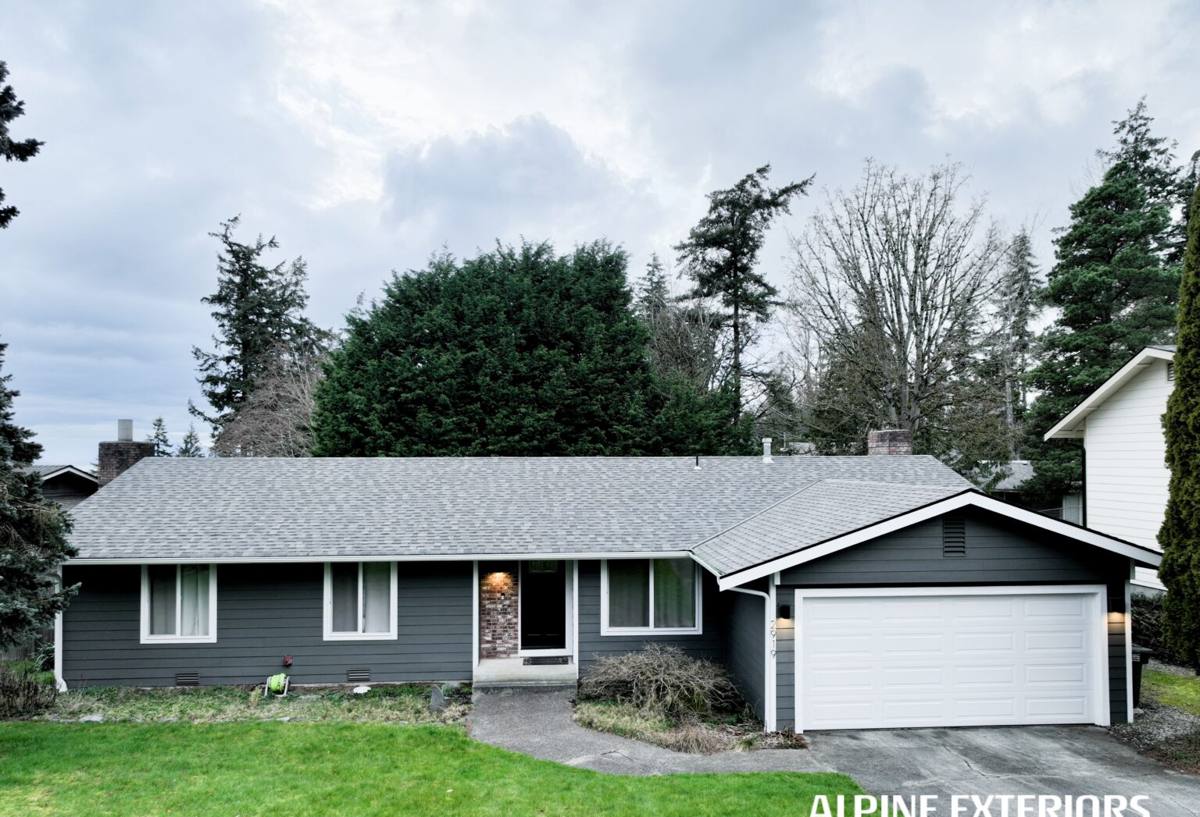
Visual Warning Signs You Can Spot From the Ground
Most siding problems give visual clues well before they become structural ones. Walk the perimeter of the house a couple of times a year and look for these:
Paint and Finish Problems
Peeling, alligatoring, or bubbling paint on siding is almost never just a paint-quality issue — it's usually a sign that moisture is trapped underneath the surface and trying to escape. On wood-based products, this is one of the earliest and most reliable failure indicators. If you're repainting the same section every two to three years instead of every seven to ten, the siding underneath is telling you something.
Warping, Bowing, or Buckling
Panels or boards that no longer sit flat against the wall — especially ones that ripple or bow outward — have usually absorbed moisture and are swelling, or the fasteners have failed and the panel has shifted. This is common on engineered wood siding that has taken on water at cut edges or seams.
Cracking and Splitting
Hairline cracks that run with the grain, or splits that open up at butt joints and corners, let water directly into the wall assembly. On fiber cement, cracking is unusual unless a panel was mishandled or improperly fastened; on wood and engineered wood products, cracking from freeze-thaw cycling and moisture swelling is a known long-term wear pattern.
Discoloration and Staining
Dark streaking, black or green-tinged patches, and soft, chalky white residue are all signs of sustained moisture exposure. In this climate, moss and algae staining on siding is extremely common on shaded, north- and west-facing walls that face prevailing weather off the lake.
Signs You Can Feel, Hear, and Smell
Not every warning sign is visible from ten feet away. Some require getting hands-on, and a few show up inside the house before they're obvious outside.
- Soft or spongy spots when you press on siding, especially near the bottom courses, window sills, and anywhere trim meets a horizontal surface
- Boards that flex or give under light pressure — healthy siding shouldn't move
- A musty smell along interior walls that back up to exterior siding, particularly after heavy rain
- Rattling or loose panels in wind, which usually means fasteners have corroded or backed out
- Visible gaps that have opened between boards or at seams that used to be tight
- Interior drywall or trim staining on exterior-facing walls, which almost always traces back to a siding or flashing failure
Any one of these on its own might be minor. Two or three together, especially clustered on the same wall or elevation, usually means water has been getting behind the siding for a while.
What's Actually Happening Behind the Siding
The visible damage is only part of the story. Siding's real job is managing a "drainage plane" — a system of house wrap, flashing, and properly lapped siding that lets any water that gets past the surface drain back out instead of soaking into the wall sheathing. When siding fails, it's often this drainage system that's compromised, not just the siding material itself.
Once water gets behind siding and can't drain or dry, it can lead to sheathing rot, insulation that's lost its R-value from being wet, and in the worst cases, framing damage that isn't cheap to fix. This is why siding failure is worth taking seriously even when the visible damage looks minor — the cost difference between catching it early and catching it late is enormous.
Why Sudden Valley's Climate Accelerates the Process
Three regional factors compound siding failure here more than in drier parts of the state:
| Climate Factor | Effect on Siding |
|---|---|
| Salt-laden marine air | Accelerates fastener corrosion and finish breakdown, especially on lower-quality trim and fastener hardware |
| Driving rain off the lake and Sound | Pushes water sideways into laps, seams, and butt joints that would stay dry in calmer conditions |
| Extended moss and algae season | Keeps shaded and north-facing walls damp for months, feeding rot on absorbent materials and staining most finishes |
None of these factors alone would doom a siding job. Together, over the 25-40 year lifespan homeowners expect from siding, they're exactly the conditions that separate a product and installation that holds up from one that doesn't.
Failure Patterns Differ by Material
Not all siding fails the same way, and knowing what to look for depends partly on what's on the house. This is a general guide to failure symptoms, not a case against any single product on its own — but the differences matter when you're deciding whether to repair or replace.
| Material | Common Failure Pattern | What Drives It |
|---|---|---|
| Cedar / primed spruce | Cracking, cupping, rot at butt joints and bottom courses | Organic material absorbs moisture directly; finish maintenance is constant |
| Engineered wood (LP-type) | Edge swelling, delamination, soft spots at seams | Wood-fiber core swells when moisture reaches an unsealed cut edge or gap |
| Vinyl | Warping in heat/cold cycling, cracking with age, fading | Thin material with limited dimensional stability and UV resistance over decades |
| Fiber cement (Hardie) | Failure mainly at improperly installed joints or caulk lines, not the material itself | Installation quality matters more than material behavior; the material doesn't rot, swell, or feed insects |
This is a large part of why our crews standardized on James Hardie fiber cement years ago. It's not that other materials can't be installed well — it's that fiber cement removes an entire category of failure (moisture absorption into the material itself) that we were repeatedly called back to repair on wood-based and engineered wood products throughout this climate.
A Practical Self-Inspection Checklist
You don't need a ladder or special tools to do a useful walk-around inspection twice a year — once in early fall before the rains set in, and once in spring after the wettest months have passed.
- Walk the full perimeter and look at each elevation separately — north and west walls facing the lake typically show problems first
- Press firmly on siding near the bottom three courses, around windows, and at all corners
- Check caulk lines at trim, window edges, and butt joints for cracking or gaps
- Look at paint or finish condition closely near downspouts, hose bibs, and anywhere sprinklers hit the wall
- Note any moss or algae buildup and whether it's new or spreading since last season
- Check inside, along exterior walls, for staining, soft drywall, or musty smells
- Look at fastener heads for rust streaking, which signals corrosion working its way through
- Check where siding meets the foundation, roofline, and deck ledger boards — these transition points fail more often than flat wall sections
Repair or Replace? What Actually Determines the Answer
Not every sign of wear means a full re-side. The right call depends on how much of the wall is affected, whether the damage is cosmetic or has reached the sheathing, and how old the existing siding already is relative to its expected lifespan.
| Factor | Leans Toward Repair | Leans Toward Full Replacement |
|---|---|---|
| Extent of damage | Isolated to one board or small section | Spread across multiple elevations |
| Underlying sheathing | Dry, undamaged when opened up | Soft, stained, or visibly rotted |
| Age of existing siding | Well within expected lifespan | Already near or past it |
| Pattern of recurring issues | First occurrence | Repeated problem in the same area or across the house |
| Original installation quality | Flashing and drainage plane intact | Evidence of missing or improper flashing house-wide |
A single soft board near a downspout, caught early, is often a straightforward repair. Widespread paint failure, multiple soft sections, or sheathing damage found in more than one spot usually means the underlying system has failed and patching it will just mean chasing the same problem wall by wall for years.
What We Install When It's Time to Replace
When a homeowner in Sudden Valley is past the point of patching and looking at a full re-side, our crews install James Hardie fiber cement exclusively. It's a decision built on years of seeing which products hold up against this specific combination of salt air, driving lake-effect rain, and a moss season that runs half the year. Fiber cement doesn't absorb water into the material the way wood and wood-fiber products do, it carries a factory-applied ColorPlus finish that's engineered to resist fading and doesn't require the repainting cycle wood siding does, and it's manufactured in climate-specific HZ product lines suited to wetter regions like ours. Correct installation — proper flashing, gapping, and fastening to Hardie's specifications — is what makes the material perform for decades, and it's the part of the job we treat as non-negotiable.
If you're seeing any of the warning signs above, or you just want an honest read on where your siding stands, we're happy to take a look. We offer free, no-pressure estimates and will tell you plainly whether you're looking at a repair, a few years of runway, or a replacement worth planning for.