 Sudden Valley Siding
 Exterior Work Built for Happy Valley's Climate
Happy Valley sits within the Sudden Valley community in Whatcom County, tucked among the forested hills that roll down toward Lake Whatcom. It's a beautiful place to own a home, but it's also a demanding place to own an exterior. Whatcom County gets the full Pacific Northwest weather package: long, wet winters, a marine air pattern that pulls moisture and salt-tinged air in off the Salish Sea, and enough tree cover to keep everything shaded, damp, and slow to dry for weeks at a time. That combination is exactly what wears down siding, roofing, and trim faster here than it would in a drier inland climate.
We work throughout Whatcom County and know what this specific stretch of terrain does to a house. Steep, wooded lots mean less direct sun on north- and east-facing walls. Heavy rainfall means gutters, flashing, and water management details matter more than they do in most parts of the country. And the moss and mildew that thrive in that shade and moisture don't just look bad — they hold water against your siding and roofing longer than they should, which accelerates rot, paint failure, and structural damage if it goes unaddressed.
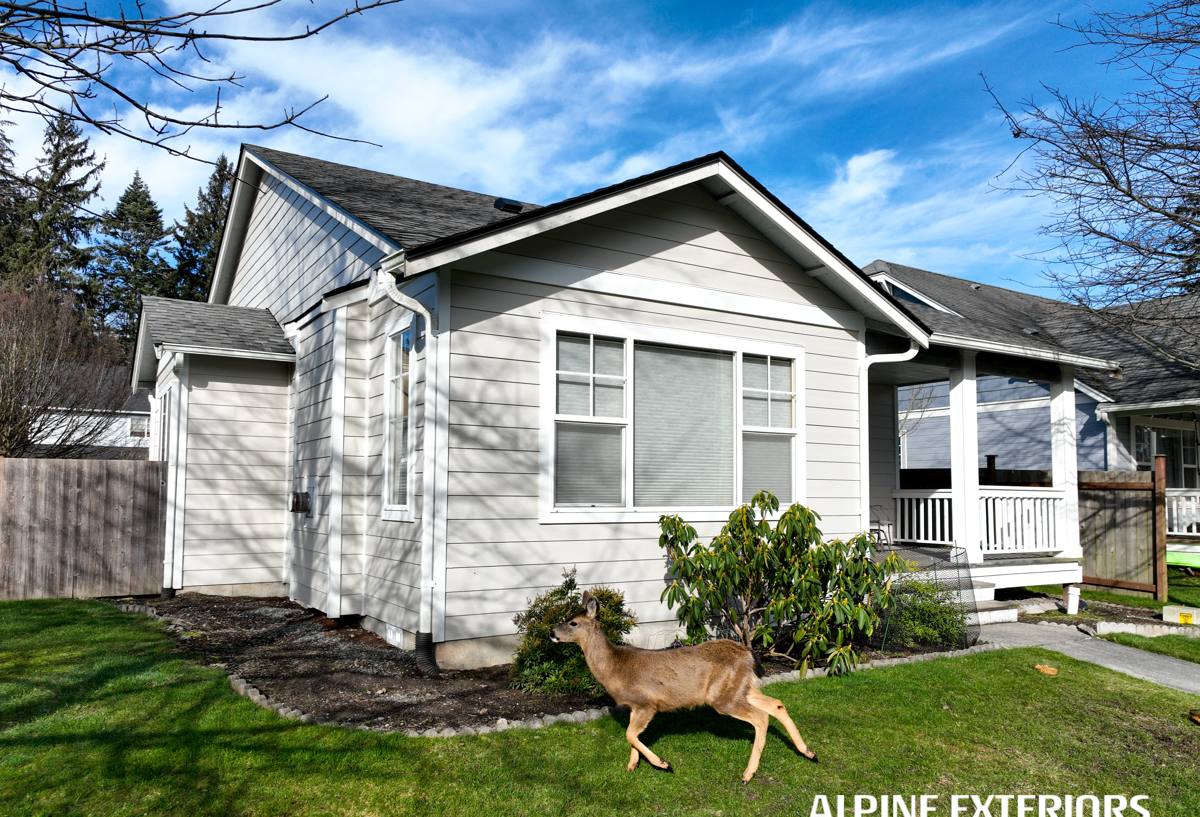
What Happy Valley Homes Are Up Against
Moss and Mildew Season Runs Long
In a lot of the country, moss is a fall-and-spring nuisance. In this part of Whatcom County, with dense tree canopy and consistent moisture, moss and algae growth can be active on roofs and shaded siding for eight or nine months of the year. Left alone, moss holds water against roofing material and siding surfaces, which speeds up granule loss on shingles and can drive moisture into seams and butt joints on lower-grade siding products.
Driving Rain and Wind-Driven Moisture
Storms coming off the Salish Sea often bring rain sideways, not just straight down. That matters for exterior work because wind-driven rain finds every weak point in flashing, caulking, and siding laps that a straight-down rain would never reach. Homes here need exteriors and installation details engineered around that reality, not just materials that look good on a dry day.
Salt-Influenced Marine Air
Even away from the immediate waterfront, Whatcom County's marine air carries a low level of salt content that accelerates corrosion on fasteners, flashing, and untreated trim, and it plays a role in how paint and coatings age over time. It's a slower process than what you'd see in a beachfront home, but it adds up over the 20-30-year lifespan of a roof or siding system.
Siding: Why We Only Install James Hardie
We install James Hardie fiber cement siding exclusively. We don't install vinyl, LP SmartSide, Cemplank, Allura, primed spruce, or cedar, and that's a deliberate standard, not a sales pitch. In a climate like this one, the material you put on a wall has to hold up to sustained moisture, shade, and biological growth for decades, and the products we've chosen not to install each carry trade-offs that show up specifically in conditions like Happy Valley's.
Where Other Products Fall Short Here
- Vinyl siding expands and contracts with temperature swings, and its seams and J-channels can become entry points for wind-driven moisture over time. It also doesn't hold paint, so fading is permanent.
- LP SmartSide is an engineered wood product. Wood-based siding is more sensitive to sustained moisture exposure than fiber cement, and in a climate with this much shade and rainfall, moisture management at every seam and cut edge becomes critical to its lifespan.
- Cedar is a beautiful natural product, but it requires ongoing maintenance — staining or sealing on a recurring cycle — to resist the rot and moss growth that this climate encourages. Skip a maintenance cycle here and problems show up fast.
- Primed spruce and unbranded fiber cement (like Cemplank or Allura) can perform reasonably well, but they generally lack the factory-applied finish warranty and climate-specific engineering that James Hardie backs its HZ10 product line with for the Pacific Northwest.
What James Hardie Gets Right for This Area
James Hardie fiber cement is non-combustible, dimensionally stable across temperature and moisture swings, and available in an HZ10 formulation engineered for wetter, harsher climates like the Pacific Northwest. Its ColorPlus factory finish is baked on under controlled conditions, which means better fade and moisture resistance than field-applied paint, and it comes with a strong transferable warranty that matters if you ever sell the home. It also simply doesn't feed moss and mildew growth the way wood-based products can, which is a real advantage on a shaded, wooded lot.
Comparing Siding Options for a Whatcom County Home
| Factor | Vinyl | Wood / LP SmartSide | James Hardie Fiber Cement |
|---|---|---|---|
| Moisture resistance | Moderate (seam-dependent) | Lower — sensitive to sustained wet exposure | High — engineered for wet climates (HZ10) |
| Moss/mildew resistance | Moderate | Lower — organic material | High — non-organic surface |
| Fire resistance | Low | Low-moderate | Non-combustible |
| Maintenance cycle | Low, but fading is permanent | Recurring stain/paint/seal needed | Low — factory finish holds color for years |
| Typical warranty structure | Prorated, product-only | Varies by manufacturer | Long-term, transferable |
Roofing for a Shaded, Wet Lot
Roofing takes the brunt of Happy Valley's climate. Moss growth on a roof isn't just cosmetic — it holds water against shingles and around flashing points, which shortens the life of the roof and can lead to leaks well before the shingles themselves would otherwise fail. Good roofing work here comes down to a few things done right: proper ventilation so the attic space isn't trapping moisture, correctly flashed valleys and penetrations so wind-driven rain has nowhere to get in, and a maintenance rhythm that keeps moss from establishing in the first place. We handle roof installation and repair with those specifics in mind, not a generic approach lifted from a drier climate.
Windows: Sealing Out Wind-Driven Rain
Old or poorly installed windows are one of the most common places we find water intrusion on homes in shaded, high-rainfall areas like this one. It's rarely the glass itself — it's failed sealant, degraded flashing, or a window that was never properly integrated with the water-resistive barrier behind the siding. When we replace windows, we treat the flashing and sealing details as seriously as the window unit itself, because in a climate with this much sustained and wind-driven rain, that's where failures actually happen.
Decks: Built for Standing Moisture
Decks in shaded, wooded settings deal with the same moss and moisture issues as roofs and siding, plus standing water on horizontal surfaces and ground-level moisture from surrounding vegetation. Proper spacing, drainage, and material choice matter more here than in a drier or sunnier setting. We build and repair decks with drainage and airflow as a starting point, not an afterthought.
Why a Local Crew Matters
Exterior work in Whatcom County isn't the same job as exterior work in a dry inland climate, and it isn't the same job as exterior work right on the saltwater coastline either. Happy Valley's mix of shade, elevation, tree cover, and sustained rainfall calls for a crew that has actually worked on homes with these specific conditions — knows which walls need extra attention because they never see direct sun, knows how moss behaves on a shaded roof slope, and knows how to detail flashing for wind-driven rain rather than just straight-down weather. That local knowledge shows up in the details that separate a job that lasts twenty years from one that starts showing problems in five.
A Simple Checklist Before You Hire
- Ask what siding, roofing, and window products the contractor installs, and why — a contractor with a clear standard has thought it through
- Ask how they handle moss and moisture-prone areas of your specific lot, not just general best practices
- Confirm licensing, insurance, and manufacturer certifications for any specialty product like James Hardie
- Ask for the warranty structure in writing, including whether it's transferable if you sell the home
- Get a written estimate that itemizes materials and labor, not a single lump-sum number
- Ask how flashing and water management are detailed around windows, doors, and roof penetrations
Get a Free, No-Pressure Estimate
If you're dealing with moss buildup, aging siding, a roof that's showing its age, or windows that let in more draft and moisture than they used to, we're happy to take a look. We'll walk the property, talk through what your home is actually facing given its location and exposure, and give you a straightforward estimate with no pressure to decide on the spot.