 Sudden Valley Siding
 Sehome's Older Homes Put Extra Strain on Aging Decks
Sehome is one of Bellingham's established, close-in neighborhoods, and a lot of its housing stock is old enough that any deck attached to a house here has probably already been patched, repaired, or partially rebuilt at least once. Add Whatcom County's marine climate on top of that: salt-tinged air moving in off the Salish Sea, driving rain that comes in sideways more often than straight down, and a moss season that can run most of the year on shaded lots near Sehome Hill and the tree cover around it. A deck is one of the most exposed structures on a house. Decking boards sit flat and catch every drop of rain and every bit of debris, the framing underneath rarely gets a full chance to dry out between storms, and every fastener and connector is outside in the weather full time, all year. That combination adds up to faster, more cumulative wear than you'd see on a deck in a drier inland climate.
We handle deck repair for homes throughout Sehome and the surrounding Bellingham area, and we treat it as its own trade rather than something tacked onto a siding or roofing job. A deck is a structure first and a surface second. Get the framing, the flashing, and the connections wrong, and no amount of good-looking decking on top will keep it safe for long.
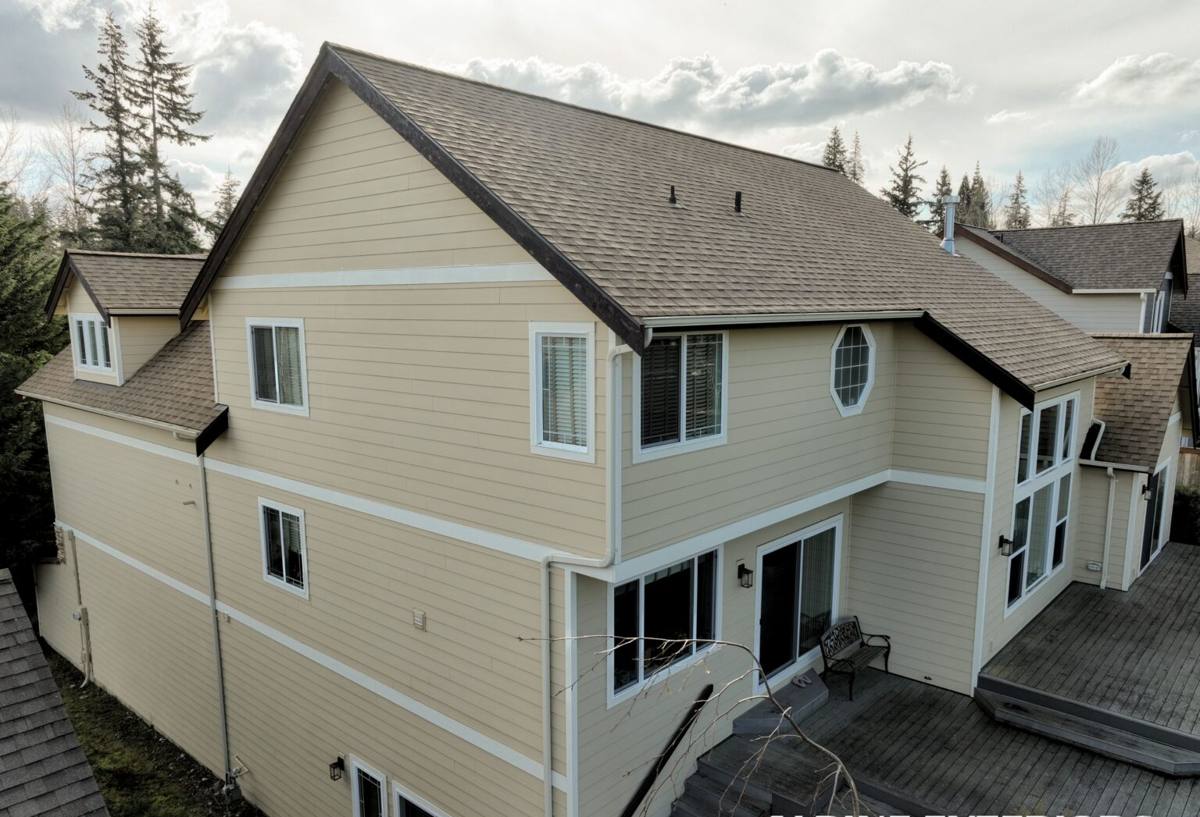
The Warning Signs We Look For First
Most homeowners call us about something they can see: a soft board, a wobbly rail, moss that keeps coming back no matter how often it's cleaned. What actually decides whether a deck needs a patch or a rebuild is usually something they can't see yet, rot at the ledger connection, corroded hardware, or hidden framing damage under the boards. Before we quote anything, we get underneath the deck and check the structure itself, not just walk across the top and look at the decking.
- Spongy or bouncy boards: especially any with dark staining that doesn't dry out between rains
- Gaps at the ledger: where the deck meets the house, including any daylight showing through that seam
- Rust streaks: running down from screws, bolts, or joist hangers
- Loose railings or posts: that flex or wiggle when pushed
- Fast-returning moss or algae: especially on shaded sections of the deck
- Soft or uneven stair stringers
- Staining or daylight on the underside of the deck after a rain
The Hidden Culprit: Ledger Boards and Flashing
Why the Ledger Connection Fails First
The ledger board, the piece that bolts the deck directly to the house, is where most serious deck failures start, and it's almost never visible once the decking is installed. If that connection wasn't flashed correctly when the deck was built, or if the flashing has failed over the years, water works its way behind it every time it rains and never fully dries out, especially on a shaded wall. By the time that shows up as a soft spot in the decking above or staining on the siding below, the rim joist and ledger have often been wet for a long time. This is the single most important thing we check on every repair call, because a deck can look completely fine on top while the connection holding it to the house is quietly failing underneath.
Fastener and Hardware Corrosion
Salt-tinged marine air off the Salish Sea accelerates corrosion on any exposed metal, and a deck has more exposed fasteners and hardware than almost any other part of a house: joist hangers, hold-down hardware, structural screws, railing brackets. Hardware that isn't rated for this kind of sustained moisture and salt exposure loses strength well before it looks obviously rusted from the top. When we open up a deck for repair, mismatched or corroded hardware is one of the most common things we find and replace, even on decks that otherwise look sound.
Moss, Algae, and the Slip Hazard on Sloped Lots
Sehome's tree cover and its rise toward Sehome Hill mean plenty of decks here sit partly or fully in shade for much of the day, and shaded, damp surfaces are exactly where moss and algae take hold fastest. Beyond the cosmetic issue, a mossy deck surface gets genuinely slick when wet, which is most of the year in this climate. Sloped lots add another layer: water runs across a deck surface, off the edge, and down toward the house or foundation differently depending on grade, and a deck that wasn't built with that slope in mind can end up channeling water somewhere it shouldn't. Cleaning the surface helps temporarily, but on a heavily shaded deck, moss usually comes back within weeks unless the underlying moisture and airflow problem gets addressed too.
Repair or Replace? How We Make the Call
Not every deck problem calls for a full rebuild, and not every deck is worth patching. We look at the framing first, since that's what actually determines the honest answer, then talk through the realistic options with the homeowner before anything gets quoted.
| Factor | Repair Usually Makes Sense | Replacement Usually Makes Sense |
|---|---|---|
| Ledger & framing | Solid, dry framing found under damaged boards | Rot or soft wood found at the ledger, joists, or posts |
| Age of structure | Deck is roughly 12-15 years old or newer | Deck is older and multiple systems are failing at once |
| Extent of damage | Isolated boards, rail sections, or fasteners | Damage spread across most of the surface or structure |
| Code compliance | Existing structure already meets current guardrail and spacing standards | Railings, spacing, or footings fall short of current code |
| Budget goals | Homeowner wants to extend the current deck's life a few more years | Homeowner wants a longer-term, lower-maintenance result |
Decking Materials: What Holds Up Here and What Doesn't
When decking boards need to come off anyway, whether for structural repair underneath or because the boards themselves are worn out, it's worth talking through material options rather than automatically replacing like for like. Each option behaves differently in a wet, shaded, occasionally salty climate like Sehome's.
Pressure-Treated Lumber
Pressure-treated lumber is the most common decking material we repair and replace, and it's a reasonable, budget-friendly choice as long as the homeowner understands the maintenance side of it. It needs cleaning and resealing on a regular schedule, more often on shaded sections that stay damp longer, or moisture works into cut ends and fastener holes over time. Skipping that upkeep is the single biggest reason we get called out to repair pressure-treated decks years earlier than they should need it.
Cedar
Cedar has natural resistance to rot and insects and a look plenty of homeowners like, but it's a softer wood that still needs regular finishing to hold up in this climate. Without upkeep, cedar decking greys, splits, and becomes more absorbent over time, which speeds up exactly the moisture problems we're trying to avoid. We're upfront with homeowners that cedar is a higher-maintenance choice here, not a low-maintenance one, despite its reputation.
Capped Composite Decking
Capped composite boards, the kind of product lines from manufacturers like Trex or TimberTech, don't rot, don't need refinishing, and resist moss staining better than wood. They cost more upfront, and the framing underneath still needs to be built and flashed correctly, composite decking doesn't fix a bad ledger connection or rotten joists on its own. For homeowners tired of the maintenance cycle on a shaded Sehome lot, though, it's often worth the higher initial cost.
Our Deck Repair Process
Every repair starts with an honest look at what's actually happening underneath the deck, not a quote based on what's visible from the top.
- Full inspection from underneath, checking the ledger connection, joists, posts, footings, and hardware, not just the decking surface
- Moisture and rot testing at any framing members that look or feel suspect
- A written scope that separates structural repair from cosmetic decking replacement, so the homeowner knows exactly what they're paying for and why
- Repair or replacement of framing, flashing, and hardware first, before any new decking goes down
- Decking, railing, or stair work completed to current code, matched to whichever material the homeowner chooses
- A final walkthrough so the homeowner understands what was fixed, what to expect long-term, and what upkeep, if any, the new work will need
Permits and Code Considerations
Deck repair work that touches structural framing, footings, or guardrails generally needs a permit, even when the project is a repair rather than an all-new deck. Purely cosmetic work, like swapping worn boards for new ones of the same size and layout, often doesn't. Depending on where a property sits, that permit gets pulled either through the City of Bellingham's permit process for in-city neighborhoods like Sehome, or through Whatcom County for homes just outside city limits. Guardrail height and baluster spacing requirements have also tightened over the years, so a deck that was built to code decades ago may not meet current standards. We handle that conversation as part of the estimate rather than leaving homeowners to sort it out on their own after the fact.
Why a Crew That Already Works Sehome Matters
A contractor who works this specific part of Bellingham regularly has already seen how salt air, driving rain, and a long moss season behave on real decks through a full year, not just how a product performs on a spec sheet. That shows up in practical decisions on a Sehome repair: knowing to check the ledger connection first on an older home, recognizing which hardware actually holds up against salt-tinged air instead of just meeting a minimum spec, and understanding how a sloped, shaded lot changes drainage around the deck's footings. A crew that only occasionally works in this climate is more likely to apply generic fixes that don't quite account for what this particular corner of Whatcom County does to a structure over time.
If your Sehome deck has a soft spot, a wobbly rail, moss that won't quit, or you just want an honest opinion on whether it needs a repair or a rebuild, we're happy to take a look. Reach out using the form below for a free, no-pressure estimate, straight talk, no upsell script.