 Sudden Valley Siding
 Why Lake Whatcom Is a Tough Place for Siding
Sudden Valley sits right on the shore of Lake Whatcom, tucked under heavy tree cover on the east side of Whatcom County. That setting is beautiful, but it's also a rough environment for exterior building materials. Homes here deal with three things at once: driving rain that comes in sideways off the lake during fall and winter storms, humid marine-influenced air pushing inland from Bellingham Bay and the greater Puget Sound corridor, and deep shade from the surrounding fir and cedar canopy that keeps siding damp long after a storm has passed. Add in a moss season that can run six months or more in the shaded, north-facing sections of a lot, and you have a combination that punishes anything that isn't dimensionally stable or moisture-tolerant.
Wood-based siding products struggle hardest here because they absorb water at the cut edges and behind moss growth, then swell, crack, and eventually rot from the inside out. Vinyl doesn't rot, but it flexes and gaps over time, and gaps are exactly what moss spores and driving rain need to get behind the cladding. Fiber cement, installed correctly, is one of the few claddings that holds its shape and its paint film through repeated wet-dry cycles without becoming a maintenance project every other year. That's why it's the product we recommend for homes around the lake, and why we're specific about how it goes on — not just that it goes on.
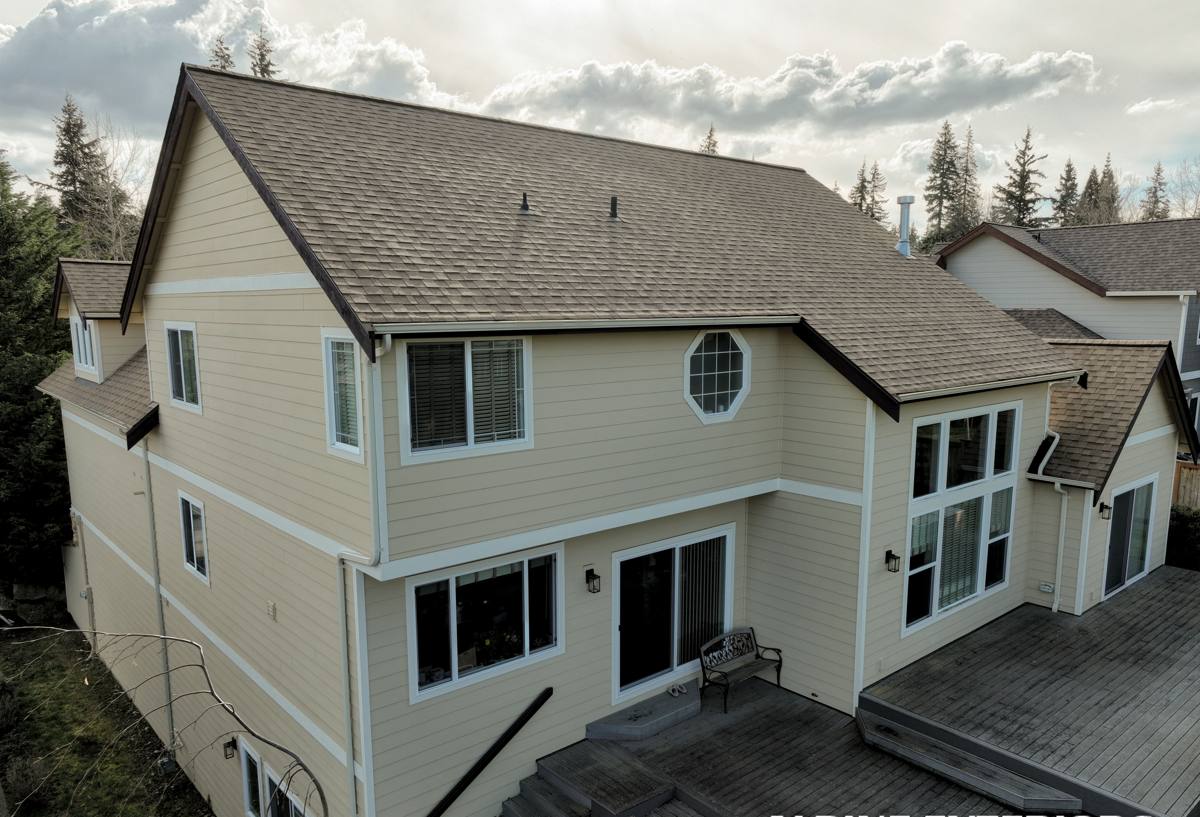
What Lake Whatcom Homes Actually Need From Their Siding
Moisture Management, Not Just Water Resistance
Any siding can shed water on a clear day. What matters in Sudden Valley is what happens after three straight days of rain when the sun doesn't get through the canopy to dry things out. That means the assembly behind the siding — the weather-resistive barrier, the flashing at windows and penetrations, and the drainage gap — has to be doing real work, because the siding face alone won't keep a wall dry in this climate.
Resistance to Moss and Organic Growth
Moss doesn't just sit on top of siding — its root structure holds moisture against the surface and, on softer materials, works into surface texture over time. A dense, factory-cured fiber cement panel with a durable finish gives moss less to grip and makes annual cleaning (a soft wash, not pressure-blasting) actually effective instead of a losing battle.
A Finish That Doesn't Need Repainting Every Few Years
Repainting siding on a home tucked into trees on a lakefront lot is not a fun job — access is often tight, and damp conditions shorten the paint season. A factory-applied finish that's warrantied against peeling and flaking removes that recurring chore for a lot longer than field-applied paint on wood.
Why We Install James Hardie and Nothing Else
We standardized on James Hardie fiber cement for every job we take on, including here in Sudden Valley, and we don't install LP SmartSide, vinyl, Cemplank, Allura, primed spruce, or cedar. That's not a marketing position — it's a decision based on what holds up in exactly the conditions described above. Hardie's fiber cement formulation is non-combustible, dimensionally stable when it gets wet, and backed by a factory finish system (ColorPlus) engineered to resist UV fade and moisture-driven paint failure far longer than field-applied paint. The company also engineers specific product lines for different climate exposures, which matters more here than in a dry inland market.
We're happy to talk through the trade-offs of other products with any homeowner who asks — every siding material has a reasonable case behind it. But we've made our call, and on a lake-shaded, high-moisture lot, we're not willing to put our install crew's name behind a product we don't think will hold up without heavy upkeep from the homeowner.
Choosing the Right Hardie Product Line for This Site
James Hardie makes climate-engineered "HZ" product lines, and which one goes on a given wall depends on sun exposure, elevation, and how close the wall sits to the lake. A south-facing wall that gets more direct sun and dry-out time has different needs than a shaded, moss-prone north wall thirty feet from the water. Part of doing this job right in Sudden Valley is not treating every elevation of the house the same way.
| Wall Condition | Typical Challenge | What We Prioritize |
|---|---|---|
| Lakeside, shaded, low airflow | Slow dry-out, moss growth, humidity | Moisture-tolerant Hardie panel, wider drainage gap, careful caulk joint placement |
| Tree-canopy north walls | Near-constant dampness, organic buildup | Durable ColorPlus finish, minimal horizontal ledges for moss to catch on |
| Open, sun-exposed walls | UV fade, thermal cycling | Factory finish rated for UV stability, correct fastener spacing for expansion/contraction |
| Ground-level / near grade | Splashback, standing moisture | Proper clearance above grade and hardscape, correct flashing at the base |
What a Correct Installation Involves
Fiber cement is only as good as the installation underneath it. Most of the siding failures we get called out to inspect around the lake aren't product failures — they're installation shortcuts that let water in behind a perfectly good panel. On every Sudden Valley job we control for the same things:
- Correct clearance between siding and grade, decks, and roof lines so water can't wick or splash up into the panel
- A weather-resistive barrier installed shingle-style with proper overlaps, not just stapled on flat
- Flashing integrated at every window, door, and penetration — not caulk used as a substitute for flashing
- A drainage gap behind the siding so any moisture that does get past the face has somewhere to go and dry out
- Fastener placement and spacing that matches Hardie's published specifications, not a generic nailing pattern
- Factory-cut and factory-primed edges wherever possible, with any field cuts properly sealed before installation
Skipping any one of these doesn't usually show up as a problem in year one. It shows up in year five or six as a soft spot, a stain, or moss taking hold at a seam — right when a homeowner assumed the siding was maintenance-free.
How Our Process Works on a Sudden Valley Job
1. On-Site Assessment
We walk the full exterior, note sun exposure and shade patterns by elevation, check the current siding and sheathing for hidden moisture damage, and look at drainage around the foundation and any retaining walls or slopes typical of lakefront lots.
2. Product and Line Selection by Elevation
We spec the Hardie product and finish for each wall based on that walkthrough rather than applying one product across the whole house.
3. Tear-Off and Sheathing Check
Old siding comes off and we inspect the sheathing underneath before anything new goes up. Any rot or soft sheathing gets addressed before we move forward — covering a moisture problem with new siding just delays it.
4. Weather Barrier, Flashing, and Drainage Plane
This is the step that actually determines how the wall performs in wet weather, and it's the one step that's invisible once the job is finished — which is exactly why we don't shortcut it.
5. Installation to Manufacturer Spec
Panels go on with correct fastening, joint treatment, and clearances, following Hardie's installation guidelines to keep the transferable warranty intact.
6. Final Walkthrough
We walk the finished job with the homeowner, cover basic care (soft washing, what to watch for near ground contact and under heavy shade), and leave clear documentation of what was installed for warranty purposes.
What Drives the Cost of a Job Like This
Every Lake Whatcom property is a little different, and cost depends more on site conditions than on the siding material itself. Broad factors that move the number:
| Factor | Why It Matters Here |
|---|---|
| Access and lot slope | Many Sudden Valley lots step down toward the water, which affects staging and scaffolding |
| Condition of existing sheathing | Hidden moisture damage found during tear-off adds repair scope before new siding goes on |
| Number of elevations and product lines used | Mixing HZ product lines by wall exposure is more precise but adds planning and material variety |
| Trim, fascia, and detail work | Homes with more window trim, corner boards, and architectural detail take more labor per square foot |
| Tree cover and drying conditions | Shaded lots often need extra care with sequencing to avoid trapping moisture during installation |
We give an honest, itemized estimate after the walkthrough rather than a rough figure over the phone — on a site with this much variation in shade, slope, and prior siding condition, a phone quote isn't a real number.
Signs a Sudden Valley Home Needs Siding Attention Now
- Moss or dark streaking that returns within weeks of being cleaned off
- Soft spots or slight give when you press on siding near the base of the wall
- Paint that's peeling or bubbling rather than just fading
- Visible gaps or warping at panel seams and corner boards
- Persistent damp smell or staining on interior walls that back up to shaded exterior walls
- Siding that was last replaced more than 20-25 years ago and has never been inspected behind the surface
Why Local Experience on This Lake Actually Matters
A crew that's worked Sudden Valley and the broader Lake Whatcom shoreline knows which elevations of a typical lot stay damp longest, how much clearance a given property's drainage and grading actually needs, and what moss pressure looks like on this side of Whatcom County versus a drier inland neighborhood. That's not something you get from a general contractor who does one job on the lake and moves on. It shows up in small decisions — where we widen a drainage gap, which elevation gets a more moisture-tolerant Hardie line, how we sequence work around a wet week — that a crew unfamiliar with this specific microclimate is more likely to miss.
If your home is in Sudden Valley or elsewhere around Lake Whatcom and you're weighing a siding replacement, we're glad to come out, walk the property, and give you a straight answer on what your home needs and what it would cost — no pressure, no upsell to a product we don't stand behind. Use the form below to request a free estimate.