 Sudden Valley Siding
 Edgemoor's Climate Asks More of Your Siding Than Most Places
Homes in Edgemoor sit close enough to the water to catch salt-laden air off Bellingham Bay, and close enough to the mountains to get pounded by sideways rain for months at a stretch. Add Whatcom County's long, damp shoulder seasons — the stretch from October through April when surfaces barely dry out between storms — and you get a climate that's genuinely hard on exterior building materials. Salt air accelerates corrosion of fasteners and metal trim. Driving rain finds every gap in flashing and caulk. And the shade, humidity, and moisture that collect around mature landscaping give moss and algae months of ideal growing conditions on anything that stays damp.
None of that is a reason to panic about your siding. It's a reason to be specific about what you install and how it's installed. Some materials tolerate this environment well. Others need constant upkeep to survive it, and a few fail in ways that aren't obvious until the damage is already inside the wall. This page is about one product, in one place: James Hardie fiber cement siding, installed correctly on Edgemoor homes.
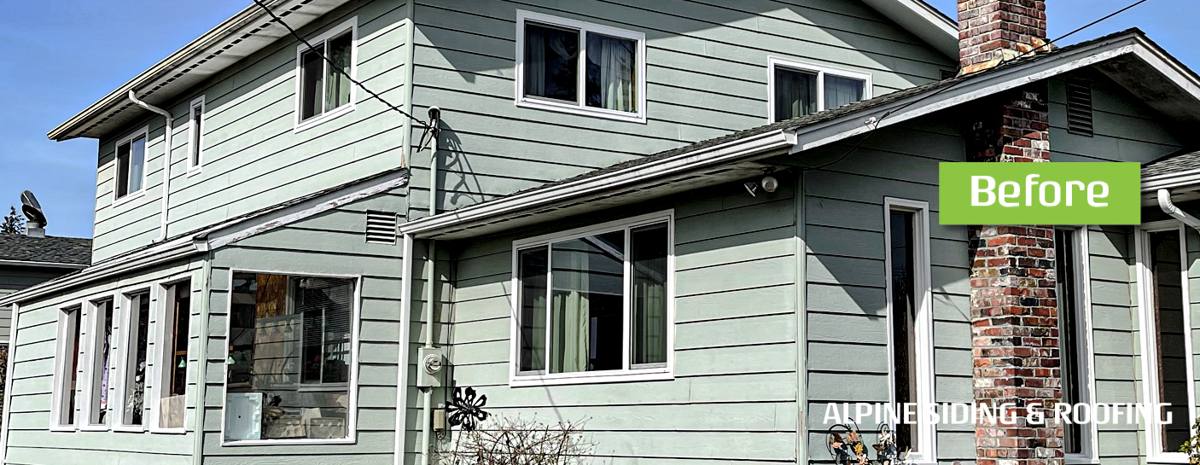
Why We Only Install James Hardie Fiber Cement
We don't install LP SmartSide, vinyl, Cemplank, Allura, primed spruce, or cedar. That's not a marketing line — it's a standard we hold to on every job, and it's worth explaining honestly rather than just asserting it.
What the alternatives get right
Vinyl is inexpensive and low-maintenance in the sense that it never needs paint. Engineered wood products like LP SmartSide are lighter to handle and can look good freshly installed. Cedar has a natural look a lot of homeowners genuinely love, and primed spruce is cheap up front. These aren't bad products in the abstract — they're just not the trade-offs we're willing to put our name behind in this climate.
Why they fall short here specifically
- Vinyl expands and contracts with temperature swings, can crack in impact, and in driving rain relies almost entirely on a water-resistive barrier behind it doing all the work — the siding itself isn't the moisture defense.
- Engineered wood (LP SmartSide) uses wood strand substrate with a resin coating. It holds up reasonably well when installation and caulking are perfect and maintained forever, but any breach that lets moisture reach the substrate can lead to swelling at edges and cut ends, which is a hard failure mode to catch early.
- Cedar and primed spruce are wood. Wood absorbs moisture, and in a climate with this much sustained dampness, that means an ongoing cycle of painting, sealing, and watching for rot — plus cedar is combustible, which matters more every wildfire season.
- Cemplank and Allura are fiber cement competitors to Hardie, and the category itself is sound — but formulation, factory finish quality, and warranty structure vary between manufacturers, and we've standardized on the one we trust most for consistency, colorfastness, and support.
Fiber cement as a category resists moisture, doesn't feed insects, doesn't burn, and holds paint or factory finish far longer than wood. Within that category, James Hardie is the manufacturer whose product engineering, finish warranty, and installation documentation we trust enough to install exclusively.
The HardieZone System: Built for This Exact Climate
James Hardie engineers its siding differently by climate zone, and Whatcom County falls into the HZ5 zone — cooler, wetter regions with more freeze-thaw cycling and sustained moisture exposure. HZ5 products are formulated with that in mind, rather than being a one-size-fits-all board shipped to every region in the country.
On top of the substrate, ColorPlus factory finish is the piece that matters most for a house dealing with salt air and moss growth. It's baked on in a controlled factory environment across multiple coats, which gives it better adhesion and UV resistance than field-applied paint, and it comes with its own finish warranty separate from the product warranty. For a home that's going to spend half the year damp, a finish that doesn't need repainting for a long time and doesn't peel at butt joints is a real, practical advantage — not a cosmetic upsell.
What a Correct Installation Involves
Fiber cement performs the way it's engineered to only when it's installed to spec. In a high-moisture environment like Edgemoor, a few details separate a siding job that lasts decades from one that causes problems in five years:
- Proper clearance between the bottom of the siding and grade, decks, or roofing — Hardie specifies minimum gaps for a reason, and closing that gap traps water against the board.
- Correct water-resistive barrier and flashing integration at every window, door, and penetration, lapped so water sheds outward rather than behind the siding.
- Fastener placement and type matched to substrate and exposure, since the wrong fastener pattern can void warranty coverage and loosen over time in wind-driven rain.
- Factory-cut and factory-primed edges kept intact wherever possible, with any field cuts sealed per manufacturer specification.
- Adequate rainscreen or drainage plane behind the siding so incidental moisture has somewhere to go instead of sitting against the wall assembly.
Skip any of these and you can end up with a product that's rated for this climate failing anyway — not because the material was wrong, but because the installation didn't respect what the material needs.
How Salt Air and Moss Actually Affect a Home's Exterior
It's worth being specific about the two climate factors called out for this page, because they act on a house differently.
Salt air
Airborne salt accelerates corrosion on exposed metal — nail heads, flashing edges, hose bib fittings — and can leave a fine residue on siding surfaces that holds moisture longer than a clean surface would. Fiber cement itself doesn't corrode, but the fasteners and trim details around it need to be chosen and installed with that exposure in mind.
Driving rain
Wind-driven rain doesn't just fall — it pushes sideways and upward under laps and around trim. This is the scenario that exposes bad flashing detail work fastest, because gravity-only water management (assuming rain just runs straight down) isn't enough here.
Moss and algae
Shaded, north-facing, or tree-covered walls stay damp longer, and mossy growth on a wall isn't just cosmetic — sustained moisture retention against a surface eventually finds any weak point in the finish or the joint sealant. Factory finish and correct joint treatment reduce how much a surface holds moisture in the first place.
Material Comparison for This Climate
| Material | Moisture Behavior | Maintenance | Fire Resistance | Typical Lifespan |
|---|---|---|---|---|
| James Hardie fiber cement | Doesn't absorb/swell like wood; engineered for HZ5 wet climates | Low — factory finish, no regular repainting needed | Non-combustible | 30+ years with correct install |
| Vinyl | Doesn't absorb water, but relies on barrier behind it; can warp with heat | Low, but cracks/fades and can't be repainted easily | Melts/deforms under heat | 20-30 years, variable |
| LP SmartSide (engineered wood) | Vulnerable at cuts and breaches if sealing fails | Moderate — caulking and touch-up over time | Combustible | 20-30 years if maintained |
| Cedar / primed spruce | Absorbs moisture; prone to swelling and rot in sustained damp | High — regular painting/sealing | Combustible | 15-25 years with upkeep |
Our Process on an Edgemoor Home
The steps are the same fundamentals on every job, applied with this climate in mind:
- On-site assessment — we look at exposure (waterfront-facing walls vs. sheltered sides), existing moisture damage, current siding condition, and trim/window details before quoting anything.
- Tear-off and substrate check — old siding comes off and we inspect sheathing for hidden rot before covering anything back up, since covering a moisture problem doesn't solve it.
- Weather barrier and flashing — house wrap, flashing, and a drainage plane go in per Hardie's specifications, not shortcuts.
- Hardie installation — siding, trim, and fasteners installed to manufacturer spec, with attention to clearances and joint treatment.
- Final inspection — a walk-through checking clearances, caulking, and finish before we call the job done.
What Drives the Cost
| Factor | Why It Matters |
|---|---|
| Square footage and wall complexity | More corners, gables, and dormers mean more cutting, trim work, and labor time |
| Condition of existing sheathing | Rot repair found during tear-off adds cost but is essential to fix before new siding goes on |
| Siding profile and finish | Lap width, shingle-style panels, and trim board style affect material cost |
| Accessibility and exposure | Waterfront-facing or hard-to-access walls can affect scaffolding and staging needs |
| Existing moisture damage | Sudden Valley and Edgemoor homes with long-neglected siding sometimes need more substrate work than expected |
We give a written estimate after seeing the home in person — broad ranges without an actual look at your walls aren't useful to you or to us.
Why It Matters That We Already Work Edgemoor and Sudden Valley
A crew that's worked this area knows what to expect before they pull the first piece of old siding off the wall — which sides of a house typically take the worst weather, how humid crawlspaces and shaded lots tend to affect sheathing, and how Whatcom County's building department expects moisture barrier and flashing details documented. That familiarity shows up in fewer surprises mid-project and a faster, more accurate estimate up front.
Signs Your Siding Needs Attention
- Visible moss or algae staining that returns quickly after cleaning
- Soft spots, bubbling, or swelling anywhere on the siding surface
- Paint that's peeling or chalking heavily, especially on rain-exposed walls
- Gaps or separation at seams, corners, or trim boards
- Musty smell or visible staining on interior walls that share an exterior wall
Any one of these is worth a closer look before it turns into a sheathing or framing repair.
Living With Hardie Siding After Installation
One advantage of switching to a correctly installed Hardie system is how little ongoing work it asks of you compared to wood. An occasional rinse to clear off pollen, moss spores, or salt residue keeps the ColorPlus finish looking its best, but there's no repainting cycle to plan around, no annual caulk inspection racing the next storm, and no soft spots to worry about after a wet winter — provided the installation was done to spec in the first place. That's the entire point of pairing the right product with the right installation: the home stops asking for attention every season.
If your Edgemoor home's siding is showing its age, or you're planning ahead of a full exterior update, we're happy to take a look and walk you through what a correct James Hardie installation would involve for your specific house. There's no cost and no pressure to move forward — fill out the form below to schedule a free estimate.