 Sudden Valley Siding
 Deck Building in Edgemoor: What the Climate Actually Demands
A deck in Edgemoor doesn't fail the same way a deck in a dry inland climate fails. Around Sudden Valley and the rest of Whatcom County, the problems show up slowly — a joist that stays damp two extra days after every rain, a ledger board that never fully dries out behind the siding, decking boards that hold a green film by late fall. None of that is dramatic on day one. By year five or six, it's the reason a deck that "looked fine" turns out to be soft underfoot.
Three things drive most of the deterioration we see on decks in this area: salt-laden air moving in off the water, long stretches of driving rain rather than short downpours, and a moss season that can run from October through April. Any one of those is manageable. Together, they mean a deck built with generic, one-size-fits-all methods usually needs real repair inside ten years instead of thirty.
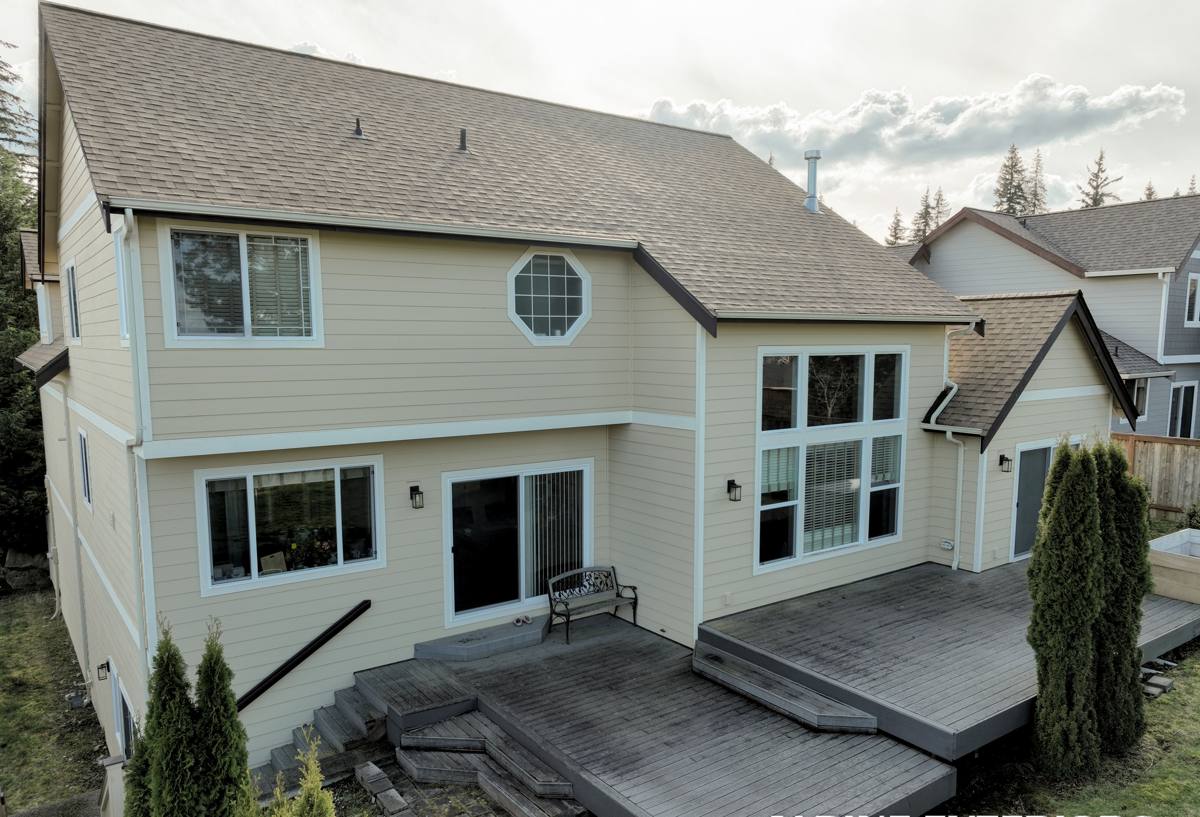
Why Driving Rain Changes How a Deck Should Be Built
Driving rain doesn't just fall on a deck — wind pushes it sideways, up under rail caps, and into any gap that isn't properly sealed or flashed. A deck built for a drier climate often relies on caulk and paint to keep water out of end grain and fastener holes. That approach doesn't hold up here. Water finds the seam eventually, and once it's inside the wood fiber or under a ledger board, it has nowhere to evaporate to before the next storm arrives.
The fix isn't exotic — it's sequencing and materials done in the right order:
- Ledger boards flashed with a proper drip cap and step flashing where the deck meets the house, not just caulked against the siding
- Joist tape or a butyl-based flashing membrane on top of every joist, so screw penetrations don't become entry points for water
- End grain sealed on every cut board, not just the factory-finished faces
- Gaps between deck boards sized for drainage and for the wood's seasonal movement, not tight-fit for looks
- Post bases and hardware rated for wet, corrosive exposure, set above grade so they're never sitting in standing water
Salt Air and Metal Hardware
Homes closer to the water deal with a slower, quieter problem: salt-laden air accelerates corrosion on anything metal. Standard electro-galvanized screws and joist hangers can start showing rust streaks within a couple of seasons in an exposed, wind-facing spot. Once a fastener starts to corrode, it loses holding strength long before it looks obviously bad — which is part of why a deck can seem structurally solid and still have a hidden weak point at every hanger.
We spec hot-dip galvanized or stainless hardware for any Edgemoor deck, and stainless fasteners in wind-exposed or higher-salt locations specifically. It costs more up front than mill-standard hardware. It's not optional in our process, because replacing corroded structural hardware later means partially disassembling the deck to get at it.
Moss, Algae, and the Real Maintenance Season
Moss doesn't damage a deck by itself, but it holds moisture against the board surface for months at a time, and that constant dampness is what accelerates rot, staining, and surface breakdown — especially on wood decking. In Whatcom County, the moss season is long enough that a deck in constant shade can stay damp from fall through spring with barely a dry week in between.
Two things matter more than any cleaning product: sunlight exposure and airflow underneath the deck. A deck built tight to grade with poor ventilation underneath will grow moss faster than one with a few extra inches of clearance and open skirting. We factor this into the design stage, not as an afterthought — board spacing, joist height off grade, and any skirting or under-deck detailing all affect how much moss and algae pressure the deck will see over its life.
Choosing the Right Decking Material for This Climate
There's no single "best" decking material — there's a best fit for how a homeowner wants to use the deck and how much upkeep they're willing to do. Here's how the common options actually compare under Whatcom County's rain and moss pressure:
| Material | Moisture Behavior | Moss/Algae Resistance | Maintenance |
|---|---|---|---|
| Pressure-treated wood | Absorbs and releases moisture; can cup or crack as it cycles wet/dry | Low — needs regular cleaning and re-sealing | Annual cleaning, re-stain/seal every 2-3 years |
| Cedar | Naturally moisture-resistant but still an organic material | Moderate — better than PT but still needs care | Cleaning and oiling every 1-2 years to hold color and resist mildew |
| Composite (capped) | Doesn't absorb water into the core; surface sheds moisture | High — smooth cap resists moss anchoring | Periodic washing; no staining or sealing |
| PVC decking | Fully synthetic, no organic material to hold moisture | Highest — least hospitable surface for growth | Occasional washing; most maintenance-free option |
Wood costs less to install and has a natural look a lot of homeowners still prefer. The trade-off in this climate is honest: wood needs a real maintenance commitment — cleaning, sealing, and watching for soft spots — or it will show its age faster here than it would in a drier region. Capped composite and PVC cost more up front but shift that maintenance burden almost entirely off the homeowner's plate, which is why we see more of them going in on newer builds and full deck replacements.
A Note on Warranty Structure
Composite and PVC manufacturers typically offer longer material warranties than wood ever will, but those warranties are conditioned on correct installation — proper spacing, fastening, and substructure ventilation. We follow manufacturer installation specs to the letter for exactly this reason: a warranty claim gets denied fast if the installation didn't match the spec, regardless of who built it.
What's Underneath Matters More Than What's On Top
Homeowners naturally focus on the decking surface — the boards they'll walk on and see every day. The framing underneath is what actually determines how long the deck lasts, and it's the part that's easiest to build wrong in a wet climate because nobody sees it again once the boards go down.
A correctly built substructure for this area includes:
- Footings sized and set below frost depth per Whatcom County code, on undisturbed or properly compacted soil
- Post bases that keep wood posts off concrete and off grade, so they're never wicking moisture from below
- Joists crowned and installed with proper spacing for the decking material's span rating — composite and PVC often require tighter joist spacing than wood
- Beam and ledger connections engineered for both vertical load and lateral (side-to-side) forces, per current code
- Cross-bracing or blocking where the deck height or design calls for it
Skipping or shortcutting any one of these doesn't show up as a problem right away. It shows up years later as bounce, sway, or a deck that fails an inspection when the house eventually sells.
Our Process for an Edgemoor Deck Build
Every deck we build in this area follows the same sequence, because skipping steps is how the climate-specific problems above end up baked into a "finished" deck:
- Site assessment — grade, drainage path, sun exposure, and how the ledger will tie into the existing house structure
- Design and material selection — sized for the homeowner's actual use, with material trade-offs explained honestly up front
- Permit and engineering — footing and framing plans submitted per Whatcom County requirements before any digging starts
- Footings and substructure — set, inspected, and built out with corrosion-rated hardware throughout
- Ledger flashing and moisture detailing — done before decking goes down, not patched around afterward
- Decking and railing installation — per manufacturer spec if composite or PVC, with proper spacing and fastening
- Final walkthrough — we go over maintenance expectations for the specific material chosen, so there are no surprises
Permits, Guardrails, and Code in Whatcom County
Most deck builds over a certain height or attached to the house require a permit and inspection in Whatcom County — this isn't a formality to skip. Guardrail height, baluster spacing, stair geometry, and footing depth are all code-regulated for good reason: they're the details that matter most in a fall or a structural failure. We pull permits and build to inspected code on every project rather than treating it as optional, because an unpermitted deck can become a real problem at resale or insurance time, on top of the safety issue.
Why a Crew That Already Works This Area Is Worth Choosing
A lot of deck problems in Edgemoor and greater Sudden Valley trace back to a build that would have been perfectly fine somewhere drier — correct lumber, reasonable fasteners, decent workmanship, just not matched to this climate's rain load, salt exposure, or moss pressure. A crew that works this specific area regularly has already seen which details actually matter here versus which ones are just extra cost with no local payoff.
That local pattern recognition shows up in small decisions: how much clearance to leave under the deck for airflow, which hardware grade is worth the upcharge on a given site, where a shaded corner is going to need different detailing than the rest of the deck. None of that comes from a spec sheet — it comes from having built and later serviced decks in this exact climate.
Get a Straightforward Estimate
If you're planning a new deck or replacing one that's showing its age, we're glad to come take a look and walk through the options honestly — what fits your budget, what fits how you'll actually use the space, and what the maintenance commitment really looks like for each material. Use the form below to request a free, no-pressure estimate.