 Sudden Valley Siding
 Why Bellingham Roofs Wear Out Faster Than the Warranty Suggests
Every asphalt shingle carries a manufacturer's warranty rated for "normal" conditions, but there's nothing normal about a roof sitting a few miles from Bellingham Bay under a canopy of Douglas fir. Homes here deal with a combination most shingle lines were never tested against day after day: salt-laden air off the water, wind-driven rain that hits siding and roof edges sideways instead of straight down, and a moss season that can run eight or nine months out of the year in shaded, north-facing sections of a roof. None of these factors alone is unusual for the Pacific Northwest. Together, on a roof that isn't detailed correctly, they shorten the useful life of a shingle roof by years.
This page is about doing asphalt shingle roofing correctly for Bellingham conditions specifically — not the generic version of the job, but the version that accounts for what a Whatcom County winter and a Whatcom County summer actually do to a roof deck, an underlayment layer, and a shingle surface over time.
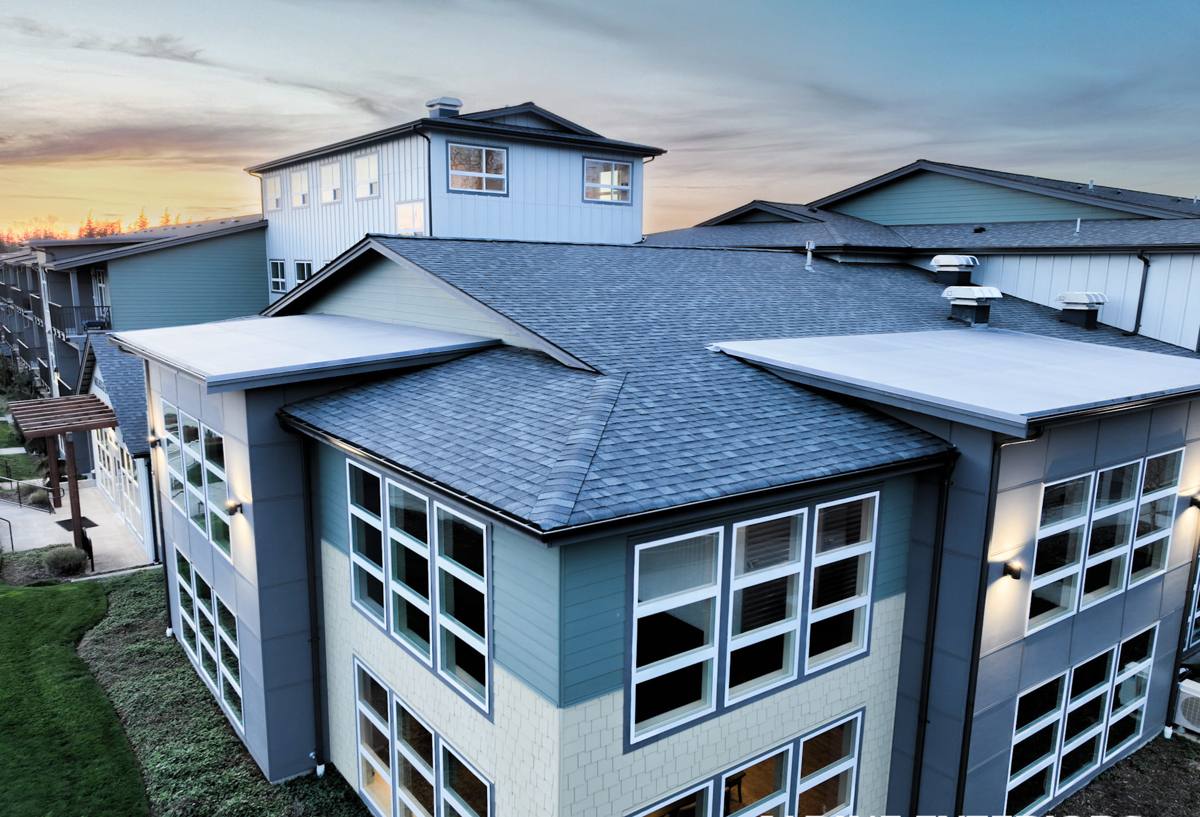
What Bellingham's Climate Actually Does to a Shingle Roof
Salt Air and Coastal Exposure
Bellingham's proximity to saltwater means airborne salt settles on exterior surfaces, including roofing. Salt itself doesn't rot a shingle, but it accelerates corrosion on exposed metal — flashing, nail heads, vent stacks, and gutter hardware. When that metal starts to corrode faster than it should, water finds its way past it long before the shingles themselves are due for replacement. A roof detailed with corrosion-resistant fasteners and flashing holds up; one detailed with whatever was on the truck that day doesn't.
Driving Rain and Wind-Driven Water
Straight-down rain is easy for any roof to shed. Driving rain — the kind that comes in at an angle off Puget Sound storms — tests every seam, lap, and fastener penetration on the roof. It pushes water sideways and upward under shingle edges in ways gravity-only design doesn't anticipate. This is where underlayment choice, shingle nailing pattern, and flashing at valleys, walls, and penetrations either hold or fail. A roof that looks fine in a light rain can still leak in a real Whatcom County storm if those details were rushed.
The Long Moss Season
Shaded roof sections, especially those under overhanging trees or on north-facing slopes, stay damp for most of the fall, winter, and spring. That moisture, combined with organic debris from surrounding trees, is exactly what moss needs to take hold. Moss doesn't just look bad — it holds water against the shingle surface, works its roots under shingle tabs, and lifts them enough for wind and rain to get underneath. A roof that's shedding shingles prematurely in Bellingham has usually got a moss problem that started years before anyone noticed it.
What a Correct Asphalt Shingle Roof Needs Here
A roof built for this climate isn't a different shingle product so much as a different set of installation decisions underneath and around the shingle. The shingle is the visible one-third of the system; the other two-thirds — deck, underlayment, ventilation, and flashing — is what determines whether that shingle actually lasts.
Full Underlayment Coverage, Not Just Code Minimum
Synthetic underlayment across the full roof deck, with self-adhered ice-and-water barrier at eaves, valleys, and around penetrations, gives the roof a second line of defense when wind-driven rain or an ice dam pushes water past the shingle layer. This matters more in Whatcom County than in drier inland climates, where a roof might go years without ever testing that second layer.
Balanced Ventilation
Intake at the eaves and exhaust at the ridge need to be sized to actually move air, not just meet a minimum. Without it, moisture from inside the attic condenses on the underside of the deck through our wet winters, which rots sheathing from below at the same time moss and rain are working on it from above. Ventilation is invisible once the roof is finished, which is exactly why it's the detail most often shortchanged.
Flashing That's Built to Last, Not Just to Pass Inspection
Step flashing at walls, valley metal sized for real water volume, and corrosion-resistant fasteners throughout cost more upfront than the minimum-code alternative. Given the salt air and rain volume here, this is one of the few places where spending a little more at install time avoids a callback — or a rotted wall — a few years down the road.
Starter Strips and Edge Detailing
Proper starter strip along eaves and rakes, with correctly lapped drip edge, keeps wind-driven rain from getting up under the first course of shingles — one of the most common failure points we see on roofs that weren't detailed carefully the first time.
Shingle Options for Bellingham Roofs
Not every asphalt shingle product performs the same way under moss pressure, wind, and constant moisture. Here's how the common categories compare for this specific climate:
| Shingle Type | Moss/Algae Resistance | Wind Rating | Best Fit For |
|---|---|---|---|
| 3-tab (economy) | Standard, no built-in resistance | Lower | Budget-driven projects on well-ventilated, less shaded roofs |
| Architectural / laminate | Standard, unless algae-resistant granules specified | Higher, due to multi-layer construction | Most Bellingham homes — better durability for the cost difference |
| Algae-resistant laminate | Copper- or zinc-infused granules resist algae/moss growth | Same as standard laminate | Shaded lots, north-facing slopes, tree-covered properties |
| Impact-resistant laminate | Standard unless combined with algae-resistant granules | Highest available in asphalt category | Homes prioritizing hail/debris resistance alongside longevity |
Our standard recommendation for most Bellingham properties, especially those with tree cover or shaded exposures, is an algae-resistant laminate shingle. The upcharge over a standard laminate is modest, and it directly addresses the moss and algae pressure that's specific to this region rather than a generic climate assumption.
Our Process for a Bellingham Asphalt Shingle Roof
1. Inspection and Honest Assessment
We start by getting on the roof, not just looking at it from the ground. That means checking the deck for soft spots, evaluating existing flashing and ventilation, and identifying whether moss or algae growth points to a moisture problem beyond what a simple re-shingle will fix.
2. Tear-Off and Deck Inspection
Full tear-off to the deck lets us see what's actually underneath — something you can't get from a layover job. Any soft, rotted, or delaminated sheathing gets replaced before anything new goes down. Skipping this step is the single most common shortcut behind premature roof failures we're asked to fix.
3. Underlayment and Flashing Installation
Synthetic underlayment across the field, ice-and-water barrier at vulnerable areas, new step and valley flashing, and corrosion-resistant fasteners go in before a single shingle is laid.
4. Shingle Installation
Shingles are installed to manufacturer nailing specifications — correct nail count, correct placement, correct exposure — because a shingle that's under-nailed or improperly lapped is a shingle that's going to lift in our windstorms regardless of how good the product itself is.
5. Ventilation Check and Correction
We verify intake and exhaust ventilation is balanced for the attic space, correcting it where the existing setup falls short, so the new roof isn't fighting trapped moisture from day one.
6. Final Walkthrough and Cleanup
Site cleanup includes a magnetic sweep for stray nails and a full walkthrough so you know exactly what was done and why, in plain language.
Keeping Moss and Algae From Coming Back
Even a correctly installed roof needs some ongoing attention in this climate. A short annual routine keeps a good roof good:
- Trim back overhanging branches to reduce shade and debris buildup on the roof surface
- Clear gutters and valleys each fall before the heavy rain season sets in
- Remove moss gently with a soft-bristle approach or approved treatment — never pressure-wash shingles, which strips granules and shortens shingle life
- Install zinc or copper strips near the ridge on shaded sections, which release trace metal ions with rainfall to inhibit new moss growth
- Schedule a visual roof check after major windstorms to catch lifted shingles before rain gets underneath them
Signs Your Bellingham Roof Needs Attention
Most roof failures in this area don't happen suddenly — they build for a season or two before anyone notices water inside the house. Watch for:
- Granules collecting in gutters or at downspout outlets
- Dark streaking or thick moss growth on north-facing or shaded slopes
- Curling, cupping, or cracked shingles, especially on south- and west-facing slopes exposed to sun and wind
- Soft spots underfoot if you're on the roof, or sagging visible from the ground
- Staining on interior ceilings or attic sheathing after heavy rain events
- Daylight visible through the roof deck from inside the attic
Any one of these on its own might just mean a repair. Several together usually mean it's time to talk about full replacement before a repair budget turns into a much larger one.
What Affects the Cost of Asphalt Shingle Roofing in Whatcom County
| Factor | Why It Matters Here |
|---|---|
| Roof size and pitch | Steeper pitches and larger footprints require more material and labor time, and steeper roofs need extra fall-protection setup |
| Deck condition | Rot from long-term moss or leak exposure means sheathing replacement, which adds material and labor beyond a straightforward re-shingle |
| Shingle grade chosen | Algae-resistant and heavier laminate shingles cost more per square than 3-tab but reduce moss-related maintenance and callbacks |
| Flashing and ventilation scope | Full flashing replacement and ventilation upgrades add cost but are the details that determine long-term performance in wind-driven rain |
| Tree cover and access | Shaded, tree-heavy lots common around Lake Whatcom and Sudden Valley can mean extra debris removal and careful staging around landscaping |
| Tear-off vs. layover | A layover is cheaper short-term but hides deck problems and is not something we recommend for this climate |
We don't quote a roof over the phone from a square-footage guess. An honest number comes from getting eyes on the deck, the ventilation, and the flashing conditions first.
Why a Crew That Already Works Bellingham and Sudden Valley Matters
Roofing crews who mostly work drier, inland climates tend to under-spec underlayment, skip algae-resistant shingle options, and treat flashing as a code-minimum item rather than a durability item. None of that shows up as a problem on day one — it shows up two or three wet seasons later, as moss, granule loss, or a leak that traces back to a flashing detail that was never built for this much rain.
Working across Whatcom County, from Bellingham neighborhoods to the wooded, lake-adjacent lots around Sudden Valley, means seeing the same failure patterns repeatedly: moss-driven shingle lift, salt-accelerated flashing corrosion, and ventilation shortfalls that lead to deck rot from the inside out. That pattern recognition is what shapes how we spec every roof we install here — it's not a generic install, it's one built for what this specific region does to a roof over ten, fifteen, twenty years.
Get a Straightforward Estimate
If your Bellingham home's shingle roof is showing granule loss, moss buildup, or you're just planning ahead before the next wet season, we're happy to take a look and give you a clear, no-pressure estimate — what we'd recommend, why, and what it would cost. Use the form below to get started.