 Sudden Valley Siding
 Roofing in Acme: A Different Job Than Roofing Somewhere Dry
Acme sits in the kind of Whatcom County terrain that keeps a roof working overtime. Between the tree cover, the humidity that never fully lets go, and the marine-influenced weather that rolls through this part of Western Washington, a roof here does more physical work over its lifespan than the same shingles would do in a drier climate. Salt-tinged air off the Sound, driving rain that comes in sideways during winter storms, and a moss season that can run most of the year all chip away at a roof's surface, its fasteners, and the wood underneath if the original install wasn't done with those specific stresses in mind.
We work Sudden Valley and the surrounding communities, including Acme, often enough that we've stopped thinking of moss and moisture as edge cases. They're the baseline. That changes how we spec a shingle roof from the first estimate — not because Acme needs anything exotic, but because skipping the details that matter here is exactly how a roof ends up needing real repair five or six years early.
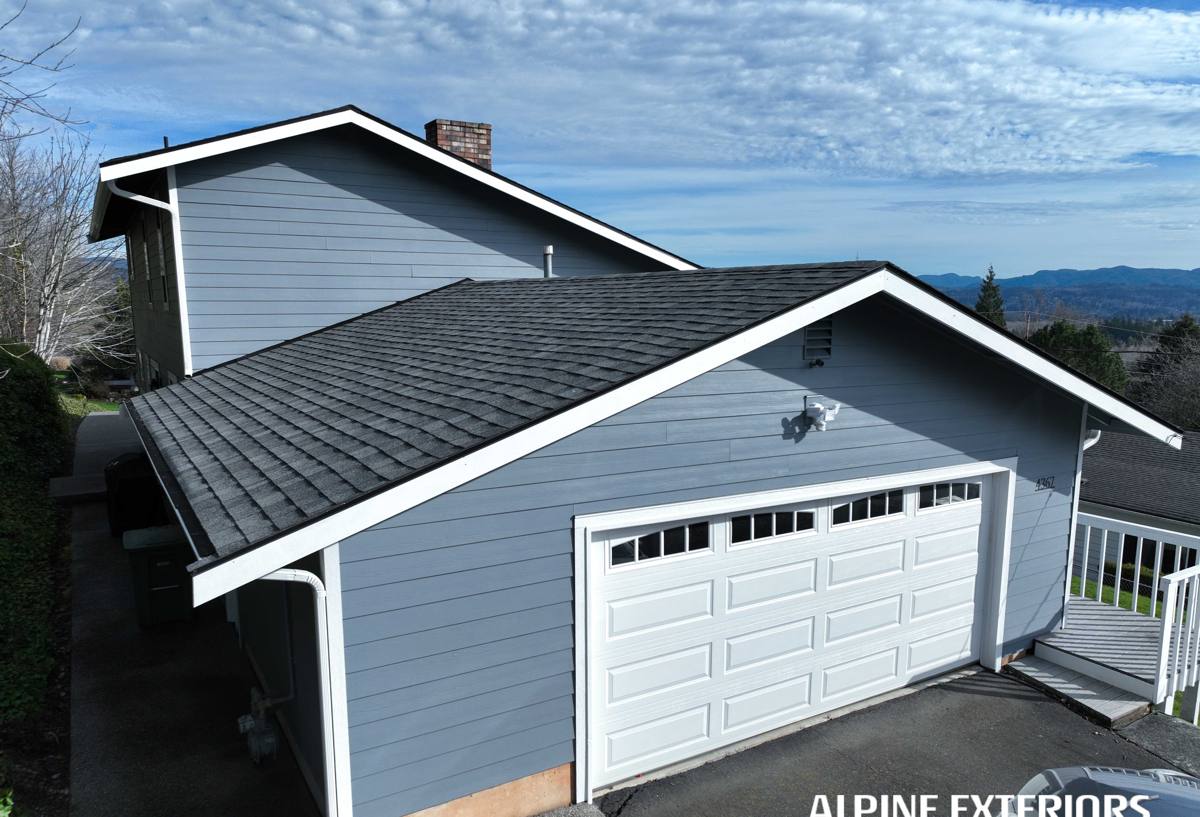
What a Correct Asphalt Shingle Roof Actually Involves
Asphalt shingles are a proven, cost-effective roofing material, but "asphalt shingle roof" covers a wide range of quality depending on what's underneath the shingles and how the details are handled. A correct installation in this climate includes several layers working together, not just the visible shingle course:
- Deck inspection and repair — any soft, delaminated, or water-stained sheathing gets replaced before anything goes back down, not covered up.
- Ice and water shield at vulnerable points — eaves, valleys, and roof-to-wall transitions, where wind-driven rain is most likely to work its way backward under the shingle line.
- Synthetic underlayment across the full deck as a secondary moisture barrier, since shingles alone are a first line of defense, not a seal.
- Proper flashing at chimneys, skylights, sidewalls, and any roof penetration — flashing failure is one of the most common causes of leaks we find on older Acme roofs, far more often than the shingles themselves failing.
- Balanced attic ventilation, intake and exhaust working together, so moisture and heat don't get trapped against the underside of the deck.
- Correct shingle nailing pattern and exposure, matched to the manufacturer's wind rating, not just "close enough."
Any one of these done wrong shortens the roof's life. Most of the premature failures we get called out to inspect trace back to one of these steps being skipped or rushed, not to the shingle brand itself.
Why Ventilation Matters More Here Than People Expect
In a climate this damp, a poorly ventilated attic doesn't just waste energy — it keeps the underside of the roof deck wet longer after every rain event, which is exactly the condition moss, algae, and eventually rot need to take hold. We check ventilation on every Acme roof we work on, because it's often the quiet reason a roof that "should" have another decade left is already showing soft spots.
Our Process, Start to Finish
1. On-Site Inspection
We look at the roof from the ground and, when it's safe and useful, up close: shingle condition, flashing, moss coverage, gutter and drainage function, attic ventilation, and any signs of past leaks inside the attic space itself. This tells us what's actually going on, not just what's visible from the driveway.
2. Honest Recommendation
Sometimes the right answer is a repair — a few damaged shingle courses, a flashing fix, a moss treatment. Sometimes it's a full replacement. We tell you which one it is and why, including what happens if you wait.
3. Written Estimate
Scope, materials, and price in writing before any work starts. No verbal-only agreements.
4. The Work Itself
Deck repair as needed, underlayment and ice-and-water shield, flashing, shingle installation to manufacturer spec, ventilation check, full cleanup including magnetic nail sweep of the yard and driveway.
5. Walkthrough
We walk the finished job with you before we consider it done.
Shingle Options and What Drives the Cost
Most Acme homeowners are choosing between three general tiers of asphalt shingle. None of these is a bad choice — the right one depends on how long you plan to own the home, your budget, and how much wind and moss exposure your specific roof gets.
| Shingle Tier | Typical Lifespan | Best Fit | Trade-offs |
|---|---|---|---|
| 3-Tab / Economy | 15-20 years | Budget-conscious replacements, rental properties | Lower wind rating, less algae resistance, flatter appearance |
| Architectural / Dimensional | 25-30 years | Most Acme homes — the standard we recommend by default | Higher upfront cost than 3-tab, better wind and impact rating |
| Premium / Designer | 30+ years | Homeowners prioritizing longevity and appearance | Highest material cost, longer lead times on some colors |
Beyond the shingle tier itself, the biggest cost drivers on an Acme roof are roof pitch and access (steep or tree-crowded roofs take longer and need more safety setup), how much deck repair is needed once the old roof comes off, and the number of penetrations and valleys, since each one needs individual flashing work. We break all of this out in the written estimate so you can see exactly what you're paying for, not just a lump sum.
Moss, Algae, and Marine Air: The Maintenance Reality
No shingle roof in this part of Whatcom County stays maintenance-free indefinitely. Moss spores travel on wind and settle wherever shade and moisture linger, which describes most tree-lined Acme lots for a good part of the year. Algae streaking is a separate, mostly cosmetic issue caused by airborne organisms rather than moisture damage, but left unchecked it can hide early signs of shingle wear. Salt-influenced air adds a slower, more corrosive factor, working on exposed metal fasteners and flashing over time.
We don't sell moss removal as a one-time fix, because it isn't one. What actually works is a combination of things done right the first time and kept up over the years:
- Zinc or copper strips installed near the ridge, which release trace metals that inhibit moss regrowth with every rain
- Keeping overhanging branches trimmed back so shingles get more sun and airflow
- Gentle, low-pressure moss and debris removal — never high-pressure washing, which can strip granules and shorten shingle life
- Clear gutters and downspouts so water isn't sitting against the roof edge
We'll walk you through a maintenance rhythm that fits your specific lot and tree cover, rather than a generic schedule that doesn't match your property.
Signs Your Acme Roof Needs Attention
A roof rarely fails all at once — it usually gives warning signs first. Worth checking for, or having us check for:
- Granules collecting in gutters or at the base of downspouts
- Shingles that look cupped, curled, or cracked, especially on south- and west-facing slopes
- Visible moss growth thick enough to hold moisture against the shingle surface
- Dark streaking that doesn't wash off with light rain
- Soft spots or sagging when viewed from the ground or attic
- Daylight visible through the roof deck from inside the attic
- Water stains on interior ceilings, particularly near chimneys or valleys
- Missing shingles or exposed nail heads after a windstorm
Any one of these on its own isn't necessarily an emergency, but it's worth a look before the next round of driving rain finds the weak spot for you.
Why a Crew That Already Works Acme Matters
Roofing crews that mostly work drier climates or different terrain don't always plan for what Acme roofs actually deal with — the tree cover, the extended damp season, the way moisture behaves on a shaded north slope versus a sun-exposed one. We work this area regularly enough to know which details actually matter here versus which ones are boilerplate from a manual written for a different climate. That shows up in small decisions: how much ice-and-water shield we use in valleys, where we push back on skipping ventilation upgrades, how we talk you through moss prevention instead of just quoting a one-time cleanup.
It also means we're a known, reachable local crew if something comes up after the job is done — not a name from an out-of-area lead generation site that's hard to track down a year later.
Warranty and Long-Term Care
Shingle manufacturers offer their own material warranties, which vary by product line and tier — we'll walk you through the specific terms for whichever shingle you choose. On top of that, our installation work is backed by our own workmanship warranty, covering the parts of the job that are on us: flashing, sealing, nailing pattern, and general installation quality. If something goes wrong that traces back to how the roof was installed, that's our responsibility to fix, not yours.
Keeping your warranty valid over the long run usually just means basic upkeep — clearing moss and debris, keeping gutters flowing, and having any storm damage looked at promptly rather than left to sit through another wet season.
If your Acme roof is showing its age, or you just want an honest read on how much life it has left, we're happy to come take a look. The estimate is free, there's no pressure attached to it, and you'll get a straight answer either way — use the form below to get started.