 Sudden Valley Siding
 Deck Building in Alger: What the Climate Actually Demands
A deck in Alger doesn't fail the way a deck fails in a dry climate. It doesn't crack from sun exposure or dry out and split first. Around here, decks fail from the bottom up and from the inside out — ledger boards that trap water against the house, joist hangers that corrode years before the wood around them gives out, and decking boards that stay damp long enough for moss and algae to take hold and turn every board into a slip hazard by November. Salt-laden air off the Sound speeds up corrosion on fasteners and hardware. Driving rain finds any gap in flashing and works it wider every winter. And the moss season here isn't a few weeks — it's most of the year, which means a deck that isn't built to shed water and dry out will spend more time wet than dry.
None of that means a deck in Alger has to be high-maintenance or short-lived. It means the build has to account for these conditions from the footings up, not patch around them after the fact. This page covers what that looks like in practice — for a new deck, a replacement, or a rebuild.
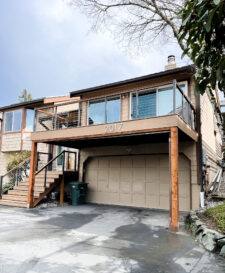
What a Correctly Built Deck Needs Here
Footings and Framing
Frost depth and drainage both matter for footings in this region. Footings that sit in standing water or poorly draining soil will heave or settle unevenly over a few wet seasons, which is what causes a deck to start feeling "bouncy" or develop gaps that weren't there when it was built. We size and place footings based on the actual soil and drainage conditions on your lot, not a one-size-fits-all spec.
Ledger Attachment and Flashing
The ledger board — where the deck attaches to the house — is the single most common failure point on decks in wet climates, and it's the one homeowners can't see once the decking is down. Flashing has to be layered correctly (housewrap, flashing, then siding or trim lapped over it) so water is directed away from the house framing, not trapped behind the ledger where it will rot the rim joist without any visible sign until the damage is significant.
Fasteners and Hardware
Salt air corrodes hardware faster than most homeowners expect, especially anything closer to open water or exposed to wind off the water. Structural connectors, joist hangers, and fasteners need to be rated for both the treated lumber they're going into (standard treated lumber chemicals corrode standard galvanized steel over time) and the coastal air. Mismatched hardware is a slow, invisible failure — it looks fine for a few years, then doesn't.
Decking Gaps and Airflow
Proper gapping between boards and clearance underneath the deck lets air move and water drain instead of sitting. A deck built tight to the ground, or with boards installed too close together, holds moisture longer, which is exactly what accelerates moss growth and wood decay in a climate that's already damp most of the year.
Choosing a Decking Material for This Climate
There isn't one "best" decking material for Alger — there's a set of honest trade-offs. We'll walk through what fits your budget, your maintenance appetite, and how the space gets used.
| Material | Moisture Behavior | Maintenance | Typical Lifespan Here |
|---|---|---|---|
| Pressure-treated lumber | Resists rot when properly sealed; absorbs water if finish is neglected | Needs re-sealing every 1-2 years in this climate | 15-20+ years with upkeep |
| Cedar | Naturally rot- and insect-resistant; still needs a finish to fight graying and moss | Regular cleaning and periodic re-staining | 15-20 years with care |
| Composite decking | Doesn't rot or absorb water like wood; can still grow surface moss/algae if shaded and damp | Periodic cleaning; no staining or sealing | 25-30+ years, manufacturer-dependent |
| PVC decking | Fully moisture-resistant, doesn't support rot | Lowest maintenance; occasional cleaning | 25-30+ years, manufacturer-dependent |
Composite and PVC cost more upfront than treated lumber but remove most of the seasonal maintenance burden that a wet, mossy climate creates. Cedar is a reasonable middle ground for homeowners who want a natural look and don't mind the upkeep. We'll give you our honest read on which fits your situation rather than pushing whatever has the best margin — that's a professional standard we hold to regardless of what's trending.
Our Deck Building Process
- Site visit and design: We look at drainage, sun/shade exposure, how the deck ties into the house, and how you actually plan to use the space.
- Material and layout decisions: We walk through the trade-offs above so you're choosing based on real information, not guesswork.
- Permitting: Deck permits and inspections are handled as part of the project, not left for the homeowner to sort out.
- Footings and framing: Built to the load and drainage requirements of your specific lot.
- Ledger flashing and structural connections: This is where we spend extra care, since it's the part that causes problems years down the road if rushed.
- Decking, railing, and stairs: Installed with correct gapping, code-compliant railing height and baluster spacing, and stair geometry that meets current code.
- Final walkthrough and cleanup: You should be able to use the deck immediately, without a punch list of loose ends.
Living With a Deck in a Wet, Mossy Climate
Even a well-built deck needs some seasonal attention here — the difference is that a well-built deck needs maintenance, not repair. Here's a practical checklist for keeping a deck in Alger performing the way it should:
- Sweep debris off the deck regularly — wet leaves and needles trap moisture against the boards and are a primary cause of moss and staining
- Check and clear gaps between boards each fall so water and debris don't build up before the wet season
- Inspect railing posts and stair stringers annually for movement, since these take the most structural stress
- Look at the ledger flashing line where the deck meets the house once a year — early signs of water intrusion are much cheaper to fix than deferred ones
- Clean moss and algae off walking surfaces before it builds up; wet moss on decking is a genuine slip hazard, not just a cosmetic issue
- Re-seal or re-stain wood decking on the schedule appropriate to that material — don't wait until it's visibly gray and dry
Cost Factors for a Deck Project in Alger
Every deck is priced on its own specifics, but the factors that move the number are consistent. We'll give you a clear, itemized estimate before any work starts — no surprises added mid-project.
| Factor | Why It Affects Cost |
|---|---|
| Size and shape | More square footage and complex shapes (angles, multiple levels) increase material and labor |
| Decking material | Treated lumber, cedar, composite, and PVC all sit at different price points, as reflected above |
| Height and stairs | A raised deck with stairs and additional railing needs more framing, hardware, and code-required guarding |
| Site access and existing conditions | Sloped lots, poor drainage, or removing an old deck all add time before the new build even starts |
| Railing and finish details | Cable rail, glass panels, or custom railing styles cost more than standard baluster railing |
| Permit requirements | Permit fees and any required inspections are part of the project cost, not an extra surprise later |
Why Local Experience Matters for a Deck Build
A deck design that works fine in a dry inland climate can be the wrong call here. A crew that hasn't dealt with this region's rain, salt air, and moss season firsthand is more likely to default to generic specs — standard hardware instead of corrosion-resistant connectors, minimal flashing details, or decking gaps sized for a drier environment. Those shortcuts don't show up as problems on install day; they show up two, five, or ten winters later.
We build decks throughout the Whatcom County area and understand how this region's weather actually behaves over the life of a deck, not just on the day it's finished. That matters for material selection, for how we detail the ledger and flashing, and for what we tell you to expect in year five versus year one. It also means when you call us after the build is done — with a question about maintenance, a warranty item, or an addition down the road — you're talking to the people who actually built it, not a call center.
What to Expect From an Estimate
An honest deck estimate should walk you through the specific conditions on your property, the material trade-offs that actually apply to your situation, and a real cost breakdown — not a generic per-square-foot number that changes once the crew shows up. We'll look at your lot, talk through what you want out of the space, and give you a straight answer on what it will take to build a deck that holds up to Alger's weather rather than fighting it every wet season.
If you're planning a new deck, replacing an old one, or just want an honest read on whether an existing deck is holding up the way it should, reach out for a free, no-pressure estimate using the form below.