 Sudden Valley Siding
 Ferndale's Weather Is Hard on Windows — Here's Why
Ferndale sits close enough to the water that homes here take on a mix of problems you don't see much further inland. There's salt in the air off the bay, there's rain that comes in sideways during a fall or winter blow, and there's a long stretch of the year — call it moss season — where surfaces stay damp for days at a time. None of that is dramatic on its own, but windows sit right at the seam between a house and all of it, and seams are where problems start.
A window is really a hole in the wall with a manufactured unit sealed into it. Every material at that seam — the frame, the sealant, the flashing behind the trim, the fasteners holding it in place — is being asked to hold up against moisture cycling in and out, day after day, year after year. In Whatcom County that cycling doesn't let up much. Salt air accelerates corrosion on metal components. Driving rain finds any gap in the flashing or caulking and pushes water sideways into the wall cavity instead of letting it run down and off. And moss, moisture, and low winter sun keep siding and trim around windows damp longer than they'd stay in a drier climate, which is exactly the condition wood rot and sealant failure need to take hold.
None of this means every window in Ferndale is doomed. It means the installation has to account for these conditions from the start, not just get a new unit in the opening and caulk around the edges.
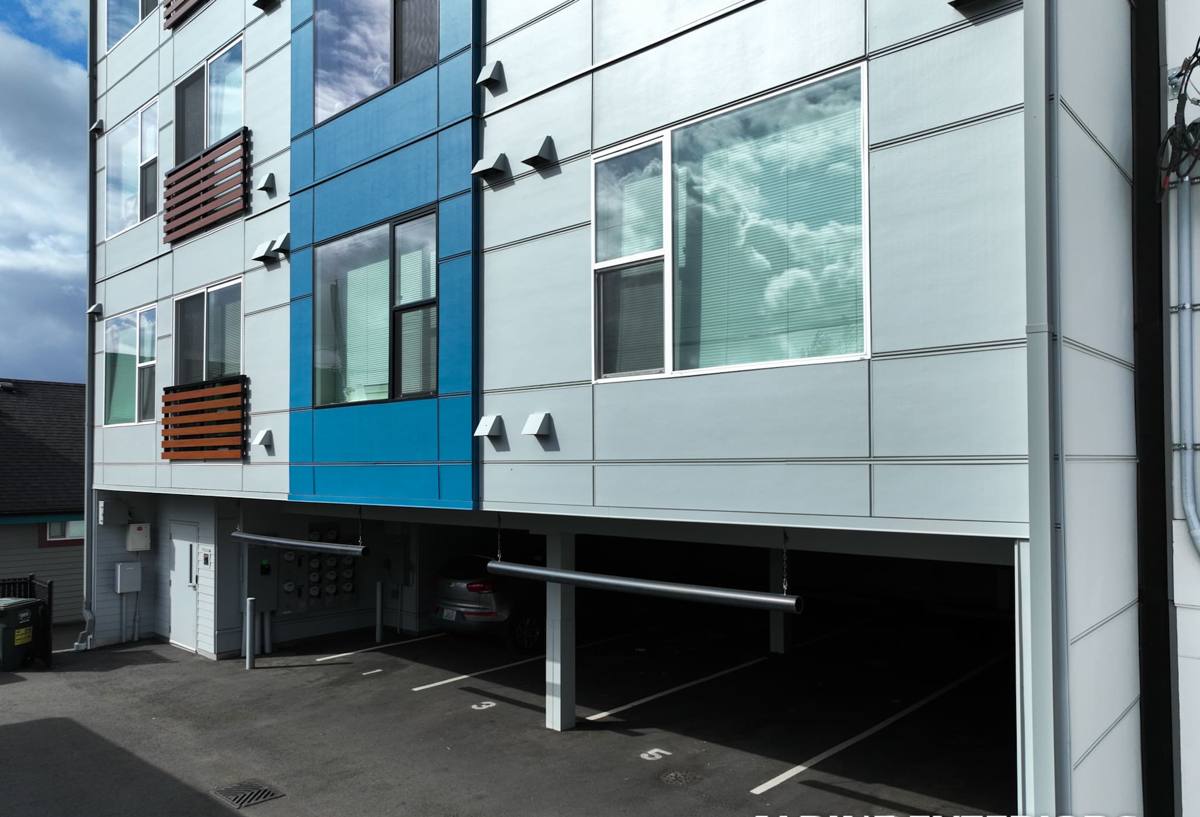
Signs It's Time to Replace, Not Repair
Not every window problem calls for full replacement. Sometimes a failed seal, worn weatherstripping, or a sticking sash can be fixed. But there's a point where repair is just delaying an inevitable, more expensive job — and in a wet climate, that point tends to arrive sooner than homeowners expect. Some signs worth taking seriously:
- Fogging or a visible haze between panes — the seal on the insulated glass unit has failed and the gas fill is gone
- Soft or spongy wood at the sill, jamb, or the trim around the window
- Visible daylight or a draft you can feel at the frame edge even with the window latched
- Paint that keeps bubbling or peeling in the same spot no matter how many times it's touched up
- Windows that are difficult to open, close, or lock — often a sign the frame has swelled, warped, or shifted
- A noticeable jump in heating costs with no other explanation
- Condensation forming on the inside of the glass regularly, even in normal weather
If you're seeing rot at the sill or jamb, that's usually the clearest signal. Once water has gotten past the glass unit and into the framing around it, patching the surface doesn't solve the underlying leak path — it just hides it for a while.
What a Correct Window Replacement Job Involves
Full-Frame vs. Pocket (Insert) Replacement
There are two basic approaches. A pocket or insert replacement drops a new window into the existing frame, leaving the old frame, sill, and exterior trim in place. It's faster and less invasive, and it can be the right call when the existing frame is solid, square, and free of rot. A full-frame replacement removes the window down to the rough opening — old frame, sill, and often the surrounding trim — and rebuilds from there.
In a climate like this one, the decision usually comes down to what we find once the old window is out or the trim is pulled back. If there's any sign of water having gotten behind the original installation — soft framing, staining, a musty smell — a pocket replacement just seals that problem back up behind a new window. Full-frame replacement is the only way to actually inspect and correct it. We don't recommend insert replacement over a compromised frame; it looks fine for a year or two and then the same failure resurfaces, now hidden behind new glass.
Flashing, Sill Pans, and Water Management
The window itself is rarely where a leak starts. It's almost always the flashing and sealant detail around it. A correct installation includes a sloped sill pan under the window so any water that does get past the glass or frame drains back outside instead of sitting on the wood sill. It includes properly lapped flashing tape integrated with the house's weather-resistive barrier — installed shingle-style, so water always sheds downward and outward, never into a seam. And it includes the right sealant at the right joints, not caulk smeared everywhere as a catch-all.
This is the part of the job that doesn't show once the trim goes back on, which is also why it's the part that gets skipped on rushed installs. Given how much driving rain Whatcom County sees in the fall and winter, it's not a detail we treat as optional.
Choosing the Right Frame Material for This Climate
Frame material affects how a window holds up to salt air, moisture, and temperature swings over the long run. There's no single right answer for every home — budget, the home's style, and how exposed the window is to weather all factor in — but here's how the common options compare for a coastal Whatcom County property.
| Frame Material | Moisture & Salt Air Resistance | Maintenance | Typical Cost |
|---|---|---|---|
| Vinyl | Good — won't corrode or rot, handles damp conditions well | Low — no painting, occasional cleaning | Lower |
| Fiberglass | Very good — dimensionally stable, resists warping and doesn't corrode | Low | Mid to higher |
| Wood-clad | Good on the exterior clad side; interior wood needs to stay dry and sealed | Moderate — exterior cladding is low-maintenance, interior may need occasional attention | Higher |
| Aluminum | Weaker in this environment — susceptible to corrosion and pitting from salt air over time, and conducts cold | Moderate to higher | Mid |
Aluminum frames are common in some window lines because they're strong and slim-profile, but bare or lightly coated aluminum doesn't hold up as well this close to salt air, and it transfers cold straight through, which shows up as condensation on the interior frame in winter. That's a maintenance and comfort trade-off worth knowing about before you buy, not a defect claim against any particular manufacturer — it's just how that metal behaves in this environment. We'll walk through what's actually a good fit for your home and budget rather than pushing one material across the board.
Our Process, Start to Finish
- On-site assessment. We look at the existing windows, check for rot or water damage at the sills and framing, and talk through what you actually need — full-frame or insert, which rooms, what's driving the decision.
- Honest recommendation. We tell you what we'd do if it were our own house, including where a repair or insert replacement is genuinely enough and a full-frame job isn't necessary.
- Written estimate. Clear pricing, clear scope, no vague allowances that turn into surprise costs later.
- Removal and inspection. Once the old window is out, we check the rough opening and framing before anything new goes in. If we find hidden rot, we tell you before proceeding, not after.
- Installation. Sill pan, flashing integrated with the existing weather barrier, correct shimming and fastening, proper sealant at the right joints.
- Interior and exterior finish work. Trim, caulking, and touch-up so the finished window looks right from both sides.
- Walkthrough and cleanup. We test operation, check for drafts, and clean up the job site before we call it done.
Why a Siding Crew Handles Your Windows Differently
Windows don't exist in isolation — they're cut into the siding and water-resistive barrier that covers the whole house, and the flashing around a window has to tie into that larger system correctly or it doesn't work. A crew that only ever installs windows, and never touches the siding around them, is working on one piece of a system it doesn't fully see. As a siding contractor, we deal with that whole envelope every day: how water actually moves down a wall, where it collects, and where past installations in this area have failed.
That matters most on older homes where the siding and trim around a window opening may already be compromised, or where a window replacement is happening alongside a siding project. Coordinating both means the flashing gets integrated once, correctly, instead of getting cut into twice by two different crews who never talk to each other.
What Affects the Cost
Window replacement pricing varies by home and by job, but the main cost drivers are consistent. We give a firm number after the on-site assessment — not a phone estimate — but here's what tends to move the price up or down.
| Factor | Why It Matters |
|---|---|
| Full-frame vs. insert replacement | Full-frame involves more labor, materials, and often trim or minor siding repair around the opening |
| Frame material | Vinyl is typically the most budget-friendly; fiberglass and wood-clad cost more up front |
| Window size and configuration | Large picture windows, bays, or custom shapes cost more than standard double-hung sizes |
| Hidden rot or damage | Framing repair discovered during removal adds cost, but skipping it just delays the same repair |
| Number of windows | Doing several at once typically lowers the per-window cost versus one-off replacements |
| Glass package | Double- vs. triple-pane, low-E coatings, and gas fills affect price and performance |
Working With a Crew That Already Knows Ferndale
There's a real advantage to hiring a crew that already works in this area regularly rather than one that's driving in from somewhere else for a one-off job. We know what tends to fail first on the housing stock common around Ferndale and the broader Whatcom County area — where moisture problems typically show up, how badly driving rain can drive water sideways during a fall storm, and what it takes to get an install to hold up through a full moss season without callbacks. We also plan around the weather instead of fighting it — there's a right and wrong window to have an opening exposed to the elements, and a local crew knows how to read that.
Being local also means we're still around after the job is done. If a question comes up six months or two years later, you're calling a crew that's actually nearby and knows your house, not chasing down a company that only showed up once.
If your windows are drafty, fogged, or showing signs of rot around the frame, we're happy to come take a look. The estimate is free, there's no pressure, and you'll get a straight answer about whether you need a full replacement, an insert job, or just a repair.