 Sudden Valley Siding
 Cordata's Climate Puts Real Demands on Siding
Cordata sits far enough from the water and high enough in elevation to feel a little sheltered compared to some Whatcom County neighborhoods, but it still gets the full package of what makes siding fail early here: salt-tinged air drifting off Bellingham Bay, long stretches of driving rain that comes in sideways more often than straight down, and a moss and algae season that can run eight months or longer in shaded, north-facing yards. None of that is dramatic on its own. It's the accumulation, year after year, that separates siding that lasts three decades from siding that needs attention by year eight.
Homes in this neighborhood range from older ranch-style houses with original wood or aging vinyl to newer builds put up during the last couple of building booms. What they have in common is exposure to the same weather pattern: moisture that doesn't evaporate quickly because the air stays humid, and organic growth that thrives wherever siding stays damp for more than a day or two. A siding installation here isn't just about appearance — it's about managing water and biological growth for the next 30-plus years.
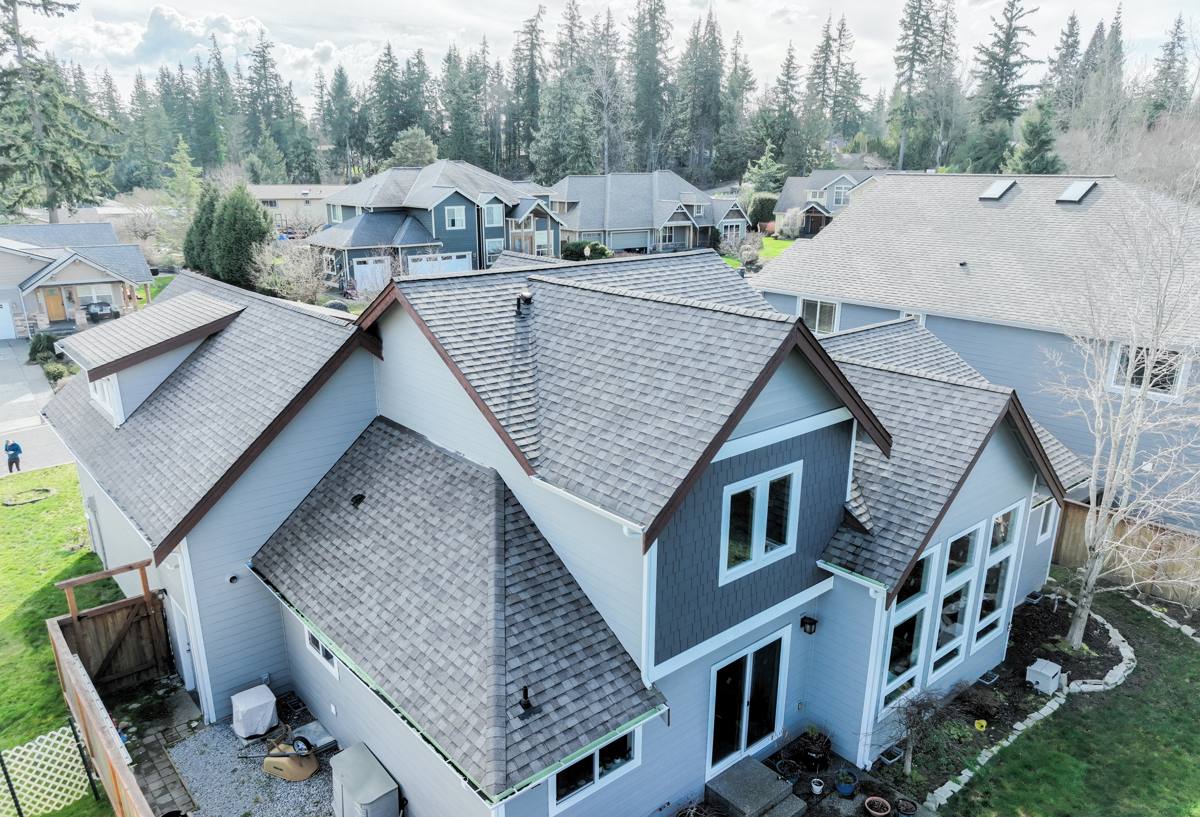
What Correct Siding Installation Actually Involves
Siding installation gets treated like a cosmetic job more often than it should. The panels themselves are only part of the system. What's underneath and behind them determines whether the house stays dry and whether the siding itself holds up.
Weather-Resistive Barrier and Flashing
Before a single piece of siding goes up, the sheathing needs a continuous weather-resistive barrier, properly lapped so water sheds downward and outward rather than working its way behind the barrier. Every window, door, and penetration needs flashing installed in the correct sequence — under the barrier on top, over it on the sides and bottom — so water is always directed away from the wall assembly. In a climate that gets driving rain, a flashing detail done out of sequence is where rot starts, usually invisibly, for years before it shows up as a soft spot or a stain.
Fastening, Clearances, and Caulking
Fiber cement siding has specific fastening requirements — nail placement, spacing, and penetration depth all affect how the panels perform over time. Clearances matter just as much: siding that's installed too close to grade, a roofline, a deck, or a walkway will wick moisture and hold it against the bottom edge, which is exactly where you'll see the earliest signs of trouble. Caulking has its place at trim and penetrations, but it's not a substitute for proper flashing — caulk fails years before a correctly flashed detail does, and re-caulking a house every couple of years is a maintenance burden nobody should have to sign up for.
Why We Install Only James Hardie Fiber Cement
We made a decision early on to stop installing vinyl siding, LP SmartSide, and other engineered wood products, and to focus exclusively on James Hardie fiber cement. That's not a marketing angle — it's a standard based on what actually holds up in this part of Washington.
Vinyl expands and contracts with temperature swings, can warp or crack in wind-driven rain events, and offers no real fire resistance. Engineered wood products depend heavily on unbroken factory sealing and perfect field caulking to keep moisture out of their wood-fiber core; once that seal is compromised at a cut edge or fastener hole, moisture intrusion can progress before it's visible from the outside. Fiber cement doesn't have that vulnerability. It's non-combustible, it doesn't support the kind of moisture-driven swelling that engineered wood products can experience, and it holds paint and factory finish far longer than either alternative. In a climate with this much sustained moisture and organic growth, that difference compounds over decades, not months.
Matching the Product to This Climate
James Hardie builds its fiber cement lines to different regional specifications, and for Whatcom County — mild but consistently wet, without the deep freeze-thaw cycles you'd see further inland or at higher elevation — the HZ5 formulation is the correct match. It's engineered for moisture resistance and moderate climate exposure rather than extreme freeze conditions, which fits Cordata's actual weather profile instead of over- or under-building for it.
We also install almost exclusively with ColorPlus factory finish rather than field-applied paint. ColorPlus is baked on at the factory in multiple coats and backed by its own finish warranty, which matters in a place where a fresh paint job can start showing dirt streaks and moss shadowing within a couple of seasons. Factory finish sheds that grime differently and holds color longer under the same rain and shade conditions.
Our Installation Process
The steps don't change much from job to job, but the details we pay attention to are specific to this climate:
- Assessment and tear-off. We remove the existing siding and inspect the sheathing underneath for rot, soft spots, or prior water damage — common on older Cordata homes where flashing details were missed the first time around.
- Sheathing repair. Any compromised sheathing gets replaced before anything else happens. Installing new siding over damaged sheathing just hides a problem that keeps getting worse.
- Weather-resistive barrier and flashing. Installed continuously, lapped correctly, with proper flashing at every window, door, and penetration.
- Panel installation. Hardie panels, lap siding, or shingle-style siding installed to manufacturer fastening specs, with correct clearances at grade, rooflines, and decks.
- Trim, caulking, and touch-up. Trim work finished, caulk applied only where it belongs, and any factory-finish touch-up done with matched ColorPlus product.
- Final walkthrough and cleanup. Jobsite cleared, and we walk the exterior with the homeowner before calling it done.
What Affects the Cost of a Cordata Siding Installation
Every home is different, but the same handful of factors drive most of the cost variation we see on jobs in this neighborhood:
| Factor | Why It Matters | Typical Impact |
|---|---|---|
| Existing siding removal | Multiple layers or old asbestos-era siding take longer and may need special handling | Moderate to significant |
| Sheathing condition | Rot found during tear-off has to be repaired before new siding goes on | Variable, sometimes significant |
| Home size and complexity | Dormers, multiple stories, and cut-up rooflines add labor time | Moderate |
| Siding profile chosen | Lap, shingle-style, and panel siding have different material and labor costs | Minor to moderate |
| Trim and accessory work | Corner boards, trim boards, and soffit work add scope beyond the field siding | Minor to moderate |
We walk every home in person before giving a number — there's no accurate way to price this kind of work without seeing the actual condition of the walls underneath the current siding.
Why Hiring a Crew That Already Works in Cordata Matters
A crew that installs siding across Whatcom County regularly knows what to expect before they even pull the first piece of old siding off a Cordata house: where moisture damage tends to concentrate on homes of a certain age, how much clearance to leave given how wet this ground stays through winter, and which details tend to have been shortcut on older installs in this area. That's not something you get from a crew that mostly works a drier climate and treats every job the same way.
Permitting and inspection expectations are also consistent when a contractor already works this area regularly — there's no learning curve on local requirements, and no guessing about what an inspector here is going to want to see at flashing details or fastening schedules.
Keeping Your New Siding Performing After Installation
Correct installation does most of the work, but a little homeowner attention afterward keeps things performing the way they should for the full life of the product:
- Keep gutters clean so water isn't overflowing and running down the siding face
- Trim back vegetation and tree cover that keeps siding shaded and damp longer than it needs to be
- Rinse moss and algae growth off with a garden hose rather than a pressure washer, which can force water behind panels and joints
- Watch for any caulk failure at trim joints and have it addressed before water gets behind the surface
- Keep an eye on anything installed too close to grade after landscaping changes — soil and mulch built up over time can reduce clearance that was correct when installed
None of that is heavy maintenance. It's the kind of upkeep that, combined with a correctly installed fiber cement system, is the difference between siding that still looks right at year 25 and siding that needed premature attention.
If your Cordata home needs new siding, or you're not sure whether what's on the walls now is doing its job, we'll come take a look and give you a straightforward, no-pressure estimate — free, with no obligation attached. Use the form below to get started.