 Sudden Valley Siding
 Why Decks in Sehome Wear Out Faster Than You'd Expect
If you own a home near Sehome and Sudden Valley, you already know the weather here isn't gentle on outdoor structures. Whatcom County sits in a corridor where marine air off the Salish Sea, driving rain off the water, and a long, wet moss season combine to attack a deck from every angle at once — not just the top surface, but the framing underneath, the fasteners holding it together, and the ledger board where it meets the house. A deck that would last two decades in a drier inland climate can start showing structural trouble in half that time here if it wasn't built or replaced with this environment in mind.
Salt-laden air accelerates corrosion on fasteners, brackets, and hardware that aren't rated for it. Driving rain doesn't just fall straight down — wind pushes it sideways into board gaps, under flashing, and against the house band board, so water finds its way into places a dry-climate deck design never has to account for. And the moss season, which in this part of Washington can run from early fall through late spring, keeps every horizontal surface damp for months at a time, feeding rot in wood that isn't properly sealed or ventilated underneath.
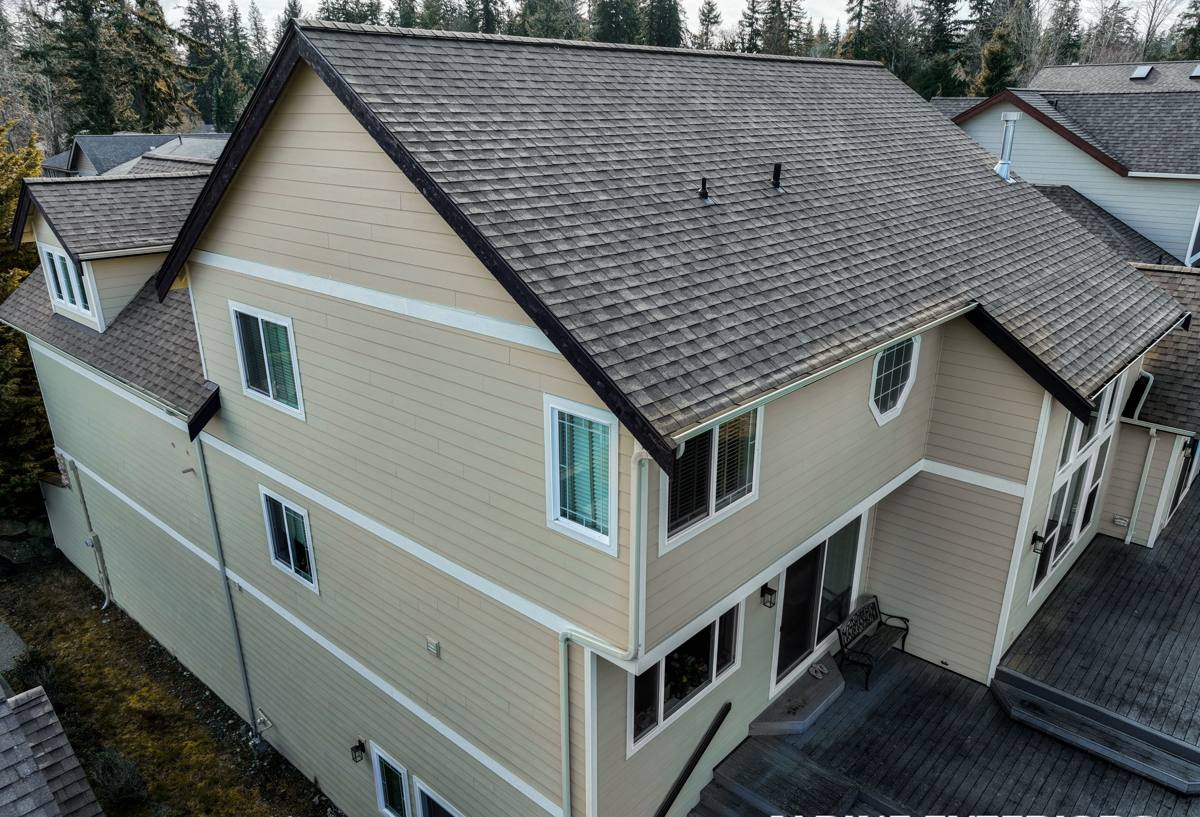
Signs Your Deck Needs Replacement, Not Just Repair
Not every tired-looking deck needs a full teardown. But there's a point where patching boards is just delaying a bigger problem — and often costing more over time than doing the job right once. Here's what tells us a deck has crossed that line:
- Soft, spongy, or springy spots underfoot, especially near the house or stair landings
- Visible rot or dark staining at the ledger board where the deck attaches to the home
- Rust streaking from screws or nail heads, or fasteners that back out on their own
- Posts or footings that have shifted, settled, or show cracking at grade level
- Persistent moss or algae growth that keeps coming back no matter how often it's cleaned
- Railings that flex or feel less rigid than they used to
- A deck more than 15–20 years old built with older pressure-treated lumber and galvanized (not stainless or coated) hardware
If you're seeing two or more of these, especially anything involving the ledger board or footings, it's worth having someone look at the structure before deciding whether repair or replacement makes sense.
What a Correct Deck Replacement Actually Involves
It starts underneath, not on top
A lot of deck work in this region focuses on what's visible — new boards, new railing — while the framing and connections underneath stay original. In a climate like ours, that's backwards. The framing, footings, and ledger connection are what fail first, because they're the parts exposed to trapped moisture the longest. A proper replacement means evaluating footings for frost depth and drainage, replacing or sistering framing members that show any rot or checking, and reattaching the ledger with correct flashing and fasteners rated for exterior, coastal-influenced exposure.
Flashing and fastener choice matter more here than almost anywhere
The ledger flashing detail — where the deck framing bolts into the house — is the single most common failure point we see on older decks in this area. Water that gets behind an unflashed or poorly flashed ledger doesn't just rot the deck; it can migrate into the house band joist and framing. On every replacement, we use proper flashing at the ledger and stair stringers, and we spec fasteners and structural hardware rated for the moisture and salt exposure typical of this part of Whatcom County — not standard galvanized hardware that corrodes prematurely near the water.
Ventilation underneath is not optional
Decking that sits low to the ground or against a foundation wall with poor airflow underneath stays damp far longer after our fall and winter rains. Where grade and layout allow it, we build in airflow and drainage paths so the underside of the deck can actually dry out between storms instead of staying saturated through the whole wet season.
Choosing the Right Decking Material for This Climate
There's no single "best" decking material for every home — it depends on budget, how much maintenance you want to do, and how the deck is used. Here's how the common options actually perform under Whatcom County's rain and moss conditions:
| Material | Moisture & Moss Resistance | Maintenance | Typical Lifespan Here |
|---|---|---|---|
| Pressure-treated wood | Moderate — needs sealing and regular cleaning to resist moss and rot | Annual cleaning, periodic re-sealing | 10–15 years with upkeep |
| Cedar | Naturally rot-resistant but still needs maintenance in constant damp | Regular cleaning and re-oiling to hold color and resist moss | 12–18 years with upkeep |
| Composite decking | Good — resists rot, but can still grow surface moss/algae if not cleaned | Occasional washing; no sealing or staining | 20–30 years (manufacturer-dependent) |
| PVC / capped polymer decking | Best — fully moisture-sealed, least prone to moss taking hold | Low; occasional washing | 25+ years |
We don't push one material on every job. What we will tell you honestly is that in a climate with this much sustained dampness, the extra upfront cost of composite or capped PVC decking usually pays for itself in avoided maintenance and a longer service life — while a natural wood deck can still be the right call if you like the look and are willing to keep up with sealing and cleaning on a schedule.
Our Deck Replacement Process
- On-site evaluation. We look at the existing deck, framing, footings, and ledger connection, and talk through how you actually use the space.
- Honest scope and estimate. You get a clear picture of what needs full replacement versus what can be reused, and a written estimate before any work starts.
- Demo and structural rebuild. We remove the old decking and any compromised framing, then rebuild footings, framing, and the ledger connection to current standards for this climate.
- Decking, railing, and finish work. New decking is installed with proper spacing and fastening for expansion and drainage, followed by railing, stairs, and any trim.
- Final walkthrough. We go over the finished deck with you, including basic maintenance guidance specific to the material you chose.
Permits and Local Considerations
Deck replacement in Whatcom County can involve permitting depending on the deck's height, size, and whether the footprint or structural attachment changes from what's there now. Requirements and review vary by jurisdiction, so we handle the permit conversation as part of the estimate rather than leaving you to figure it out — if your project needs a permit, we walk you through what that means for the timeline before work begins. We also account for typical residential lot conditions in this area — sloped yards, drainage paths, and proximity to the house foundation — when planning footing placement and grading around the new structure.
What to Ask Before Hiring a Deck Contractor
Deck replacement is structural work, not cosmetic work — a poorly built deck is a safety issue, not just an eyesore. Before hiring anyone, it's worth asking:
- Will you inspect and address the footings and ledger connection, or only replace the decking surface?
- What flashing detail do you use at the ledger board, and is it rated for this region's rainfall?
- What fasteners and hardware do you use, and are they rated for coastal/marine-influenced moisture exposure?
- Are you licensed and insured, and will the work be permitted if required?
- Do you provide a written estimate that separates structural work from surface materials?
- What's the expected timeline, including weather-related delays common in our wet season?
A contractor who answers these clearly and specifically, without hesitation, is generally one who's done this kind of work in this exact climate before — not just decks in general.
Maintenance That Actually Protects Your Investment
Whatever material you choose, a few habits make a real difference in a climate with this much sustained moisture: clear leaves and debris from board gaps and drains before fall rains set in, keep gutters and downspouts diverting water away from the deck structure, wash off moss and algae buildup before it takes hold rather than after, and have the structure checked periodically for any softening at the ledger or posts. None of this replaces a properly built deck, but it extends the life of whatever decking material sits on top of it.
Why It Matters to Hire a Crew That Already Works This Area
Deck problems in Sehome and around Sudden Valley tend to follow patterns — ledger rot from a specific flashing gap, footing issues from certain drainage conditions, moss buildup on north-facing decks that stay shaded most of the day. A crew that's worked this part of Whatcom County knows what to check first and what corners get cut on older builds that weren't designed for this much sustained moisture. That local experience shows up in fewer surprises during demo and a deck that's actually built to hold up through another decade of driving rain and moss season, not just look good the first summer.
If your deck is showing its age or you're just not sure whether it needs repair or full replacement, we're happy to take a look and give you a straight answer. Reach out for a free, no-pressure estimate using the form below.