 Sudden Valley Siding
 Edgemoor sits close enough to the water that salt-laden air is a fact of life for the homes here, and it combines with Whatcom County's driving rain and a moss season that runs far longer than most homeowners expect. That combination is hard on any exterior, but it's especially hard on siding that depends on a field-applied finish or a moisture-sensitive substrate to hold up. We install James Hardie fiber cement exclusively, and this page is about what that looks like specifically for a home in Edgemoor — what the climate actually does to a wall assembly here, what a correct Hardie installation involves, and how our process runs from first look to final walkthrough.
This isn't a generic siding overview. It's written for someone weighing a siding project on a specific property in this specific area, who wants to know what actually matters before signing a contract.
What Edgemoor's Climate Actually Does to a House
Every siding material eventually meets the same three stressors here: salt air, sustained rain, and shade-driven organic growth. How a material handles all three at once, year after year, is what separates a low-maintenance exterior from one that's constantly asking for attention.
Salt Air and Corrosion
Homes with any proximity to the water pick up airborne salt that accelerates corrosion on fasteners, hardware, and unprotected metal trim. It also breaks down field-applied paint and stain faster than it breaks down a factory-cured finish, which is a real factor when comparing siding options for a property like this.
Driving Rain and the Wall Assembly Behind the Siding
Whatcom County's rain doesn't just fall straight down — wind pushes it sideways into laps, seams, and trim joints, which means the water-resistive barrier, flashing, and gapping behind the siding matter as much as the siding material itself. A material that's dimensionally stable helps, but only if it's installed with the detailing to actually keep water moving out and away from the wall.
A Moss Season That Doesn't Really End
Edgemoor's tree cover and shaded lots keep some wall faces damp for long stretches of the year, which gives moss and algae far more opportunity to take hold than they'd get on a fully sun-exposed property. On north-facing or heavily shaded walls, that growing season can run close to year-round rather than pausing through a dry summer stretch most other parts of the country get.
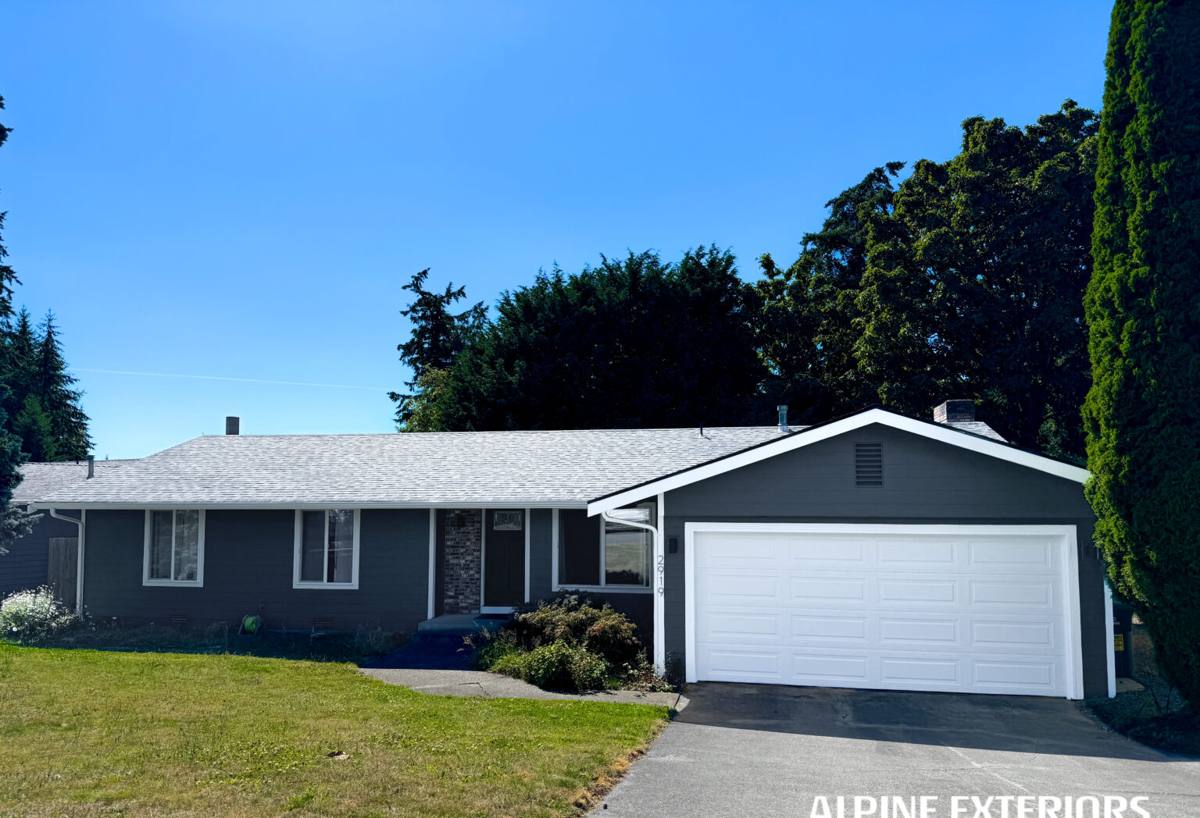
Why James Hardie Is the Right Match for This Job
We don't install James Hardie because it's the only option on the market — we install it because it's engineered around exactly the three stressors above, rather than depending on ongoing homeowner maintenance to compensate for a material that wasn't built for them.
HZ5 Engineering for This Region
James Hardie manufactures regional formulations rather than one generic product for the whole country. Homes in our part of Washington get the HZ5 line, engineered specifically for high-moisture, high-humidity conditions — a different formulation than what's sold into dry inland climates, not a marketing distinction.
ColorPlus Factory Finish
Because salt air and UV both degrade paint faster than most homeowners expect, the finish matters as much as the substrate. ColorPlus color is baked on in a controlled factory process through multiple coats, backed by its own separate finish warranty, rather than relying on a field-applied coat that has to be reapplied on a recurring cycle.
Non-Combustible Material
Fiber cement doesn't burn the way wood siding or many wood-composite products do. That's a straightforward safety benefit that has nothing to do with moisture or moss, but it's worth knowing as part of the full picture of what you're putting on the house.
What a Correct Installation Involves
Material quality only pays off if the installation is done to specification. In a climate that drives rain sideways into seams and keeps some walls damp for months at a time, shortcuts here show up faster than they would somewhere drier. A correct James Hardie installation on an Edgemoor home includes:
- A continuous, properly lapped weather-resistive barrier behind the siding, not house wrap that's stapled up and left with gaps at seams
- Correct fastener type, spacing, and penetration depth per James Hardie's published specifications, using fasteners rated for a marine-influenced climate
- Proper clearance between the bottom of the siding and grade, decking, or roofing, so the material isn't sitting in standing water or splash-back
- Flashing at every horizontal transition — window and door heads, roof-to-wall intersections, and any point where trim meets a wall plane
- Correct gapping at butt joints and terminations, sized for the expansion and contraction the manufacturer specifies
- Caulking limited to where James Hardie actually specifies it, not used as a substitute for proper flashing and gapping elsewhere
None of these steps are unique to a waterfront-adjacent property, but they matter more here because the margin for error shrinks when a wall assembly is dealing with driving rain and salt air at the same time.
Choosing the Right Hardie Product Line for This Home
James Hardie's product system covers more than one profile, and the right choice for an Edgemoor property depends on the home's architecture, sun and shade exposure, and how close it sits to the water.
| Product Line | Look | Where It Fits Best Here |
|---|---|---|
| HardiePlank lap siding | Traditional horizontal board look, several width and texture options | Most home styles; the standard choice for full-elevation replacement |
| HardiePanel with battens | Vertical board and batten pattern | Gables, dormers, and accent walls, or full board-and-batten exteriors on modern and farmhouse-style homes |
| HardieShingle | Staggered or straight-edge shingle profile | Craftsman and cottage-style homes wanting a shingle look without wood's moisture upkeep |
| HardieTrim | Fascia, corner boards, window and door casing | Paired with any of the above for a finished, consistent look at edges and transitions |
These lines are designed to work together, so it's common to see lap siding on main walls with board and batten or shingle detailing as an accent — a practical way to get architectural interest without pricing the whole exterior at the accent-material rate.
Our Process for an Edgemoor Project
- On-site assessment — we walk the property and look specifically at sun and shade exposure, tree cover, proximity to the water, and the current siding's condition, since all of that affects both product recommendation and installation detailing.
- Product and profile selection — we go over which Hardie line and profile fit the home's style and budget, including where board and batten or shingle accents make sense versus a full lap-siding exterior.
- Written scope and estimate — materials, fastener specifications, flashing details, and warranty terms laid out before anything is signed, so there's no ambiguity about what's being installed and how.
- Tear-off and prep — removal of existing siding, inspection of the sheathing underneath for hidden moisture damage, and repair of anything that needs it before new material goes up.
- Installation to manufacturer specification — weather barrier, flashing, fastening, and gapping done per James Hardie's published requirements, not shortcuts that only show up as problems years later.
- Final walkthrough — a check of the finished work against the original scope before we call the job done.
Cost Factors on a James Hardie Project in This Area
| Factor | Why It Affects Price |
|---|---|
| Home size and wall complexity | More square footage, corners, and roof lines mean more material and labor |
| Existing siding removal | Tear-off and disposal of the current material adds labor before installation starts |
| Product line and profile | Lap siding, board and batten, and shingle profiles carry different material and labor costs |
| Trim and detail work | Corner boards, window casing, and accent details add labor time beyond flat wall coverage |
| Site access and tree cover | Tight lots, slopes, or heavy landscaping around the home can slow staging and installation |
| Sheathing repair, if needed | Hidden moisture damage found during tear-off is addressed before new siding goes up, which can add cost |
We don't quote from a distance for exactly this reason — an accurate number depends on what we actually find on the property, not a per-square-foot average that ignores site conditions.
Maintenance Expectations After Installation
One of the practical benefits of going with Hardie in this climate is what homeowners stop having to do. Realistic upkeep looks like:
- An occasional rinse to clear salt residue, pollen, and general grime, particularly on wall faces exposed to onshore air
- A visual check after major storms for shifted trim or flashing, not a full re-inspection
- Keeping landscaping and sprinklers from spraying directly against the base of the wall
- Touch-up only where physical damage occurs — this isn't a material that needs a recoat on a fixed schedule
That's a meaningfully shorter list than what wood or wood-composite siding asks for in a climate that keeps shaded walls damp for months at a stretch.
Why Hiring a Crew That Already Works This Area Matters
A crew that's installed siding across Whatcom County knows how differently a shaded, tree-covered lot behaves compared to an open, sun-exposed one just a few miles away, and they know which fastener and flashing details actually hold up against salt-laden air rather than just meeting a generic code minimum. That local pattern recognition is the difference between a crew following a manufacturer's manual and a crew that knows exactly why each detail in that manual matters for a home like yours.
If you're considering a siding project for a home in Edgemoor or elsewhere around Sudden Valley and Whatcom County, we're glad to take a look at the property's specific sun, shade, and exposure conditions and put together a free, no-pressure estimate.