 Sudden Valley Siding
 Fairhaven's Coastal Climate Is Hard on Siding
Fairhaven sits close to the water, and that proximity shapes everything about how siding performs there. Homes in this part of Whatcom County deal with a combination that inland neighborhoods don't see nearly as much: salt-laden air off Bellingham Bay, driving rain that comes in sideways during winter storms, and a moss and mildew season that can stretch for most of the year in shaded, north-facing exposures. None of these factors is dramatic on its own. Together, over ten or fifteen years, they're what separate a siding job that ages gracefully from one that needs premature repair.
Our crew works this area regularly, including nearby Sudden Valley, so we're not guessing at how a wall assembly holds up here — we're replacing siding that failed for predictable, repeatable reasons and building the next one to actually handle them.
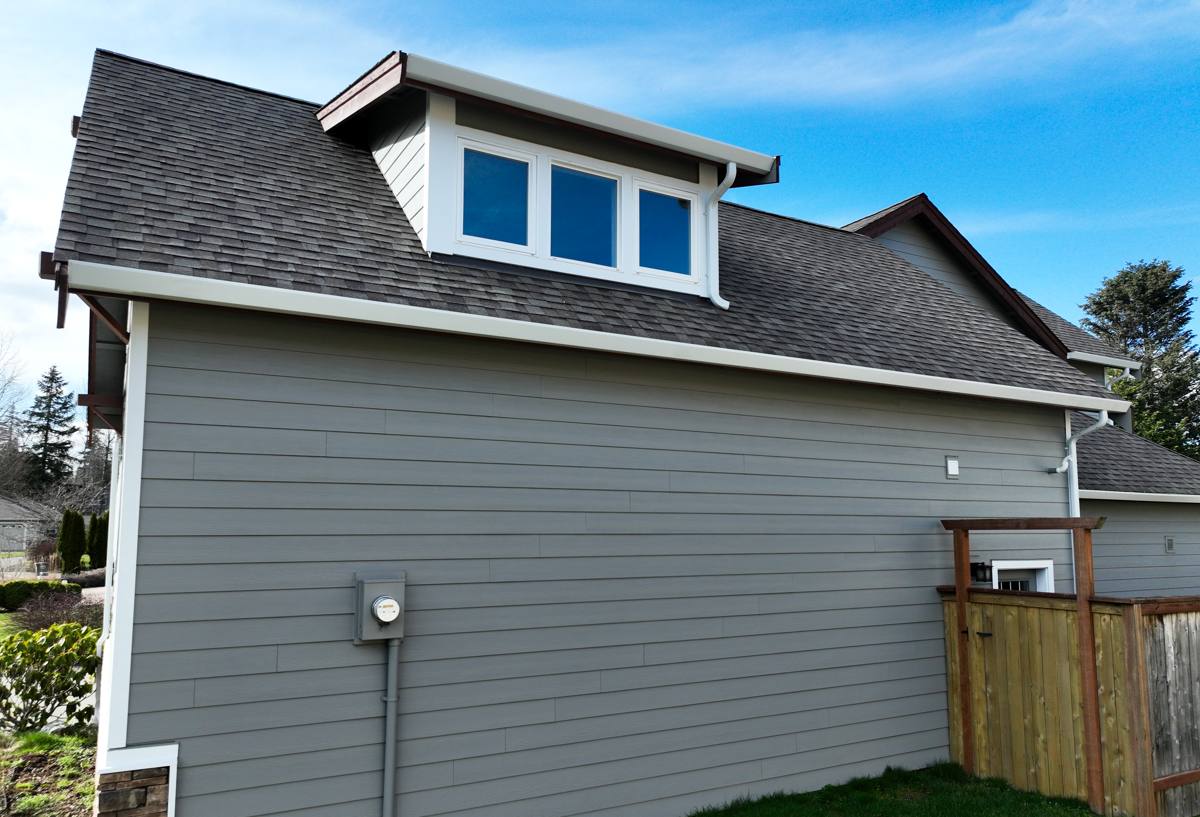
What Coastal Exposure Does to Siding Over Time
Salt Air and Metal Fastener Corrosion
Airborne salt doesn't just sit on the surface of siding — it works its way into seams, fastener heads, and any exposed cut edge. Over years, that accelerates corrosion on fasteners and trim hardware that isn't rated for coastal exposure, and it breaks down paint films faster than the same product would fail a few miles inland. This is one of the biggest reasons product and fastener selection matters more in Fairhaven than in a dry, sheltered neighborhood.
Wind-Driven Rain at Trim, Corners, and Laps
Rain that falls straight down is manageable for almost any siding. Rain that's being pushed sideways by wind off the water finds every weak point — undersized laps, unsealed trim joints, butt seams that weren't flashed, and corners where two planes meet. Water intrusion at these points rarely shows up right away. It shows up two or three years later as staining, soft trim, or rot in the sheathing behind the siding, by which point the damage is already done.
A Long Moss and Mildew Season
Whatcom County's damp, mild climate keeps moisture in wall assemblies and on siding surfaces longer than drier regions. Shaded elevations, north walls, and areas under tree cover stay wet for extended stretches, which is exactly the environment moss, algae, and mildew need to establish. Some siding materials tolerate that constant dampness far better than others — and the difference shows up in how much maintenance a homeowner ends up doing.
Signs Your Fairhaven Home Needs Siding Replacement, Not Just Repair
Not every siding problem calls for a full replacement. But in a coastal-influenced climate, patch repairs often just delay the inevitable if the underlying material or water management has already failed. Watch for:
- Soft or spongy spots when you press on the siding, especially near the bottom courses and around windows
- Paint that's peeling, bubbling, or chalking heavily rather than just fading
- Visible cracking, warping, or delamination in individual boards or panels
- Persistent moss or dark streaking that comes back within a season of cleaning
- Gaps opening up at seams, corners, or trim joints
- Rising energy bills that suggest the wall assembly is no longer sealing properly
- Interior signs — musty smell, staining, or soft drywall — on exterior walls
If you're seeing two or more of these at once, that's usually a sign the siding system as a whole has reached the end of its useful life, not that one board needs swapping out.
Why We Install Only James Hardie Fiber Cement
We don't install vinyl, LP SmartSide, primed spruce, cedar, or other fiber cement brands. That's a deliberate standard, not a lack of options. In a climate like Fairhaven's, the trade-offs of those materials — moisture sensitivity, field-applied finishes that need repainting, or long-term maintenance demands — are exactly the weaknesses that salt air and driving rain expose fastest. James Hardie is the one product line where we're confident the material itself, not just the installation, is built for this exposure.
Built for This Climate: HZ5 Engineering
James Hardie engineers its siding by climate zone, and the HZ5 formulation is built specifically for wetter, more moisture-exposed regions like the Pacific Northwest. It's fiber cement — a mix of cement, sand, and cellulose fiber — which means it's non-combustible and dimensionally stable in a way wood-based and vinyl products can't match. It doesn't warp, rot, or provide a food source for pests, and it holds up to sustained damp conditions far better than materials that rely on a surface coating to keep moisture out.
ColorPlus Factory Finish vs. Field-Painted Siding
Most siding failures we see aren't the substrate itself — they're the finish giving out. Hardie's ColorPlus technology is baked on in a controlled factory setting with multiple coats, which gives it far better adhesion and UV resistance than a coat of paint applied on-site after installation. In salt air and heavy rain, that difference compounds over time: a factory finish sheds water and resists fading and chalking years longer than a field-applied coat, which means fewer repaint cycles over the life of the siding.
What a Correct Siding Replacement Actually Involves
The material is only half the equation. Most siding failures in this region trace back to installation shortcuts, not product defects. A correct replacement means the whole wall assembly is addressed, not just the visible surface.
Tear-Off and Sheathing Inspection
Once the old siding comes off, we inspect the sheathing underneath for rot, soft spots, or existing water damage before anything new goes up. Covering damaged sheathing with new siding just hides a problem that will keep getting worse.
Water-Resistive Barrier, Flashing, and Ground Clearance
A weather-resistive barrier goes on correctly lapped, with proper flashing at every window, door, and horizontal joint so water is directed out and away from the wall rather than trapped behind it. Bottom courses need proper clearance from grade, decks, and roof lines — a detail that's easy to shortcut and one of the most common causes of rot we see in older siding jobs in this area.
Fastening and Manufacturer Spec
James Hardie publishes specific fastening, clearance, and caulking requirements, and following them isn't optional — it's what the product warranty is actually based on. Correct fastener type and placement, proper lap dimensions, and manufacturer-approved caulking at joints are what keep wind-driven rain from finding its way behind the siding in the first place.
| Installation Detail | Done to Spec | Common Shortcut |
|---|---|---|
| Water-resistive barrier | Continuous, properly lapped, integrated with flashing | Gaps or reverse-lapped seams that trap water |
| Window and door flashing | Flashed and sealed per manufacturer detail | Caulk-only "flashing" with no drainage path |
| Ground/deck clearance | Manufacturer-minimum clearance maintained | Bottom edge touching or near grade/decking |
| Fasteners | Correct type, spacing, and depth per Hardie spec | Wrong fastener type or overdriven nails |
| Joint caulking | Manufacturer-approved sealant at all butt joints | Uncaulked joints or incompatible sealant |
Our Process for a Fairhaven Siding Replacement
- On-site walkthrough to assess current siding condition, sheathing risk areas, and exposure on each elevation
- Written estimate outlining the James Hardie products, colors, and scope for your home
- Tear-off and full sheathing inspection, with any rot or damage addressed before new siding goes up
- Installation of water-resistive barrier, flashing, and trim to manufacturer specification
- Hardie siding installation with correct fastening, laps, and clearances
- Final walkthrough so you can see the completed work and ask questions before we consider the job done
Why a Crew That Already Works Fairhaven and Sudden Valley Matters
A crew that's out here regularly already knows which elevations in this area tend to take the worst of the wind-driven rain, how much clearance ground cover and landscaping typically require against a wall, and what moss and mildew patterns look like on homes exposed to this specific microclimate. That's not something you can fully substitute with a general contractor coming from outside the region for a single job. It shows up in the small decisions — where extra flashing attention matters, which corners need the most careful sealing — that add years to how long a siding job actually lasts.
What Affects the Cost of a Siding Replacement in Fairhaven
Every home is different, but the same handful of factors drive most of the cost variation we see on siding replacements in this area:
| Cost Factor | Why It Matters |
|---|---|
| Home size and wall complexity | More square footage, corners, and roof lines mean more material and labor |
| Existing sheathing condition | Rot repair behind old siding adds cost but is not optional to skip |
| Siding profile and accessories | Lap width, trim detail, and accent boards affect material and labor time |
| Access and site conditions | Slopes, tight setbacks, or limited equipment access affect labor time |
| Tear-off vs. overlay | Full tear-off costs more upfront but is the only way to inspect and correct the wall assembly |
We don't quote from a distance for this reason — an accurate number depends on actually looking at your walls, your current siding condition, and your home's specific exposure.
If your Fairhaven home's siding is showing its age, or you're planning ahead before winter storms roll in off the bay, we're happy to take a look and walk you through what we find. Reach out for a free, no-pressure estimate — there's no obligation, and you'll leave the conversation with a clear picture of what your home actually needs.