 Sudden Valley Siding
 Why Sunnyland Decks Take More of a Beating Than People Expect
Sunnyland sits close enough to the water and low enough in the Whatcom County landscape that decks here deal with a combination most drier regions never see: a steady dose of moisture-laden marine air, long stretches of driving rain from fall through spring, and a moss and algae season that can run eight months or more. None of those things destroy a deck by themselves. Together, over years, they do.
The damage pattern is predictable if you've seen enough of these decks. Salt-tinged air accelerates corrosion on fasteners, joist hangers, and any exposed metal hardware long before the visible wood shows a problem. Driving rain finds its way sideways under flashing and into ledger boards, joints, and end grain — the places builders don't think to protect because the water isn't supposed to come from that angle. And moss doesn't just look bad on decking boards; it holds moisture against the wood surface for months at a time, which is exactly the condition that breeds rot underneath a coating that still looks fine on top.
A deck built without those specific local pressures in mind can look sound for years and still have a compromised frame underneath. That's the gap we're hired to close — not just swapping old boards for new ones, but replacing a deck so it's actually built for this climate.
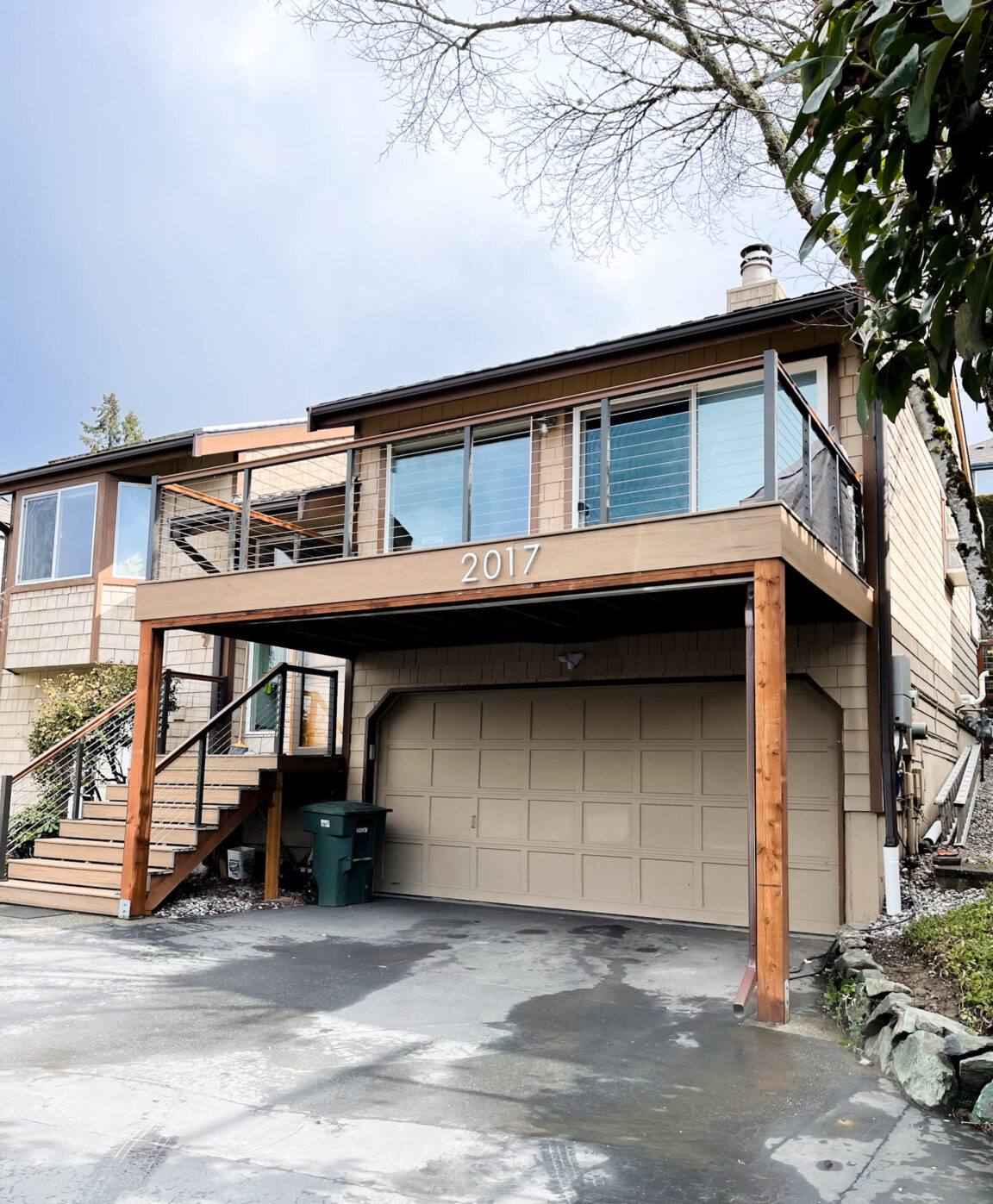
Repair or Replace? How to Tell the Difference
Not every tired-looking deck needs a full replacement, and we won't tell you it does just to sell a bigger job. The honest dividing line comes down to whether the problem is on the surface or in the structure.
Repair usually makes sense when:
- A handful of boards are cupping, splintering, or graying, but the frame underneath is solid and dry
- Railings are loose but the posts are still securely anchored
- The deck is relatively young and the issue is cosmetic or maintenance-related, not structural
Replacement is the right call when:
- The ledger board (where the deck attaches to the house) shows soft spots, staining, or separation
- Joists or beams flex noticeably underfoot or show rot when probed with a screwdriver
- Multiple footings have settled, heaved, or cracked
- Fasteners and hardware are heavily corroded, especially near the ledger and stair stringers
- The deck was built with undersized framing or missing flashing that no amount of board replacement will fix
We'll always tell you straight which category your deck falls into, and we'll show you what we find under the decking before we recommend the bigger job.
Decking Material Options for This Climate
Every decking material handles Whatcom County's rain and moss differently. There's no single "best" choice for every homeowner — it depends on your budget, how much upkeep you're willing to do, and how long you plan to stay in the home. Here's how the common options actually compare in a wet, moss-prone environment like Sunnyland's.
| Material | Moisture Behavior | Moss/Mildew Resistance | Maintenance | Typical Lifespan |
|---|---|---|---|---|
| Pressure-treated pine | Absorbs and releases moisture; prone to cupping if not sealed | Low — needs regular cleaning and sealing | Annual cleaning, re-sealing every 1-2 years | 10-15 years |
| Cedar | Naturally moderate moisture resistance | Moderate; still needs periodic cleaning | Sealing every 2-3 years to hold color and resist checking | 15-20 years |
| Capped composite | Does not absorb water into the core | High — sheds surface growth more easily and cleans up with basic washing | Occasional washing; no staining or sealing | 25-30+ years |
| PVC decking | Fully moisture-resistant, no wood fibers | High | Occasional washing | 25-30+ years |
We install both quality wood and composite/PVC systems and won't push you toward one just because it's easier for us. What we won't do is cut corners on the parts of the job that matter regardless of decking material — proper flashing, correct fastener types, and adequate ventilation underneath. A composite deck installed over a poorly flashed, poorly ventilated frame will still fail early; the surface material was never the weak point.
A Word on Uncapped Composite
Early-generation composite decking without a fully capped, protective outer layer can absorb moisture at the surface over time, which shows up as swelling, staining, or mold growth in a wet climate like this one. Our standard is to spec fully capped composite or PVC when a homeowner wants a low-maintenance product, precisely because that capped layer is what actually keeps moisture out in a region that gets this much rain and shade-driven moss growth.
What a Correct Deck Replacement Actually Involves
A deck replacement done right is a structural project, not a cosmetic one. The decking boards you walk on are the smallest part of what determines how long the deck lasts. Here's what we look at and rebuild on every replacement:
- Ledger board and flashing — the connection point to the house, sealed and flashed so wind-driven rain can't work its way behind the siding
- Footings — sized and set below frost depth, checked for settling or heaving before anything is built on top of them
- Framing (joists and beams) — sized for the actual span and load, not just matched to what was there before
- Fasteners and hardware — corrosion-resistant hardware rated for treated lumber and coastal-influenced air, not generic hardware that will rust out in a few seasons
- Ventilation and drainage — enough clearance and airflow underneath that moisture and moss don't have a permanent, shaded, damp space to work in
- Railings and stairs — rebuilt to current code height and baluster spacing, not just re-attached to old posts
Skipping any one of these to save time is how a "new" deck ends up with the same rot problem in half the time.
Our Deck Replacement Process
- On-site assessment. We inspect the existing deck, probe the framing and ledger for soft spots, and check footings before we ever quote a number. This is also when we confirm whether repair is genuinely an option.
- Design and material selection. We walk through decking material, railing style, and layout options with you, including honest trade-offs on maintenance and cost for each.
- Permitting. We handle the permit application and coordinate any required inspections with the local building department.
- Demolition and disposal. The old deck comes out, including footings if they're undersized or compromised, with the site protected and debris hauled off.
- Framing and flashing. New footings, framing, ledger connection, and flashing go in first — this is the stage that determines how long the deck actually lasts.
- Decking, railing, and stairs. Surface materials go on last, installed to the manufacturer's fastening pattern and spacing requirements.
- Final walkthrough and inspection. We review the finished deck with you and confirm it passes any required final inspection.
Permits and Local Code Considerations
Most deck replacements in Whatcom County require a building permit, particularly when footings, framing, or railings are being rebuilt rather than just resurfaced — the exact threshold depends on the scope of work and the specific jurisdiction covering Sunnyland and Sudden Valley. Guardrail height, baluster spacing, and stair rise-and-run all have to meet current code, even if the deck being replaced was built under older rules. We pull the permit, build to the current code requirements, and coordinate inspections as part of the job rather than leaving that step for the homeowner to sort out. If you're not sure whether your project needs a permit, that's a fair question to ask before work starts, not after.
Cost Factors in a Deck Replacement
We won't quote a number without seeing the deck, but the factors that move the price up or down are consistent from job to job. This table shows what typically drives cost, not a fixed price — every deck is different in size, access, and existing condition.
| Factor | Why It Affects Cost |
|---|---|
| Deck size and height | More square footage and taller decks mean more material, more framing, and more labor time |
| Decking material | Composite and PVC cost more upfront than wood but require far less long-term maintenance spending |
| Footing condition | Footings that need to be replaced or resized add excavation and concrete work |
| Ledger and framing damage | Rot found in the ledger board or joists means more structural rebuild, not just a resurfacing job |
| Railing and stair complexity | Multiple stair sections, custom railing, or added guardrail length add labor and material |
| Access to the site | Decks with limited equipment or material access take more time to build and demo |
Broadly speaking, a straightforward wood deck replacement sits at the lower end of the cost range, and a larger composite or PVC deck with multiple stair sections and railing work sits at the higher end. We'll break down exactly where your project falls once we've seen it.
Why a Crew That Already Works Sunnyland Matters
Deck problems in this part of Whatcom County follow patterns we've seen repeatedly — the same ledger board failure points, the same moss buildup zones on north-facing and shaded decks, the same corrosion patterns on hardware that wasn't rated for the moisture and marine-influenced air here. A crew that already works this specific area isn't guessing at how to detail flashing for driving rain or how much ventilation clearance a deck needs to keep moss from taking hold underneath — we've built and repaired enough of them locally to know what actually holds up.
That local track record also means faster, more accurate estimates. We're not learning the area's soil conditions, permit process, or climate demands on your project — we already know them, which means less guesswork and fewer surprises once the job is underway.
Caring for Your New Deck
A correctly built deck still needs some basic upkeep to hit its full lifespan in this climate. None of it is complicated, but skipping it shortens the life of even a well-built deck.
- Sweep leaves and debris off regularly, especially in fall — trapped organic matter feeds moss and holds moisture against the surface
- Rinse or lightly scrub composite and PVC decking once or twice a year to remove surface algae before it takes hold
- Re-seal wood decking on the schedule appropriate to the product — waiting too long lets moisture back into the wood fibers
- Keep gutters and downspouts near the deck clear so runoff isn't dumping extra water onto or under the structure
- Check railings and stair connections annually for looseness before it becomes a safety issue
If you're not sure what your current deck needs, that's exactly the kind of question worth asking during an estimate rather than guessing at it yourself.
Get a Straight Answer on Your Deck
If your deck in Sunnyland is showing soft spots, heavy moss, or just isn't holding up the way it used to, we're happy to take a look and tell you honestly whether it needs repair or full replacement. Reach out for a free, no-pressure estimate using the form below.