 Sudden Valley Siding
 South Hill's Climate Puts Real Demands on a Deck
A deck in the South Hill area near Sudden Valley doesn't live an easy life. Whatcom County gets a long, wet season with driving rain that comes in sideways off passing fronts, followed by stretches of damp, low-light weather that keep every horizontal surface wet longer than it should be. Add in salt-tinged air that pushes inland during storms and a moss season that can run most of the year on shaded or north-facing surfaces, and you have a climate that's genuinely hard on outdoor structures. A deck built without that in mind will show it within a few seasons — soft spots in the framing, green film on the boards, corroding hardware, and a surface that's slick more mornings than it's dry.
Composite decking exists partly to solve the wood side of this problem, but composite isn't a magic material that ignores climate. It still has to be installed with drainage, airflow, and hardware choices that match what this part of Whatcom County actually throws at a structure. A board that resists rot does nothing for you if the framing underneath it is rotting instead.
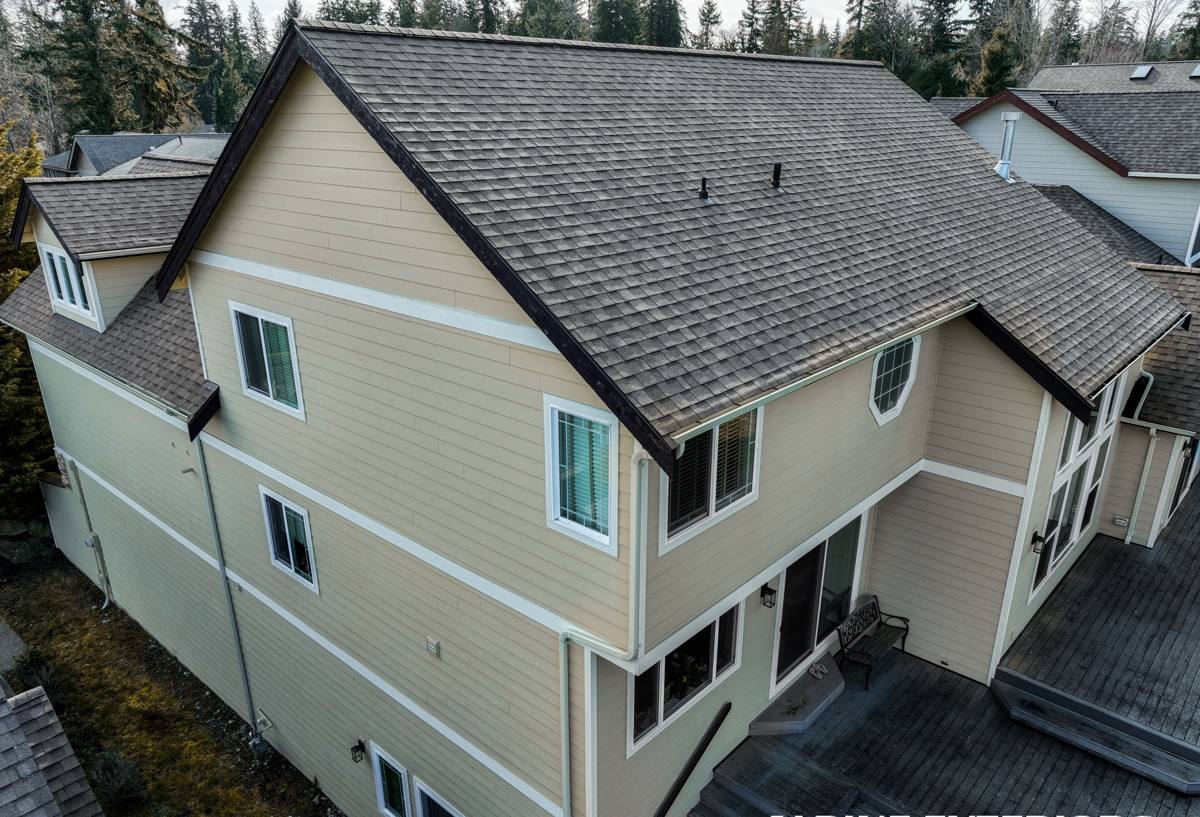
What a Correctly Built Composite Deck Requires Here
Most composite deck problems we get called out to fix aren't board failures — they're substructure and installation shortcuts that a wetter, mossier climate exposes faster than a dry one would.
Framing and Drainage First
The framing under a composite deck should be pressure-treated lumber rated for ground contact where it's close to grade, with joist tape or a protective barrier over the top of every joist. That tape does one job: it keeps rainwater that gets past the decking from soaking directly into the top of the joist, which is exactly where standing water causes rot in a climate that rarely gets a long enough dry stretch to let wood fully dry out. Any deck built without that detail is betting on a dry season Whatcom County doesn't reliably give us.
Fastening, Flashing, and Hidden Water Paths
Where the deck attaches to the house, the ledger board needs proper flashing that directs water out and away from the rim joist, not just a bead of caulk. Caulk fails; flashing sheds water by shape, not adhesion, and that matters when the deck is going to see months of driving rain a year. We also use corrosion-resistant fasteners and hidden fastener systems where the board allows it, both to keep the surface clean and to avoid the small water-trapping pockets that face screws create over time.
Airflow Underneath the Deck
Composite boards don't rot, but they do stay wet longer than wood in tight, unventilated spaces, and a damp underside is exactly where moss, algae, and mildew get a foothold that eventually reaches the walking surface. Proper joist spacing, ground clearance, and in some cases vents or gaps at the perimeter keep air moving underneath the deck instead of letting it sit like a lid over damp ground.
Composite, Wood, and PVC Decking Compared
Homeowners in this area usually narrow it down to three real options. Here's how they hold up against South Hill's rain, moss, and salt-air conditions specifically.
| Material | Moisture Behavior | Moss/Algae Resistance | Maintenance |
|---|---|---|---|
| Pressure-treated wood | Absorbs water, swells and checks with wet/dry cycling | Needs regular cleaning and sealing to slow growth | Annual sealing/staining recommended |
| Capped composite | Core resists water absorption when fully capped | Cap layer resists staining; surface still needs periodic washing | Occasional wash, no sealing or staining |
| PVC / cellular decking | Fully synthetic, essentially no water absorption | Very resistant, easiest to keep clean | Lowest maintenance, higher upfront cost |
Wood is the cheapest option up front and the most demanding one to keep looking decent through a Whatcom County winter. Capped composite is the middle ground most of our South Hill clients land on — a real upgrade in moisture and moss resistance over wood without jumping to PVC pricing. PVC earns its higher price where a deck sits in constant shade or ground-level dampness and low maintenance matters more than upfront cost.
Understanding Composite Board Types and Capping
Not all composite decking is built the same, and the difference matters more here than in a drier climate.
Uncapped composite is essentially wood fiber and plastic blended together with no protective shell. It resists rot better than solid wood but the exposed surface can still absorb moisture, stain, and support mold growth, which is a real liability in a climate with this much sustained dampness.
Capped composite wraps that core in a plastic shell, either on the top and sides (three-side capped) or fully around the board (cap-stock/four-side capped). The cap is what actually keeps moisture, dirt, and organic growth from working into the board itself. For a deck near Sudden Valley that's going to sit under tree cover and damp air for most of the year, we treat full capping as the baseline, not an upgrade — it's the difference between a board that sheds moss with a rinse and one that holds onto it.
Board texture matters too. Grooved boards (for hidden fastener systems) create a clean look but the grooves can hold moisture and debris longer than a solid-edge board; in a moss-prone area that's worth weighing against the cleaner fastener line they give you.
Moss, Algae, and Salt Air: The Maintenance Reality
Even a properly capped composite deck isn't maintenance-free in this climate — it's low maintenance, which is a different thing. Here's what actually keeps a South Hill composite deck looking right year over year:
- An annual wash with a composite-safe cleaner (not a pressure washer on high pressure, which can etch the cap) removes the film that moss and algae need to establish
- Boards with a lightly textured or wood-grain finish hide dirt and water spotting better than glass-smooth caps, and give better footing when the surface is damp
- Lighter colors show mildew and pollen faster; darker, wood-tone colors hide seasonal grime longer between cleanings
- Railing brackets, screws, and structural hardware should be stainless steel or otherwise corrosion-rated, especially on decks that catch salt-tinged air during storm systems off the Sound
- Keeping overhanging branches trimmed back reduces the shade and leaf litter that feed moss growth on the deck surface
None of this is heavy work, but skipping it entirely for years is how a low-maintenance deck starts looking neglected faster than it should in a climate this consistently damp.
Our Process for a South Hill Composite Deck
We run the same disciplined process on every composite deck we build in the South Hill and Sudden Valley area, because the climate doesn't reward shortcuts:
- On-site assessment of the existing structure (if replacing a deck) or the build site, checking grade, drainage path, and sun/shade exposure
- Design and measurement, including board layout, railing style, and any stairs or transitions
- Permit handling with the applicable local jurisdiction where the project requires it
- Demolition and disposal of the old deck, if applicable, with an inspection of the ledger and framing underneath
- Framing and structural work, including joist tape, flashing, and footings sized to code
- Composite board installation with the fastening system specified for that product line
- Railing, fascia, and trim work, with end caps or fascia boards over any exposed composite edges
- Final walkthrough and site cleanup before we call the job done
That order matters. Framing and drainage decisions made in steps four and five are what determine whether the finished deck actually performs here, long after the composite boards on top look the same either way.
What Drives the Cost of a Composite Deck in This Area
Composite decking installed typically runs in a broad range of roughly $35–$70 per square foot depending on the factors below — there's no single number that applies to every yard.
- Square footage and shape — more cuts, angles, and picture-framed borders add labor time beyond the raw material cost
- Condition of the existing structure — reusable, sound framing costs less than a full rebuild of rotted joists and posts
- Height and stairs — a deck with a significant drop needs more structural work, railings, and stair framing
- Board tier and brand — entry-level capped composite costs less than premium cap-stock lines with longer warranties
- Railing choice — composite or metal railing systems cost more than basic wood rail but hold up better to the same moisture and salt-air exposure the decking is built for
- Permitting and engineering — decks above certain heights or attached in certain ways may require stamped plans, which adds a line item
- Site access — a deck site that's hard to reach with equipment or materials adds labor hours regardless of the deck's size
We walk through each of these during the estimate so the number you get reflects your actual site, not a generic average.
Why Hiring a Crew That Already Works in South Hill Matters
A lot of what makes a composite deck last here isn't printed on the manufacturer's spec sheet — it's knowing how wet this specific area gets in a normal winter, which framing details actually fail first when they're skipped, and what the local permitting process expects before a project starts. A crew that already works South Hill and the greater Sudden Valley area has seen what a few seasons of Whatcom County weather does to a deck built without proper flashing, tape, or airflow, and builds around those failure points as a default rather than an upsell.
Local experience also shows up in smaller ways: knowing which composite lines actually perform well under sustained tree cover and moss pressure, sourcing the right corrosion-resistant hardware without treating it as a special order, and being available for a warranty call or a quick maintenance question without a long drive. That kind of familiarity is hard to replicate with a crew that's building its first deck in this climate.
Get an Honest Look at Your Project
If you're weighing composite decking for a home in the South Hill area, we're glad to come take a look, talk through what your site actually needs, and give you a straightforward estimate — no pressure, no upsell script. Use the form below to get started.