 Sudden Valley Siding
 Why Acme Roofs Face a Different Set of Problems
Acme sits back in the timber and lake country east of Sudden Valley, and that setting cuts both ways. You get more tree cover, more shade, and more shelter from wind than homes closer to the water — but you also get roofs that stay wet longer after every storm. Add in the salt-laden air that drifts up from the Puget Sound side of Whatcom County on a south wind, and you've got a combination that's hard on fasteners, hard on flashing, and brutal on anything with exposed seams or low-grade coatings.
A roof in this area isn't just fighting rain. It's fighting the fact that the rain rarely stops long enough for anything to fully dry out, and it's fighting moss and organic growth that gets a foothold anywhere water sits or debris collects. Metal roofing, done correctly, handles this combination better than almost anything else on the market — but "done correctly" is doing a lot of work in that sentence, and that's what this page is really about.
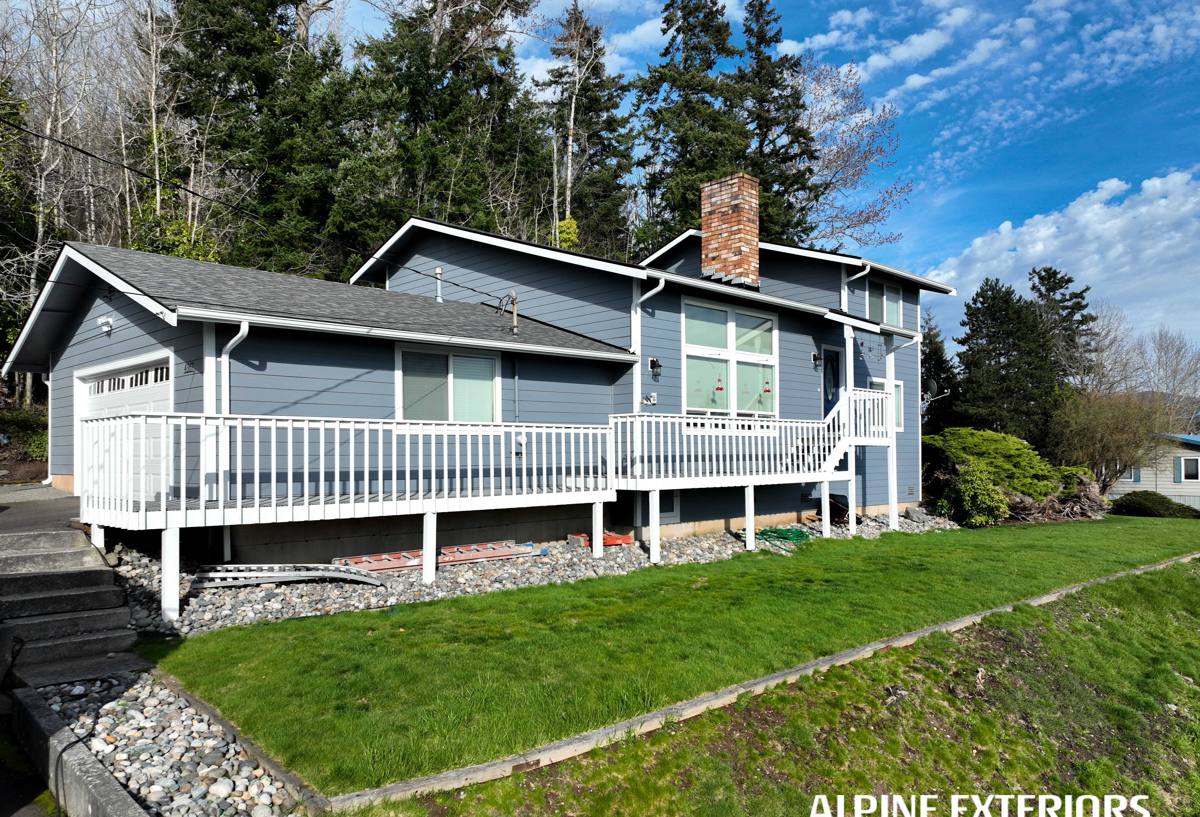
What Sudden Valley and Acme Homes Actually Need From a Metal Roof
Not every metal roof is built for this climate, even though most manufacturers will tell you their product works everywhere. In practice, a metal roof that's going to hold up on an Acme home for decades needs a few specific things:
- Real moisture management underneath the metal — not just a roof that sheds water, but a system that handles the condensation that forms on the underside of metal panels in a cool, humid climate
- Fasteners and flashing rated for coastal exposure — standard hardware corrodes faster here than in drier inland regions
- A finish that resists moss and algae staining — bare or poorly coated panels will streak and green up in shaded, damp spots within a few seasons
- Panel profiles that shed needles and debris instead of trapping them at seams, valleys, and low-slope transitions
- Attention to slope and valley detailing, since a lot of Acme lots have roof lines shaped by mature trees and irregular pitches rather than simple gable designs
Skip any one of these and you end up with a roof that looks like a premium upgrade for the first few years and then starts showing the same problems as a poorly maintained asphalt roof — just more expensive to fix.
Moisture, Condensation, and the Underlayment Question
This is the part of a metal roof job that homeowners almost never see discussed, and it's the part that causes the most callbacks in wet, wooded climates like this one. Metal is a poor insulator and a fast conductor of temperature change. On a cool, humid Whatcom County morning, the underside of a metal panel can drop below the dew point of the air trapped beneath it, and that means condensation — sometimes enough to drip, stain, or eventually rot sheathing if it's not managed.
The fix isn't complicated, but it has to be done at install time, not added later. A proper underlayment system — synthetic, high-temp rated, and installed with correct lap and fastening patterns — combined with adequate ventilation at the ridge and eaves keeps that condensation from ever becoming a problem. We treat this as a non-negotiable part of every metal roof we install in this area, not an upsell. A roof that looks great on day one but was installed without that layer is a roof we'd rather not put our name on.
Ventilation Matters as Much as the Panels
A metal roof without balanced intake and exhaust ventilation traps heat and moisture against the deck. In a climate that already keeps roofs damp longer than average, that's a shortcut to premature sheathing damage — regardless of how good the panels themselves are.
Panel Types and What They're Actually Good For
There isn't one "best" metal roofing product — there's a best product for a given roof, budget, and homeowner's priorities. Here's how the common options stack up for an Acme-area home:
| Panel Type | Best For | Trade-Offs to Know |
|---|---|---|
| Standing Seam | Long-term durability, clean look, minimal fasteners exposed to weather | Higher upfront cost; installation quality matters more than with any other type |
| Exposed-Fastener Panels | Budget-conscious projects, outbuildings, secondary structures | Fasteners are exposed to salt air and need periodic inspection/replacement over the roof's life |
| Stone-Coated Steel | Homeowners who want a shake or shingle look with metal's durability | More surface texture can hold moss spores longer in deep shade; needs a finish rated for it |
| Corrugated / Ag-Panel Metal | Shops, sheds, low-cost coverage | Not typically what we'd recommend for a primary residence in this climate |
For most primary homes in and around Sudden Valley, we steer people toward standing seam or a quality stone-coated system, specifically because of how few exposed fasteners they leave sitting in salt-influenced air over the decades. That's a maintenance-and-longevity call, not a knock on other products — exposed-fastener panels have their place, just usually not as the main roof on a house we expect to last 40-plus years.
The Moss Problem, Specifically
Moss doesn't just grow on shingles. On metal roofs, it tends to show up at seams, in valleys, and anywhere debris collects long enough to hold moisture against the panel — often on the north-facing or heavily shaded slopes that are common on wooded Acme lots. Left alone, moss traps water against the finish, and depending on the coating, can lead to staining or, over a long enough timeline, accelerated wear at the affected spots.
The right panel finish and a roof design that doesn't create flat, debris-catching zones go a long way. So does keeping overhanging branches trimmed back and gutters clear — moss needs organic material and standing moisture to get started, and a roof that sheds both quickly gives it nowhere to take hold.
What We Check For During an Acme Roof Inspection
- Moss or algae buildup concentrated on shaded or low-slope sections
- Debris accumulation in valleys, behind chimneys, and around skylights
- Fastener condition on any exposed-fastener sections
- Signs of condensation staining on the underside, visible from the attic
- Flashing condition at penetrations, walls, and transitions
- Gutter and downspout function — undersized or clogged systems make every moss and moisture issue worse
Flashing and Details: Where Most Metal Roof Failures Actually Start
Almost every metal roof leak we get called out to look at, whether we installed it or not, traces back to a flashing detail — not the panels themselves. Chimneys, skylights, wall transitions, and valleys are where water is redirected and concentrated, and they're the places where a rushed or generic installation shows its weaknesses first.
In a climate that sees as much sustained rain as Whatcom County does, we treat flashing as custom work on every job, not a one-size-fits-all component. That means fabricating or fitting flashing to the actual geometry of the roof, using compatible metals to avoid galvanic corrosion between dissimilar materials, and sealing transitions with products rated for long-term UV and moisture exposure — not just what shipped in a generic kit.
Our Process for an Acme Metal Roof
- On-site assessment — we walk the roof and the attic, not just look from the ground, to check deck condition, ventilation, and existing moisture damage
- Honest scope and product recommendation — based on your roof's slope, shade exposure, and budget, not a default upsell
- Tear-off and deck inspection — any soft or water-damaged sheathing gets flagged and addressed before a single panel goes on
- Underlayment and ventilation install — the part that protects the roof from the inside, done to spec every time
- Panel installation — with attention to fastening patterns, panel alignment, and manufacturer specs for your specific product
- Custom flashing at every penetration and transition — chimneys, skylights, valleys, and wall intersections
- Final walkthrough — we show you what was done and what to expect over the roof's first few seasons
Cost Factors Homeowners Should Actually Weigh
Metal roofing costs more upfront than asphalt shingles, and any contractor who tells you otherwise isn't being straight with you. What varies job to job is how much more, and why:
| Factor | Why It Moves the Price |
|---|---|
| Panel type | Standing seam runs higher than exposed-fastener or stone-coated systems due to labor and material |
| Roof complexity | Steep pitches, multiple valleys, and dormers common on wooded lots add labor time |
| Existing deck condition | Rot or moisture damage found during tear-off adds repair cost before installation can proceed |
| Ventilation upgrades | Older Sudden Valley-area homes often need added intake or exhaust venting to meet current standards |
| Access and site conditions | Tree cover, slope of the lot, and staging space affect labor and equipment needs |
We'd rather walk you through these variables honestly during an estimate than quote a number that doesn't hold up once we're on the roof.
Why It Matters to Hire a Crew That Already Works This Area
A contractor who mostly works drier, lower-elevation neighborhoods can install a technically correct metal roof and still get the details wrong for Acme's conditions — because the failure points here aren't the same ones they're used to solving for. Knowing which slopes hold moss, how much ventilation a shaded, tree-covered lot actually needs, and how salt air factors into fastener and flashing choices isn't something you pick up from a spec sheet. It comes from working roofs in Sudden Valley and the surrounding Whatcom County communities season after season and seeing what actually holds up.
That's the difference between a roof that looks right at installation and one that's still performing correctly in year fifteen.
If you're weighing a metal roof for your Acme-area home, we're glad to walk the roof with you, answer questions honestly, and put together a straightforward estimate — no pressure, no pushy sales pitch. The form below gets you started whenever you're ready.